
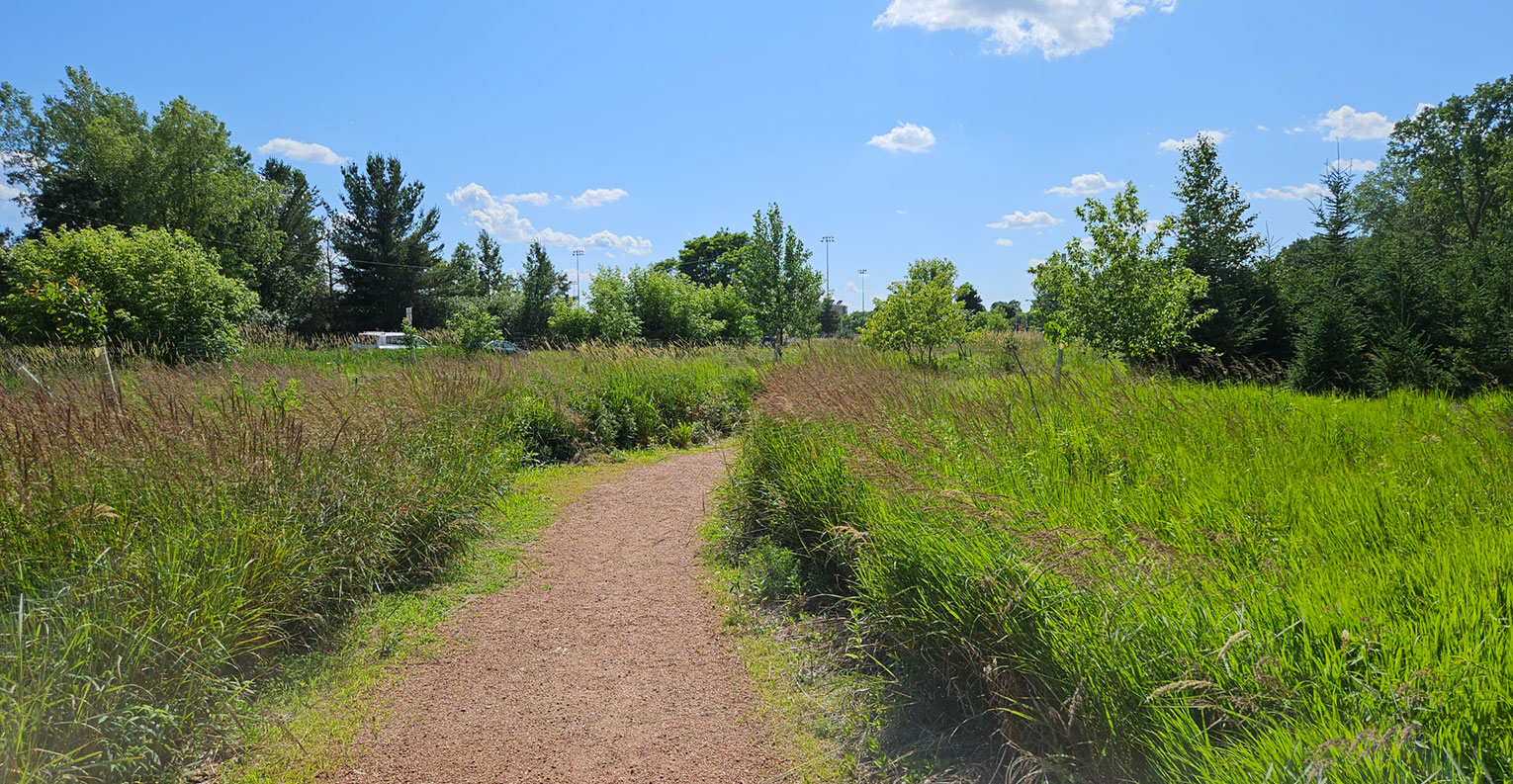
The Lake Forest Habitat Restoration is a multi-year project to restore a 4-acre plot woodland around the southwest corner of Lake Joanis. A major storm in 2017 flattened most of the trees in this area. Periodic disturbance is a natural part of many healthy ecosystems. With such a high water table, wind has likely always played a major role in changing the land that would become Schmeeckle Reserve. Much of the previous forest was dominated by mature aspen trees nearing the end of their natural lives. The storm provided an opportunity to restore the forest to a more diverse and resilient habitat.
Background
On June 12, 2017, a major storm swept through the Stevens Point area, flattening hundreds of trees in Schmeeckle Reserve. One of the areas hit hardest was a 4-acre wooded site around the southwest corner of Lake Joanis dominated by aspen trees. The mature age of the aspens and the moist soil made them especially susceptible to the winds, and most came down in the storm leaving a jumbled and unsightly mess. While the storm was devastating, it gave Schmeeckle a unique opportunity to plan a restoration for the site that would make it more diverse and aesthetically pleasing.
Restoration Timeline
- October 22-24, 2017: Great North Timber Services from Tomahawk was hired to harvest all down and standing aspen trees in the area. Many of the standing trees were damaged by the storm and would have been hazardous to users.
- November 9-10, 2017: Brush, branches, and slash leftover from the harvest were ground into woodchips in preparation for site planting. Invasive buckthorn shrubs were also grinded to the ground. This was accomplished by Kevin Burns, forest ecologist for Treehaven, using a FECON grinder attached to a skid steer.
- April 13, 2018: Native grass seed and about 100 native trees were planted by Dr. Michael Demchik and his Ecological Monitoring class students. This included 7 pounds of Little Bluestem, 8 pounds of Sideoats Grama, 40 Eastern Cottonwood (4-5′ tall), 10 Swamp White Oak (18″ tall), 10 Eastern White Pine (18″ tall), 25 River Birch (6-12″ tall), and 10 Silver Maple (3-4′ tall). The trees were protected by 6-foot high deer fencing and plastic planting tubes.
- April 22, 2018: After a major snowstorm on April 14, the ground was still covered by snow, but some areas were thawed enough to plant. Volunteers, including several who were attending the Midwest Great Lakes Chapter of the Society for Ecological Restoration conference in Stevens Point, planted 75 additional trees. This included 50 White Spruce (6-9″ tall) along the lake, 15 White Cedar (8-24″ tall) in the deer exclosure area (around a pond), and 10 Eastern Cottonwood (4-5′).
- April 29, 2018: Members of the Rotary Club of Greater Portage County, the Rotary Club of Stevens Point, UWSP Rotaract, and Portage County employees celebrating milestone anniversaries planted 28 additional trees in the deer exclosure area. This included 25 Quaking Aspen (2-3′) and 3 River Birch (12-18″). The volunteers also added compost and mulch to all of the planted trees.
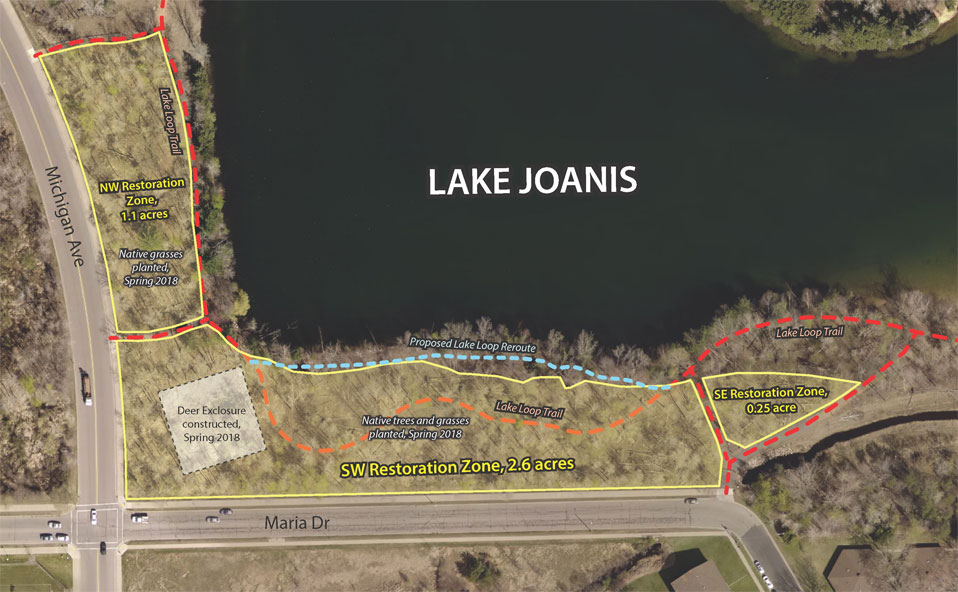
- June-July, 2018: A 100 foot-by-100 foot, 8-foot high deer exclosure fence was constructed at the southwest corner of the restoration site around a small ephemeral pond. This will provide a protected area free of deer browse for forest regeneration.
- June-November, 2018: As they leafed out, resprouts of invasive buckthorn were treated with Element 3A herbicide (triclopyr amine) at a 5% solution. This is safe for use in wetlands and will not impact the grasses. Buckthorn control is essential in order to create a native plant understory. The grasses that were seeded in April grew very well this season. American burnweed, a native plant that grows readily in disturbed areas, was also prolific on the site. Aspen tree saplings have started to sprout on their own in the deer exclosure.
Continued management of the area includes continued glossy buckthorn control and additional palnting of native trees and shrubs.
Goals of the Restoration
The goal of the restoration site is to develop a rich woodland habitat native to central Wisconsin that will support diverse wildlife species, provide recreation and education opportunities, and be an aesthetically pleasing addition to campus. This will be accomplished by:
- Planting a diversity of native grasses and trees. Trees that thrive in wet conditions were selected, such as Eastern Cottonwood, Swamp White Oak, White Spruce, River Birch, Silver Maple, and White Cedar. Trees such as cottonwood will grow quickly and provide cover to the site. Other trees, like the oaks and spruce, will grow more slowly and eventually take over the canopy when the cottonwoods reach their end of life.
- Protecting new plants from deer. The high deer population in Schmeeckle make restoration projects difficult. All trees will be protected with a 6-foot plastic growing tube or metal fence. A 100-foot by 100-foot, 8-foot high deer exclosure fence was also constructed at the southwest corner of the restoration site. This creates a unique area protected from deer browse to restore a small pond and wetland.
- Controlling invasive buckthorn. Buckthorn is an invasive shrub that dominated the understory of the site, shading out any native species. Small amounts of herbicide will be used to control the buckthorn as it re-sprouts. The native grass is resistant to the herbicide, so we can spray directly onto it, preserving the grass and killing the buckthorn.
- Planting native shrubs and groundcover. After 2-3 years of buckthorn control, native shrubs, wildflowers, and other vegetation will be planted in the restoration area to increase the diversity.
- Education. The restoration project on campus is ideal for sharing with students and the public. Students and volunteers will assist in maintaining the site through the years.
Map of the Restoration Site
Support
The following groups have supported the restoration project through generous donations, funding, and volunteer assistance.
- College of Natural Resource (UW-Stevens Point), Property Management Committee ($3,000)
- Hampton Inn, Plover, Hilton Travel with Purpose Action grant ($1,000)
- Rotary Club of Greater Portage County ($500)
- Rotary Club of Stevens Point ($400)
- Portage County, on behalf of county employees celebrating milestone anniversaries in 2018 ($350)
Photo Gallery
Click the button below to view photo galleries of cedar signs and benches that were constructed at Schmeeckle Reserve (external link to Flickr).
Lake Forest Restoration Gallery