

Welcome to the Office of Field Experiences
Student Teachers
Applications for student teaching are made in the first month of the semester preceding student teaching. Attendance is required at an Application Meeting at which the process is explained and important information presented. These meetings are announced by email, and you must register to attend. Those who register for an Application Meeting will be given access to a Canvas course containing all application materials. Dates and deadlines surrounding this process are critical to assure the success of securing appropriate placements.
School District Maps
- WI Public School Districts (DPI interactive map)
- Zoom in to see districts. The district names will be black with a white outline.
- DPI District Search
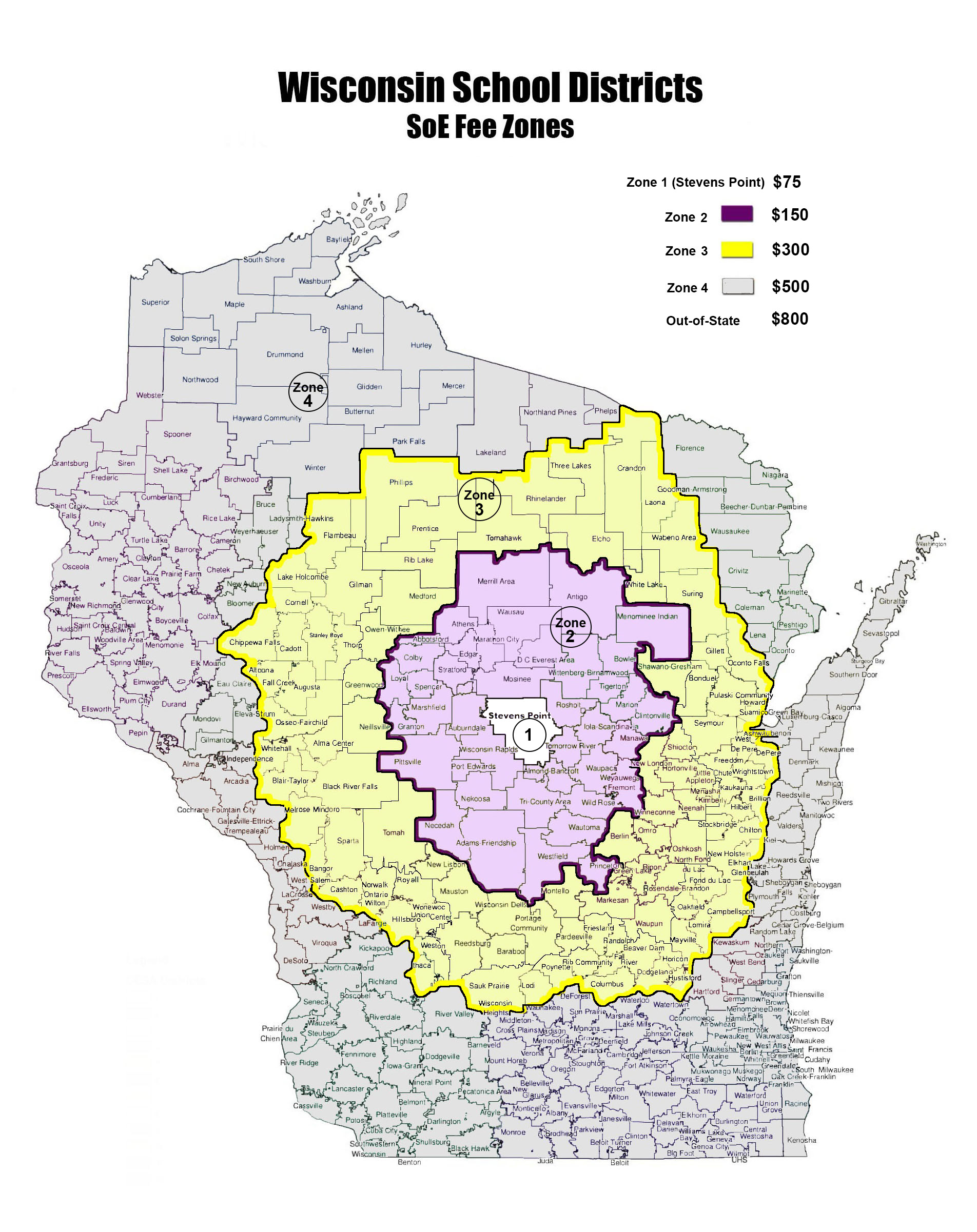
- Map of UWSP Fee Zones
- List of Districts in each zone
- List of Rural School Districts
Important information to consider/complete, as needed:
- Intern Information
- Student Teaching through the Institute for Urban Education (IUE)
- Student Teaching in Alaska
- Student Teaching Abroad: It is advised to plan three semesters in advance and meet with the Office of Field Experiences manager at the earliest possible opportunity
- Your supervisor may ask for information regarding your placement. Please provide them with the Teacher Candidate Placement Information form
Student Teaching Seminar
All students must be enrolled in a student teaching seminar during their student teaching/internship experience. Attendance at on-campus meetings is required, and a final capstone presentation will be required at the last seminar.
Cooperating Teachers
Cooperating teachers play a vital role in the development of future teachers. They are an integral part of the Student Teaching Triad (along with the student teacher and university supervisor). The Handbook for Student Teaching (updated Summer 2024) provides guidelines for this collaboration.
The Office of Field Experiences extends our gratitude for the contribution of cooperating teachers and will express it with our support in every possible way.
Hosting a UWSP Teacher Candidate
According to state statute, Cooperating Teachers must
- Hold a valid Wisconsin license,
- Have volunteered for the assignment of CT,
- Have at least 3 years of teaching experience, including one year of experience at the current place of employment, and
- Have completed training* in the supervision of clinical students.
The Office of Field Experiences (OFE) will work with school districts and administrators to arrange student teaching placements with qualified Cooperating Teachers. If your school confirms you’ll be hosting a student teacher in an upcoming semester, *OFE will provide you with up-to-date training via Canvas prior to the start of the placement.
During the placement semester, CTs will have access to a Canvas course with training materials (live and recorded Zoom training sessions), the evaluation template, and other resources helpful in supporting and mentoring future teachers. Ongoing support and communication are provided to CTs via Canvas and email throughout the semester.
Graduate Credit for CTs
Anyone interested in receiving graduate credit for learning how to become a Cooperating Teacher prior to being assigned a student teacher can take advantage of either of the training options below:
- EDUC 758 (Offered Fall and Spring, 1 credit)
You will be eligible for reimbursement of the cost of the course (upon successful completion) thanks to a scholarship fund supporting cooperating teachers.
University Supervisors
University supervisors play a vital role in the development of future teachers. They are an integral part of the Student Teaching Triad (along with the student teacher and cooperating teacher). The Handbook for Student Teaching (updated Fall 2021) provides guidelines for this collaboration.
University supervisors provide continuous oversight of the student teacher and offer regular feedback during this capstone learning experience. In addition, the university supervisor serves as an important resource to the cooperating teacher in the classroom.
Important Resources
- Supervisor Assessment Form
- Supervisor Checklist
- e-Reimbursement Travel Info (January 2020)
- UWSP Payment Services
Student Teaching Seminar
The final seminar day consists of…
- A capstone presentation
- Teacher Job Fair
- Licensing Session
Oconto Falls
Rural School Teacher Talent Program
Tori Hutchinson
Pre-Clinical Levels
Level I (Up to 20 hours): The primary duty is to observe instructional program in progress. These observations may involve limited participation, such as preparing materials or tutoring students. Participation must be under the direct supervision of a host teacher, preferably in a classroom setting. Documentation of hours by the host teacher is required.
Level II (Typically 20-40 hours): Practicum students may assume further responsibilities, such as instructing small groups or large groups for all or parts of lessons. Lesson content and materials may be prepared by the practicum student along with beginning experience with assessment of student work, subject to approval and guidance by the host teacher. Participation must be under the direct supervision of a host teacher. Documentation of hours by the host teacher is required.
Level III (As determined by the program): Practicum students will, over time, at the discretion of the host teacher, assume additional responsibilities including planning for, instructing, and assessing student learning. Participation must be under the direct supervision of a host teacher in prekindergarten through grade 12 school settings. Evaluation based upon observations by the host teacher, or a university supervisor of practicum student performance is required.
Note: Clinical Experience consists of Student Teaching. The Office of Field Experiences will send out requests for each student teaching placement at that time.
Seeking Practicum Experiences
A Practicum Fair is held by the School of Education at the start of every semester. You are encouraged to attend and sign up with teachers in Stevens Point, and the surrounding area. Your course instructor will provide you with the dates of the fair. They will also be posted in the School of Education Newsletter.
If you are seeking practicum experiences outside of the Stevens Point area, you will need approval from your course instructor, the building administrator, and the teacher. Please use the Request for Practicum Experience Form when seeking this type of practicum.
- Stevens Point – Bus Schedule and Map
- Wisconsin School Districts – Map
Practicum Experience Etiquette and Protocol
- Timeliness and Professional Courtesy: Arrive and leave on time, every time; check in with the main office of the host school upon arriving and leaving. Be reliable. Be sure to notify your host teacher ahead of time if for some reason you will not be able to come at your arranged time, and also when you have completed your hours and will not be returning.
- Cell Phone: Don’t forget – be sure your cell phone is turned off and not used while you are in the host school.
- Go to Your Host Classroom: Roaming the building is not allowed. If you would like a tour of the building, work with your host teacher to arrange this.
- Professional Dress & Appearance Expectations:
- long pants include khakis, chinos, etc. (no jeans, shorts, mini-skirts, or baggy pants) Low cut tops are not acceptable (no cleavage, midriff, etc. showing) underwear must be covered.
- clothing must be free of symbols/words/logos that are suggestive, offensive, obscene, sexually degrading, racially motivated.
- clothing must be free of graphics or statements that promote alcohol, tobacco, drug products, gang affiliations.
- soled shoes (preferably close-toed – flip-flops are not acceptable).
- hats must be removed when entering and while inside the host school also – carefully consider tattoos or piercing that may be distracting to students.
- follow all in school dress codes.
- Communications: Communicating with students that you are working with in the host school through social media sites (e.g. Facebook, texting) is unacceptable and unprofessional. This could result in negative consequences that negatively impact you and the UWSP Teacher Education Program.
- Be Mindful and Professional in Conversation and Comments: Communicate with students and teachers in a professional and respectful manner. Also always be mindful of comments you make related to your host school, teachers and students. The nature of our work is confidential and to be considered in a professional manner. Of course, it is appropriate and acceptable to explore and discuss your experiences within the context of your teacher education courses. If, in your work with students, you learn something about the student(s) that is a potential concern, please talk with your host teacher about it right away.
Practicum Requirements
- Follow the instructions provided with the link
- Initial Background check through Viewpoint Screening – Scroll down to select the School of Education, and then the Pre-Clinical Background Check
- If you have already completed a Pre-Clinical Background Check through Viewpoint, but need to complete a Recheck, please contact field.experiences@uwsp.edu
Some schools or districts may require additional forms. Contact the UWSP Office of Field Experience to make sure you are following each district’s requirements.
Building the Teachers of Tomorrow
Inside the SPAPSD and UWSP Collaborative P.E. Teacher Practicum
When do I apply for student teaching?
A meeting is held in the first month of the semester preceding the one when you plan to student teach to go over the application process. Applications will be due to the Office of Field Experiences (OFE) one week after this meeting. Watch for announced dates and places. In the meantime, you are welcome to stop by our office at 464 CPS with your questions.
Where are policies and procedures published?
- Professional Education Program Undergraduate Advising Guide
- The Handbook for Student Teaching provides important information needed to assure your success in carrying out student teaching, preparing professional credentials, obtaining a license and pursuing a teaching position.
What are the prerequisites?
To apply for student teaching, you must have a GPA of at least 2.75 in every program for which you are seeking certification (some majors/minors may require a higher GPA). To student teach for initial certification, you must have completed 100% of the courses in your major, 100% of the courses in any minor (or minors) for which you plan to apply for certification, as well as have passing grades in all state-required content exams (Ex: ACTFL/ Foundations of Reading). For adding endorsements to an existing license, rules vary depending upon program area.
You must also demonstrate content knowledge by either 1) obtaining a 3.00 or higher in each teaching major and teaching minor or 2) submit passing scores on the required Praxis Subject Assessment exam(s). Students must meet one of the above requirements for teacher licensure.
NOTE: Any student seeking a teaching license in French, German or Spanish are required to pass the ACTFL OPIC and WPT exams, regardless of their major/minor GPA.
How many placements must I have?
You must student teach in your major in order to graduate and obtain initial certification, in most cases. If you have completed all requirements for a certifiable minor, you may choose to pursue certification in the additional subject area by requesting either a split placement during a single student teaching semester, or an additional placement before or after full-semester student teaching. For full-semester student teaching for initial certification, you may request a split placement; however, such placements are sometimes difficult to obtain and complete.
**The OFE does not guarantee the availability of initial student teaching placements beyond the minimum range of grade levels in your major. For minors or extended ranges of grade-level, you have choices, not obligations for initial certification. As you explore various options, please bear in mind that quantity of experiences does not replace quality of experience. For all student teachers, one or two good experiences are better than many mediocre ones
How are placements assigned?
In your Student Teaching Application, you will provide the OFE with three school district preferences. The OFE will then follow your first preferred district’s procedure for requesting student teaching placements. If a school is unable to provide a placement, the OFE will move the request to another school within that same district. If a placement is denied by the district, then the OFE will move on to the second district preference you provided. In order to keep the request process moving, you will not be notified of any denied requests unless additional district preferences are needed.
What is lobbying?
Under no circumstances does UWSP condone actively seeking a student teaching placement through unwelcome contacts with cooperating school administrators, teachers, or staff. If you do not appropriately meet with cooperating professionals, any contacts you pursue by such so-called “lobbying” could lead to denial of your application for student teaching as well as refusal by a cooperating school or agency, not only of your application but those of others.
What are conflicts of interest?
Teacher candidates may not be assigned in cooperating schools and classrooms where the following conflicts occur, unless agreed upon by the host district: the teacher candidate has a child in that school building; the teacher candidate has a direct relative in that school building in a teaching or administrative capacity, or a direct relative in that school district in an administrative capacity; the school district has explicitly stated a policy regarding former students of that district’s schools returning as teacher candidates. The OFE may terminate any student teaching placement in which a conflict of interest is found to occur.
What locations can I request for my student teaching?
- Student Teaching may be completed in any district in Wisconsin; however, fees will be applied based on location for supervision services rendered to offset costs assumed by UWSP at the student’s choice. Please refer to the fee zones located on the map.
- Approval will depend on the availability of placements and conflict with other programs.
- Requests for placements out-of-state will only be considered in the event of spousal/domestic partner relationship relocation. We cannot guarantee any out-of-state placements. In the event a successful placement can be made, additional fees may be assessed.
- In conjunction with Educators Abroad, some student teaching placements may be overseas, which also entail additional fees. Such requests will be considered only in conjunction with a quarter of student teaching in Wisconsin.
- UWSP also places teacher candidates with the Institute for Urban Education (IUE). This program makes placements in urban settings in Wisconsin; participants are supported in a collaborative seminar. Interest in such a placement should be expressed early in the application process by meeting with the Director of Field Experiences.
What are internships and how are they assigned?
Internships are placements in which student teachers are given temporary certification from the WI DPI and partial contracts from the sponsoring school district. Interns may be placed in independent teaching situations for up to 50% of their day. Following guidelines established by the Wisconsin Improvement Program, internship requests originate from school districts to meet various needs. As such, they may be posted anytime. Nomination of candidates may be taken anytime by the OFE from program areas. If you wish to apply for an internship, you must have a cumulative GPA of at least 3.0; upon applying, you will have an interview with the Director of Field Experiences before your application materials are forwarded to postings identified by you. There are many uncertainties about internships. We at the OFE cannot be sure of the content and timing of any such assignment but will make every effort to assure you that your application will be fully considered and fairly handled.
How can I best prepare for a successful student teaching experience?
Successful teacher candidates enter the student teaching semester understanding the complex nature of teaching and working as an integral part of a school community. They also understand the expectations for a successful evaluation. The Handbook for Student Teaching provides information and resources to assist in preparing for the experience. Especially recommended are a thorough understanding of the Wisconsin Teaching Standards (Appendix E) and the Teacher Candidate Dispositions (Appendix J).
What do I need to know as I plan ahead for my semester of student teaching?
Teacher candidates should be aware that the semester of student teaching follows the calendar of the host school district. This means that you will start before the UWSP semester and/or extend beyond it, depending upon the semester of your experience. Wisconsin school district calendars typically require teachers to report during the last week in August. The end of the school year is usually in early June. Teacher candidates must be in attendance for all teacher workdays. Vacation days also follow the host school district calendar. Do not plan personal events that cause conflicts with this requirement.
Teacher candidates must attend required seminars on campus scheduled during the semester, regardless of the location of the placement.
Field Experiences Staff
Erin Heider
- Student Status Examiner Associate – School of Education O…
Kelly Seefeldt
- Manager – School of Education Office of Field Experience