
LEAF offers many forms of forestry lessons and curriculum for educators and forester professionals. Take a look at our K-12 Forestry Education Guides, Curriculum Bundles, Lessons for Forester Professionals and more.
Wisconsin K-12 Lessons Guides
The LEAF Wisconsin K-12 Forestry Lesson Guide includes complete interdisciplinary units for teaching students about forests and forestry in Wisconsin. Subject areas addressed in the lessons include Arts, English Language Arts, Math, Science, and Social Studies. The Wisconsin Model Academic Standards and H. Gardner’s Multiple Intelligences Theory were referenced during the development of the guide. The LEAF Lesson Guide is based on principles outlined in the LEAF Conceptual Guide To K-12 Forestry Education in Wisconsin.
Unit-Based Lessons
The unit-based lessons are divided by grade levels: K-1, 2-3, 4, 5-6, 7-8, and 9-12. Lessons build upon one another to provide connectivity in the students’ educational experience. When taught as a unit, these lessons provide students a well-rounded understanding of forestry in Wisconsin. You may find that they are also effective when taught individually and integrated with other classroom material. Each lesson includes an introduction, step-by-step procedure for activities, and a conclusion. Formative assessment is woven throughout each lesson. Questions with answers are provided to help teachers follow the level of understanding of students. Summative assessment ideas are listed at the end of each lesson. Suggested activities have students apply what they have learned in a new way.
Careers Exploration
There are hundreds of interesting and exciting forestry-related careers. In each lesson you will find a career profile of a forestry professional working in Wisconsin. Use these profiles to help students explore careers by reading them aloud, copying and handing them out, or creating a bulletin board. At the end of each unit is a careers activity that utilizes the career profiles from the unit.
Field Enhancements
Take your students outside for some hands-on learning and fun with forestry field enhancements. Each unit contains at least three field enhancements that can be done in your schoolyard or school forest. These activities are designed to enhance the classroom lessons by adding tactile elements and exploration.
K-1 Forestry Lesson Guide
The K-1 Unit is an introduction to trees and forests for the Kindergarten and 1st grade classrooms. Students learn about the parts of a tree, what forests are, and why they are important.
5 classroom lessons, 1 careers lesson, 3 field enhancements
Introduction | LEAF K-1 Standards Addendum | Glossary
- Tree Hardware | A LEAF Forestry Lesson for grades K-1 in PDF | Students are introduced to tree biology through a fun and active song. By playing Build a Tree, students learn the parts of a tree and the basic needs of a tree. Students are exposed to the life stages (from germination to decomposition) of a tree as they act out and draw the life of an oak tree.
- What’s in a Forest? | A LEAF Forestry Lesson for grades K-1 in PDF | Students learn that forests have living and nonliving parts by going on a walkabout and playing a game of Forest Memory. An art project and discussion help students make connections between different parts of the forest. Throughout the lesson, students are immersed in the idea that they, too, are part of the forest!
- My Favorite Forest Use | A LEAF Forestry Lesson for grades K-1 in PDF | Students learn what it means to value Wisconsin’s forests by searching Tree Spy collages and playing a “Through the Forest” board game. The lesson concludes with the class singing a song about forest values.
- Forest Product Time Machine | A LEAF Forestry Lesson for grades K-1 in PDF | Students learn about historical uses of forest resources. Students share ways we use the forest while playing a game of Hot Pine Cone. The class explores forest resources used to create products of the past, while relating them to present-day goods. To conclude, students examine forest products and draw a picture of one they use every day.
- Animals Need Forests Too | A LEAF Forestry Lesson for grades K-1 in PDF | Students explore what the forest provides for its animal residents. Cooperatively, students create a forest ecosystem with their classmates, and enter the forest as animals in search of food, water, shelter, and space.
- Forestry-Related Careers | A LEAF Forestry Lesson for grades K-1 in PDF | Students become aware of eight careers that are forestry-related by reading descriptions of them and playing Charades.
- All About My Tree | A LEAF Forestry Lesson for grades K-1 in PDF | Students adopt one tree as their own – students record their observations and draw an adopted tree. Students then share information about their trees and create a class scrapbook.
- Sensing the Forest | A LEAF Forestry Lesson for grades K-1 in PDF | Students learn about living and nonliving parts of the forest through a series of sensory activities. The lesson concludes with each student using his or her senses of touch, smell, and hearing to investigate a tree while blindfolded.
- Searching for Basic Needs | A LEAF Forestry Lesson for grades K-1 in PDF | Students explore what an imaginary animal needs to survive and decide if it could live on their playground. Then, students look at the needs of real animals that may live in their schoolyard.
2-3 Forestry Lesson Guide
The 2-3 Unit expands on basic ideas about forests and helps students understand their connection to forests; appropriate for 2nd and 3rd grade classrooms. Students learn about energy flow, basic tree identification skills, forest products, and what it means to be a forest steward.
6 classroom lessons, 1 careers lesson, 3 field enhancements
Introduction | LEAF 2-3 Standards Addendum | Glossary
- To Be a Tree | A LEAF Forestry Lesson for grades 2-3 in PDF | Students review the three main parts of a tree, complete a tree part worksheet, and play a game about how a tree meets its basic needs. They then label and put in order the life stages of a tree. As a conclusion, students draw their own tree, label it, and write a paragraph about how that tree is identified.
- What Makes a Forest | A LEAF Forestry Lesson for grades 2-3 in PDF | Students match plant species with forest ecosystems and learn that living things are influenced by the nonliving things around them. They create a song or skit to show what they have learned about living and nonliving connections. The students conclude the lesson by creating a mural of different types of Wisconsin forests.
- Forest Energy Flow | A LEAF Forestry Lesson for grades 2-3 in PDF | Students are introduced to the idea that trees create their own food energy. By acting out the flow of energy, students learn how producers and consumers interact. As a conclusion, students draw their own comic strip about the adventures of Zippy the Energy who lives in a forest
- Forests Are Important to Me! | A LEAF Forestry Lesson for grades 2-3 in PDF | Students explore and graph their personal forest values. Using a checklist, they discover how many of the forest products they use are made right here in Wisconsin and map them. As a conclusion, students create a collage and write about why they value forests.
- Decisions, Decisions | A LEAF Forestry Lesson for grades 2-3 in PDF | Students learn about forest management by making a plan for a schoolyard. Using a card game similar to Old Maid, students learn about some of the people involved in managing forests. As a conclusion, they act out the roles of people involved in forest management and sing a song about what forests can be managed for.
- I Can Be a Forest Steward | A LEAF Forestry Lesson for grades 2-3 in PDF | Students learn what it means to be a forest steward. Students suggest solutions to forest problems by using an I Spy-like picture. A board game illustrates various decisions people can make for forests. As a conclusion, students draw their impressions of what our forests will be like in the future based on stewardship decisions.
- Forestry-Related Careers | A LEAF Forestry Lesson for grades 2-3 in PDF | Students become aware of five forestry-related careers by listening to descriptions of them, matching the name of the career with a symbol of the career, and drawing a picture of the career that they think is most interesting.
- I Can Be a Forester | A LEAF Forestry Lesson for grades 2-3 in PDF | Students get a taste of what foresters do. First, they learn about the many roles of foresters. Then, students collect data from a forest plot and discuss how this information is useful.
- Observing Forest Interactions | A LEAF Forestry Lesson for grades 2-3 in PDF | The class explores the living and nonliving parts of a forest while on a hike. Students spend individual quiet time observing and drawing parts of a forest. The lesson concludes with opportunities for students to act out and share what they observed.
- Forest Habitat Scavenger Hunt | A LEAF Forestry Lesson for grades 2-3 in PDF | Students go on a scavenger hunt and play a game to learn about habitat needs of organisms in a forest.
4th Grade Forestry Lesson Guide
The 4th Grade Unit focuses on Wisconsin forest history. Students learn about the forests and people who lived in what is now Wisconsin before European settlement, the logging days, farming the cutover, events that led to modern forestry, and why forests are important today.
7 classroom lessons, 1 careers lesson, 3 field enhancements
Introduction | LEAF 4th Standards Addendum | Glossary
Lesson Resources:
Resources to support this Guide can be found in Google Drive.
- American Indians and the Forest | A LEAF Forestry Lesson for grades 4 in PDF | Students learn what Wisconsin’s forests were like before European settlement and discover how American Indians living in what is now Wisconsin relied on forests and altered them to meet their basic needs.
- Forests Built Our State | A LEAF Forestry Lesson for grades 4 in PDF | Students explore the importance of forests to early settlers and learn how forests played a role in settling Wisconsin through a mapping activity. Students examine the impact of settlement on Wisconsin’s First Nations.
- Help Wanted – Lumberjacks | A LEAF Forestry Lesson for grades 4 in PDF | Students examine the steps and people involved in an 1800s logging process and the impact of logging on Wisconsin’s First Nations.
- Broken Dreams | A LEAF Forestry Lesson for grades 4 in PDF | Students experience what it was like to farm in Wisconsin during the cutover by role-playing and studying letters, photographs, and documents.
- I Saw It on the News | A LEAF Forestry Lesson for grades 4 in PDF | Students learn about events in Wisconsin that have led to the forests of today by participating in a live newscast.
- Forests Are Important to You and Me | A LEAF Forestry Lesson for grades 4 in PDF | Students discover reasons why Wisconsin forests are important to our quality of life.
- Sustaining Our Forests | A LEAF Forestry Lesson for grades 4 in PDF | Students are introduced to the sustainability and stewardship of forests by listening to a fable, brainstorming, learning about the Menominee and Mohican Forests, and discussing situation cards.
- Forestry-Related Careers | A LEAF Forestry Lesson for grades 4 in PDF | Students read about eight professionals working in forestry-related careers. They examine the skills, education, and experience necessary for each career and decide if it is a job they are interested in. A final game of Who Am I? challenges students to guess who mystery professionals are.
- Unlocking a Forest’s Past | A LEAF Forestry Lesson for grades 4 in PDF | Students uncover a forest’s history by becoming detectives, collecting data, and making predictions about a forest.
- Are Forests Important Today? | A LEAF Forestry Lesson for grades 4 in PDF | Students find out why forests are culturally, ecologically, economically, and socially valuable by searching in a forest and playing a scavenger hunt game.
- Caring for the Future of Forests | A LEAF Forestry Lesson for grades 4 in PDF | Students learn what a tree needs to grow, how to choose an appropriate site, how to properly plant a tree, and care for it.
5-6 Forestry Lesson Guide
The 5-6 Unit connects the science of forests with human aspects for 5th grade and 6th grade classrooms. Students learn about forest layers, ecosystems, and energy flow. This information is related to the value of trees, forest ownership, and management.
8 classroom lessons, 1 careers lesson, 3 field enhancements
Introduction | LEAF 5-6 Standards Addendum | LEAF 5-6 Ag Standards Correlations Chart | Glossary
- Me As a Tree | A LEAF Forestry Lesson for grades 5-6 in PDF | Students learn how trees and humans are similar. Students use comparisons between humans and trees to understand a tree’s functions, life stages, role in the forest community, and that they compete for basic needs.
- What Makes a Forest? | A LEAF Forestry Lesson for grades 5-6 in PDF | Students learn about earth systems and what makes a forest ecosystem. Students choose animals and plants they think can be part of a forest ecosystem. They also learn about forest layers by acting out and discussing each layer.
- Forests are Always Changing | A LEAF Forestry Lesson for grades 5-6 in PDF | Students simulate forest succession and disturbances by role-playing different species of trees. Using mathematics calculations, students discover how forests are renewable resources if harvested and replanted.
- Ecosystem Extravaganza | A LEAF Forestry Lesson for grades 5-6 in PDF | Students learn about ecosystem functions and the types of organisms found in ecosystems. Students complete a diagram of photosynthesis and use calculations to follow the flow of energy through producers and consumers. Students read to learn about the water cycle and carbon cycle and create their own diagrams of the processes.
- We All Need Trees | A LEAF Forestry Lesson for grades 5-6 in PDF | Students learn about forest values and categorize them. As a culmination, students write and produce a radio or television commercial promoting the value of trees.
- What Is Management? | A LEAF Forestry Lesson for grades 5-6 in PDF | Students explore events in Wisconsin’s history that led to modern forestry. They learn about forest management techniques and read a “choose your own adventure” type story about management to learn what can happen if various management decisions are made.
- Who Owns It? | A LEAF Forestry Lesson for grades 5-6 in PDF | Students study a plat map and answer questions about who owns land and how much they own. Students then observe how the management goals of landowners impact forest ecosystems. Finally, they identify the roles different groups have in forest management decisions.
- Whose Job Is It? | A LEAF Forestry Lesson for grades 5-6 in PDF | Students learn about stewardship and how their choices affect the future of forests by participating in a mock school board meeting. Students role-play to learn about different perspectives on forest management.
- Forestry-Related Careers | A LEAF Forestry Lesson for grades 5-6 in PDF | Students review profiles of Wisconsin college students who are working toward degrees in natural resource fields. Students study the profiles and select education, work experiences, skills, and other qualifications to create a résumé. Students then choose one of five career fields and match their résumé to the qualifications required to fill a vacancy announcement. In summary, students discuss how to prepare for a career in a competitive job market.
- Wood’s Worth | A LEAF Forestry Lesson for grades 5-6 in PDF | Students make their own tree scale stick and use it to determine the number of board feet in a tree and the number of products that can be made from a tree. Afterwards, students go on a scavenger hunt to explore many ways that forests are valuable.
- Studying Forest Layers | A LEAF Forestry Lesson for grades 5-6 in PDF | Students observe the structural layers of a forest and draw a color-coded picture. They also embark on two exploration activities to discover which animals can be found in each of the forest layers.
- Competition in a Forest | A LEAF Forestry Lesson for grades 5-6 in PDF | Students compete for basic needs in an active game. Afterwards, they observe and write about how trees compete with one another for their basic needs.
7-8 Forestry Lesson Guide
The 7-8 Unit highlights a wide variety of topics related to Wisconsin’s forests; appropriate for 7th and 8th grade classrooms. Students learn about forest biomes; types of forests; biodiversity; forest management; forest trends, issues, products; and sustaining forests.
8 classroom lessons, 1 careers lesson, 3 field enhancements
Introduction | LEAF 7-8 Standards Addendum | LEAF 7-8 Ag Standards Correlations Chart | Glossary
Lesson Resources:
Field Enhancement 1: Tree ID cards
Lesson 3: Companion Maps
Lesson 3: Video – How Forests are Managed
- Discovering Wisconsin’s Forests | A LEAF Forestry Lesson for grades 7-8 in PDF | Students compare temperature and precipitation data from three forest biomes of the world — tropical rainforests, temperate forests, and boreal forests. They discover which biome Wisconsin is in and learn about six types of forests found in that biome by watching a short video. Through a mapping activity, students explore the factors that influence the location of the different types of forests. As a conclusion, students present their findings in a travel brochure.
- Biodiversity and the Forest Connection | A LEAF Forestry Lesson for grades 7-8 in PDF | Students develop a definition for biodiversity. They analyze pictures of three ecosystems (forest, prairie, wetland) to determine their unique qualities and interconnections and then represent this on a Venn diagram. Finally, they use a jigsaw puzzle as a metaphor to illustrate why biodiversity is important and discuss Wisconsin’s role in world biodiversity.
- How Forests Are Managed | A LEAF Forestry Lesson for grades 7-8 in PDF | Students use a familiar object to model multiple use and sustainability. Watching a short video about forest management and answering questions help students explore forest management plans and their connection to sustainable forestry. Finally, through a quick game, students generate a list of factors that influence forest management.
- Forest Management Issues | A LEAF Forestry Lesson for grades 7-8 in PDF | Students brainstorm ways to manage a piece of property and discuss factors that can affect management decisions. They examine forest management techniques and determine their effect on society, the economy, and the environment. After reading an article about a controversial forest-related issue, students evaluate some of the conflicts that can arise because of differing beliefs, values, and knowledge.
- Many Forests, Many Values, Many Reasons | A LEAF Forestry Lesson for grades 7-8 in PDF | Games, story analysis, and brainstorming help students categorize and assess people’s forest values. Groups answer questions about Wisconsin’s past and present forest use to get an idea of how forests shape the economy, culture, society, and environment. Students have a chance to demonstrate creatively what they’ve learned about values by completing an independent or small-group project and presenting it in class.
- Making Broader Connections | A LEAF Forestry Lesson for grades 7-8 in PDF | Students make connections between forests of Wisconsin and forests worldwide. Students discover how forestry and forest products affect the economy, society, and environment of Wisconsin by tracing the life cycle of a forest product and playing Forestry Jeopardy. Through a sustainability simulation, students learn how demand for forest products in Wisconsin affects forests worldwide. Finally, students examine challenges to Wisconsin’s forests and discuss broader implications they may have.
- Key Strategies for Our Future | A LEAF Forestry Lesson for grades 7-8 in PDF | Students are introduced to different types of science and technology used in forestry and the collaborative partners that make it possible by locating examples from three readings. They also create a Fantasy Future Forest to predict future innovations and their effects. Based on their drawings, students discuss factors that influence the balance between quality of life and the quality of forests.
- Sustaining Our Forests–Citizens’ Roles | A LEAF Forestry Lesson for grades 7-8 in PDF | Students read about people in Wisconsin who are practicing good stewardship strategies as a way to understand what stewardship means. They then use ‟Dilemma Cardsˮ to debate how lifestyle choices affect forests and identify those that lead to sustainability
- Forestry-Related Careers | A LEAF Forestry Lesson for grades 7-8 in PDF | Students learn about professionals in Wisconsin with forestry-related careers and the skills used in each profession and create help wanted posters for those careers
- Tree Identification | A LEAF Forestry Lesson for grades 7-8 in PDF | Students learn to use a dichotomous key to identify Wisconsin trees. Students also participate in hands-on activities that help them learn tree identification vocabulary. Students work in groups to study and identify trees and discover the process is not difficult when broken into steps. “
- Forest Mapping | A LEAF Forestry Lesson for grades 7-8 in PDF | Students work in small groups to map features of a forest plot. Included in their data collection are the measurement, identification, and aging of trees. As a large group, students compare their information and discuss unique features of the area. ”
- Forest Diversity | A LEAF Forestry Lesson for grades 7-8 in PDF | Students study and collect data on three components of diversity found within a forest: species, structural, and functional diversity. After comparing two types of forests, students discuss the value of diversity and the role it plays in a forest.
9-12 Forestry Lesson Guide
The 9-12 Unit has an environmental science focus. Students learn about forest ecosystem processes, succession, the economics of forest products, and science and technology; appropriate for 9th, 10th, 11th, and 12th grade classrooms.
5 classroom lessons, 1 careers lesson
Introduction | Marketplace Matters | LEAF 9-12 Standards Addendum | LEAF 9-12 Ag Standards Correlations Chart | Glossary | Appendix
Lesson Resources:
Lesson 2: Video – Forest Story: Restoring Wisconsin’s Treasure
Lesson 3: Saving Chestnut Trees (audio file)
Lesson 4: Video – The Forest Marketplace: Our Relationship with Forests
Lesson 5: Land Cover, Ashland County, Wisconsin
- The Forest Odyssey | A LEAF Forestry Lesson for grades 9-12 in PDF | Students learn about ecosystem functions and the natural processes that occur in forests. They read the essay “Odyssey” from Aldo Leopold’s A Sand County Almanac and discuss the concepts of change, interconnectivity, and sustainability. In small groups, students research a forest ecosystem in Wisconsin and then work in a large group to create ecosystem food webs. Together, students use the knowledge they have gained to create a story that describes the journey of an atom through different forest ecosystems.
- A History of Succession | A LEAF Forestry Lesson for grades 9-12 in PDF | Students work in groups to create a descriptive timeline that illustrates how Wisconsin’s forests have changed throughout history in response to disturbance. To gather information, students listen to a short presentation on Wisconsin’s natural history, read passages about Native American relationships with the forest, and watch a video about influences on forests since European settlement. Students use the timeline and tree characteristics to deduce changes in the distribution of certain tree species. In conclusion, students discuss current causes of change in Wisconsin’s forests and discuss how the causes fit into the context of the forests’ disturbance history.
- Forest Biodiversity-Tree Case Studies | A LEAF Forestry Lesson for grades 9-12 in PDF | Students learn the importance of forest biodiversity. They discuss and define terms important to the study of biodiversity. They study maps that illustrate how climate and glacial history influence the range of different tree species in Wisconsin. Students discuss how levels of biodiversity differ from forest to forest by studying different forest biomes and different forest characteristics. Students then attempt to answer important questions about forest biodiversity by analyzing case studies of five trees found in Wisconsin. Students work in groups to create a poster about their tree case study and give a short presentation.
- The Forest Marketplace | A LEAF Forestry Lesson for grades 9-12 in PDF | Students participate in activities that illustrate economic factors influencing the supply of and demand for forest products. Students first learn how veneer is produced and used. They create a circular flow market diagram, define economic terms, and interpret supply-and-demand graphs. Students work in small groups and use data tables and statistics to describe the general supply of and demand for forest resources in different regions of Wisconsin. They use graphs to further describe the supply-and-demand characteristics of the Midwest and United States. In summary, students compare and contrast the economies of different nations, analyze the relative cost of production in each, and work together to describe the economic relationship between Wisconsin’s forest resources and those of the rest of the world.
- Forest Science and Technology | A LEAF Forestry Lesson for grades 9-12 in PDF | Students analyze the production of three construction materials — wood, concrete, and steel. Students create a life cycle analysis that illustrates the energy inputs and pollution outputs that occur during the production of each material. Students compare the renewability, longevity, and function of each material and quantify their overall environmental impact. Students describe how different forest management and production techniques can improve the environmental impacts of wood use. Groups study the role of science and technology in sustaining forests and analyze current technologies, trends, and issues. In summary, groups identify areas in which advances are needed and create a proposal to present a solution.
- Forestry-Related Careers | A LEAF Forestry Lesson for grades 9-12 in PDF | Students learn about six professionals in Wisconsin with careers that are forestry-related. They read or listen to descriptions of them, do a word search activity, and match the name of the career to the duties associated with it.
- Geographic Information Systems (GIS) | A LEAF Forestry Lesson for grades 9-12 in PDF | Students use a Geographic Information System (GIS) to study the regional geography of their school forest. Students use geography terms to describe aspects of their community and region. They study Platt maps and county records that illustrate the land use history of their school forest and surrounding parcels. Students then use fGIS to analyze geographic data and print a map of Wisconsin and their school forest region.
- Geographic Information Systems (GIS) – Teacher Prep | A LEAF Forestry Lesson for grades 9-12 in PDF | During this session you will create a geographic information system (GIS) for your school forest area using a free, simplified software – ForestryGIS (FGIS). You will use the program to create “county-scale” GIS data files (map layers) for your school forest area. The files will be clipped from larger “state-scale” GIS data files. This will make the data easier to work with and allow the FGIS program to run faster. Once all the layers have been clipped, you will create three map print-outs for use in future lessons. You will leave the session today with the FGIS software, a project containing statewide data sets (WisconsinSF.ttkgp), and a project containing data sets for your school forest area.
- School Forest Research Plots | A LEAF Forestry Lesson for grades 9-12 in PDF | Students work together to plan and establish research plots in their school forest. Students learn about statistical sampling by using a sampling procedure to estimate the numbers of colored poker chips from a large population. They then use a school forest map and a sampling procedure to locate research plot centers in their school forest. In small groups, students work in the field to establish the plots in their school forest. Students will use the plots for a variety of research activities.
- Reading the Forest Landscape: Disturbance History | A LEAF Forestry Lesson for grades 9-12 in PDF | Students learn how to interpret the disturbance history of a forest by using evidence and applying the ecological principles of change and interconnectivity. Student use a narrative that explores human physiology to visualize how the physical world is interconnected and constantly changing. They discuss how forests change and explore disturbances common in Wisconsin forest ecosystems. They work in small groups to use evidence present in the forest landscape to interpret the disturbance history of their school forest. In conclusion, groups present their findings and work as a class to form a consensus view of their school forest disturbance history.
- Timber Cruise | A LEAF Forestry Lesson for grades 9-12 in PDF | Students conduct a timber cruise of their school forest to identify the species of trees, volumes of timber, and basal area on the property. Students work in small groups to collect data and use Kruzer software to analyze the complete class data set.
- Habitat Assessment | A LEAF Forestry Lesson for grades 9-12 in PDF | Students work in small groups and use wildlife habitat requirements to assess potential animal habitat based on map interpretation, plant and forest inventory information, on-site forest composition and structure, and wildlife habitat needs.
- Community Assets | A LEAF Forestry Lesson for grades 9-12 in PDF | Students describe their community’s assets, stakeholders, and critical issues. Students use an economic flow diagram to understand the relationships between people and valuable resources. They work as a group to identify assets and stakeholders in their local community. Students organize a community forum in which they interview local leaders to identify important issues and the actions being taken. They work individually to map community assets in the context of a specific issue. In conclusion, students reflect on their experience and identify opportunities to learn more and become involved.
This guide supplements the Wisconsin K-12 Forestry Education Lesson Guide.
Wisconsin’s urban forests are a very important resource. However, many Wisconsin residents don’t recognize the benefits urban forests provide. An urban forest is all of the plants and animals in a city, village, or town. In Wisconsin, more than 70 percent of people live in cities, villages, and urban townships.
The Urban Forest Lesson Guide helps Wisconsin teachers educate students about the value of and need for our urban forests. Additionally, the Urban Forest Lesson Guide can help teachers in urban areas teach the importance of forests in general by using familiar urban forest surroundings to engage students and ultimately make the Wisconsin K-12 Forestry Lesson Guide units more relevant.
Urban Forest Guide Introduction
Urban Forest Guide Appendix
Conceptual Guide to K-12 Urban Forest Education in Wisconsin
K-4 Urban Forest Lessons
Resources to support this Guide can be found in Google Drive.
- What is an Urban Forest? | A LEAF Forestry Lesson for grades K-4 in Google | Students go on a walkabout in the urban forest they go to school in to search for living and nonliving things. They write poems that describe the urban forest, play an urban forest water cycle game and compare urban and rural forest ecosystems.
- Why are Urban Forests Important? | A LEAF Forestry Lesson for grades K-4 in Google | Students listen to a story about the different points of view about the benefits of street trees. Then they head outdoors where they participate in a mindfulness activity in a green space, make micro-observations in nature, and search for local heat and cool islands on their school grounds.
- What do Urban Forests Need? | A LEAF Forestry Lesson for grades K-4 in Google | Students explore the reasons for urban forest management through an interactive game. Then they consider if those same problems and solutions can be applied to rural forests. This lesson includes an optional activity where students practice measurement skills in the urban forest.
- How can I be a steward of the Urban Forest? | A LEAF Forestry Lesson for grades K-4 in Google | Students learn the meaning of the word “steward” and learn about the people who care for urban forests by participating in skits and examining career profiles. Students describe benefits of the urban forest and an action they can take to be a steward of the urban forest.
5-8 Urban Forest Lessons
Resources to support this Guide can be found in Google Drive.
- Urban Forest Connections | A LEAF Forestry Lesson for grades 5-8 in Google | Students define “urban forest” and “ecosystem” and create a web diagram to show connections in an urban forest. They extend that idea to the connections urban forests have to other ecosystems using the water cycle and carbon cycle as examples. Students consider how urban forests can help mitigate the impacts of climate change.
- Urban Forest Benefits | A LEAF Forestry Lesson for grades 5-8 in Google | Students identify some of the benefits urban forests provide. They explore the connection between urban heat islands and urban forests and conduct their own heat island investigation on their school grounds. Students participate in a game to help them review urban benefits and write a few paragraphs about their local urban forest.
- Management Decisions and BioDiversity | A LEAF Forestry Lesson for grades 5-8 in Google | Students participate in a class discussion to define what urban forest management is. Students then learn about biodiversity in an urban forest by going outdoors to map and analyze data from a two-block area near their school. Students learn about management problems caused by invasive species and climate change and make suggestions on how to manage an urban forest based on what they have learned.
- Stewardship Close to Home | A LEAF Forestry Lesson for grades 5-8 in Google | Students learn what it means to be a steward and participate in an exercise to illustrate the importance of teamwork in successful stewardship. They work in groups to read and report on organizations and programs in Wisconsin that help improve urban forests. Students brainstorm things they could do to be good stewards and create forest stewardship proposals. Students select on proposal to implement as a local forest stewardship service project.
9-12 Urban Forest Lessons
Resources to support this Guide can be found in Google Drive.
- What’s it Worth? Urban Forest Economics | A LEAF Forestry Lesson for grades 9-12 in Google | Students review what urban forests and ecosystems are. They analyze data about the benefits and costs of maintaining trees in urban forests and fill out a worksheet. Then, in small groups, students read and discuss summaries of research about the benefits to humans from a social perspective. Finally, the class discusses which of the benefits they learned about also may relate to rural forests.
- Urban Forests and Public Health | A LEAF Forestry Lesson for grades 9-12 in Google | Students review what urban forests and ecosystems are. They analyze data about the benefits and costs of maintaining trees in urban forests and fill out a worksheet. Then, in small groups, students read and discuss summaries of research about the benefits to humans from a social perspective. Finally, the class discusses which of the benefits they learned about also may relate to rural forests.
- Working Together in the Urban Forest | A LEAF Forestry Lesson for grades 9-12 in Google | Students use an interactive game show activity to learn about urban forest management techniques. In a role-play activity, students learn how homeowners, business owners, and city foresters can work together to avoid conflict. Students then consider how the conflicts they encountered may impact rural forests.
- Issues and Action in the Urban Forest | A LEAF Forestry Lesson for grades 9-12 in Google | Students discuss the meaning of stewardship. They investigate an urban forest issue through a WebQuest. Students then create an action plan for addressing that issue in their own community. Finally, students use a Venn diagram to illustrate the overlap that issues have between urban and rural forests and evaluate the relevance of these issues to their own lives.
This guide supplements the Wisconsin K-12 Forestry Education Lesson Guide.
Ninety percent of all forest-related fires in Wisconsin are started by humans. Education is a key prevention tool to develop an informed and caring citizenry that will take action to prevent useless fires and who support the use of prescribed burning as a management tool.
The lesson guide focuses on the economic, social, and ecological implications of wildland fire in Wisconsin and includes one age-appropriate lesson for each LEAF Unit (K-1, 2-3, 4, 5-6, 7-8, 9-12). The lessons teach processes and skills and include online resources.
- 5-6th Grade Lesson: Color Page
- 7-8th Grade Lesson: Video – Breaking News
- 7-8th Grade Lesson: Video – Evening Report
- 7-8th Grade Lesson: Video – Fire Towers
- 7-8th Grade Lesson: Color Pages
- 7-8th Grade Lesson: Cottonville Fire PowerPoint
- 7-8th Grade Lesson: Cottonville Fire Suppression Powerpoint
- 9-12th Grade Lesson: Web Components – LEAF Wildland Fire Supplement
- My Feelings About Fire | A LEAF Forestry Lesson for grades K-1 in PDF | Students relate emotions to a variety of fire situations by gluing drawings that represent specific emotions on fire related pictures. Through group discussion, students identify safe and dangerous fire situations. Finally, students use drawings to identify responsible adults to talk to if they feel scared or recognize a dangerous fire condition.
- SmokeyToons: A Look at Fire and Human Behavior | A LEAF Forestry Lesson for grades 2-3 in PDF | Students examine ashes from paper to describe the changes that fire can cause. They also learn the elements necessary for fire to exist by studying a burning candle. Students then distinguish the difference between good and bad fire situations and learn what they can do to prevent bad fire situations. In conclusion, students create a cartoon that conveys a fire prevention message.
- The Peshtigo Theater Company Presents: The Life of Fire | A LEAF Forestry Lesson for grades 4 in PDF | Students work together and act out scenes in a play about fire. Students collaborate in small groups to enhance the script by adding actor emotions, onstage activities, costumes, and scenery. Throughout the play, students learn about and discuss fire’s relationship to people and the environment, the history of fire in Wisconsin, and issues related to development in fire prone areas.
- In the Hot Seat: The Process and Science of Decision-making | A LEAF Forestry Lesson for grades 5-6 in PDF | Students work in groups to develop solutions to wildland fire dilemmas. They participate as a class in a mock town board meeting. Students work in small groups to create system diagrams that help them predict the consequences of legislation and develop more effective ways to resolve wildland fire issues.
- Natural Phenomena Investigators (NPI) | A LEAF Forestry Lesson for grades 7-8 in PDF | Students work in teams and use primary data sources, such as weather data and an emergency radio traffic log, to investigate the Cottonville Fire. Using primary documents such as newspaper articles, students study how the fire was suppressed and evaluate successes and limitations to fighting the fire. To conclude, teams are given post-fire landowner dilemmas to discuss.
- Wildland Fire Issues and Education | A LEAF Forestry Lesson for grades 9-12 in PDF | Students conduct research to determine the need for wildland fire education. Students learn about wildland fire issues in Wisconsin through reading a memo and conducting guided Internet research. They discuss and use the scientific method and public opinion surveys as a class. After creating and conducting a survey about wildland fire, the class analyzes the results and discusses their findings and the need for wildland fire education.
Curriculum Bundles
During Forest Product Month in October 2024, Into the Outdoors aired four new episodes to celebrate the importance of forests and forest products in our lives. LEAF created 10 lessons to support the Forest Products and Wood Education episodes. Lessons include everything synonymous with a typical LEAF lesson: background information, connections to Wisconsin State standards, detailed instructions and engaging activities, and offer suggestions on how to use the lessons with students outside the designated grade band.
Click to View Videos
Click to View Lessons
- Innovative and Sustainable Products | A LEAF Forestry Lesson for grades 3-5 in Google | Students participate in a jigsaw reading activity where students learn about sustainable paper packaging. In activity 2, students examine the properties of packaging materials to determine the pros and cons of each material. Students then write about a product that is made from plastic that can also be made from trees and how making the product from trees instead of plastic would be good for the planet.
- People Need Wood Products | A LEAF Forestry Lesson for grades 6-8 in Google | Students participate in a jigsaw reading activity to explore how wood was used by Wisconsin’s First Nations and earliest settlers to construct dwellings and boats. In activity 2, students examine the properties of wood historically used as building materials. The lesson concludes with students demonstrating what they learned in an evidence-based writing activity.
- That’s Made From Trees | A LEAF Forestry Lesson for grades 9-12 in Google | Students will trace the journey of a forest product used in recreational activities from its growth in the forest, to processing, to a finished product. Students will highlight a career related to the production of their forest product and ecological changes that could impact production of their forest product in the future.
- Forest Careers in Science & Engineering | A LEAF Forestry Lesson for grades 3-5 in Google | After watching the video, students participate in a class reading activity about Eloise Gerry and learn about her work at the Forest Products Lab. In activity 2, students explore different forest-related jobs in science and engineering. The lesson concludes with students participating in a “mock” career fair.
- Branching Out | A LEAF Forestry Lesson for grades 6-8 in Google | After viewing the segments from the Into the Outdoors episode, Wood: A Scientific Wonder, students will use the Wood Database – Wood Filter to explore the properties of hardwoods and softwoods. Students will read about innovations in mass timber and learn how it can be used in sustainable construction. In the concluding activity, students come up with a creative way to use mass timber in the design of a single-family home.
- Revolutionary Wood Resources | A LEAF Forestry Lesson for grades 9-12 in Google | Students will view an Into the Outdoors episode and read an article from the U.S. Forest Products Laboratory to learn about nanocellulose and its ability to transform products of the future. Students will examine a commonly used product and propose a nanocellulose-based innovation that will enhance its design or performance.
- Cost Benefits of Play Structures | A LEAF Forestry Lesson for grades 3-5 in Google | This lesson will start using the Into the Outdoors episode, Healthy Markets = Healthy Forests and other resources to help students examine the benefits and costs of building a playground using wood from black locust trees. Students will apply what they learn in the introduction and first activity to complete a cost-benefit analysis of wood play structures versus metal play structures in a second activity. The lesson will wrap up with students using evidence from the lesson to compose a recommendation about which type of structure would be best for their school.
- Forest Marketplace | A LEAF Forestry Lesson for grades 6-8 in Google | Students will work in groups to review (or learn) economics vocabulary and build an understanding of how the words relate to each other. Students will then watch the Into the Outdoors episode, How Healthy Markets Sustain Forests. Groups will explain the role of consumers and producers, examine factors of production, investigate the relationship between supply and demand, scarcity and opportunity costs.
- Life Cycle Analysis of Wood – Denver, CO | A LEAF Forestry Lesson for grades 9-12 in Google | Students will view an Into the Outdoors episode and discuss the different things producers/ manufacturers need to think about when producing a product. Students will examine a comparative life cycle analysis of the Platte Fifteen mass timber building, and two other equivalent buildings made from steel and concrete – with a focus on embodied carbon.
- Life Cycle Analysis of Wood – Tondheim, Norway | A LEAF Forestry Lesson for grades 9-12 in Google | Students will view an Into the Outdoors episode and discuss the different things producers/manufacturers need to think about when producing a product. Students will examine a comparative life cycle analysis of two buildings – one made from steel and concrete and the other made from cross laminated timber – with a focus on greenhouse gas emissions.
Forest Products is a bundle of three lessons made to use in a series, or independently. While using them with the Forest Products Kit is recommended, they can be used without the kit. Each lesson includes a teacher guide, slideshow presentation of the lesson, and all necessary student documents. The lessons and resources can also be found as part of the Wisconsin MS-HS Forestry Scope and Sequence.
- Emerging Forest Products | A LEAF Forestry Lesson for grades 6-12 in Google | You will utilize literacy skills as you learn about cellulosic nanomaterials and other emerging technologies in the forest products industry. You will research an emerging forest product and present an argumentative essay on why your forest product is the forest product of the future.
- Track that Product – From Finish to Forest | A LEAF Forestry Lesson for grades 6-12 in Google | You will explore a forest product and develop a model to tell the complete story of their product from the tree it came from to finished product. You will examine factors that may impact their forest product in the future.
- Wood Density and Identification | A LEAF Forestry Lesson for grades 6-12 in Google | You will explore wood density and other properties of wood. You will examine different physiological properties of wood by calculating wood densityand observing cell structure and use those properties to help with wood identification. You will learn about wood from a cellular level out.
Understanding Community Systems is a bundle of four lessons that include slideshow presentations and other necessary teacher and student documents to complete the activities found in each of the Understanding Community Systems videos. The lessons can be used as a unit or independent of each other.
View the full bundleLessons For Forestry Professionals
This page contains lessons for foresters who are looking for activities to use with students in the classroom or school forest. These lessons ARE NOT intended for K-12 classroom teachers. For K-12 classroom lessons view LEAF’s Curriculum Guides.
The LEAF Forester Activity Guide includes activities related to five themes: What Does a Forester Do?, Caring for the Forest, Forest Products and Benefits, Tree Planting and Forest Health, and Fire. Each lesson includes templates for foresters to use to communicate with educators, tips for working with different grade levels of students, tips for working with students indoors or outdoors and in rural or urban settings, google slideshow presentations, and additional resources for educators use to further student learning.
Complete Forester Guide (2025 Revision)
Forester Guide Introduction
WI DNR Foresters Partner with LEAF Program to Update Forester Activity Guide (how-to article)
Tips for Using LEAF’s Forester Activity Guide (how-to article)
Lesson Resources:
- Resources to support this Guide can be found in Google Drive.
Primary Objectives
- Students will examine the job of a forester.
- Students will understand the skills needed to be a forester.
- Students will understand how to become a forester.
Primary Objectives
- Students will examine the need for sustainable forest management and understand what we do/don’t do to the forest.
- Students will be able to explain why trees are cut down in forests.
Primary Objectives
- Students will investigate the products that come from the forest.
- Students will explore the many uses of the forest.
Primary Objectives
- Students will explore WHAT trees need to grow.
- Students will learn WHERE trees should be planted.
- Students will learn HOW to care for planted trees
Primary Objectives
- Students will differentiate between “good” fire and “bad” fire.
- Students will understand how to prevent unplanned forest fires.
- Students will explore careers related to fire in the forests
High School Forestry Scope and Sequence
This “by teachers, for teachers” resource produced by LEAF brings together forestry course syllabi, curriculum maps, PowerPoint presentations, lessons, and other useful resources. To access the full Scope and Sequence from the website, click the button below, which will bring you to a Google spreadsheet.
View High School Scope and Sequence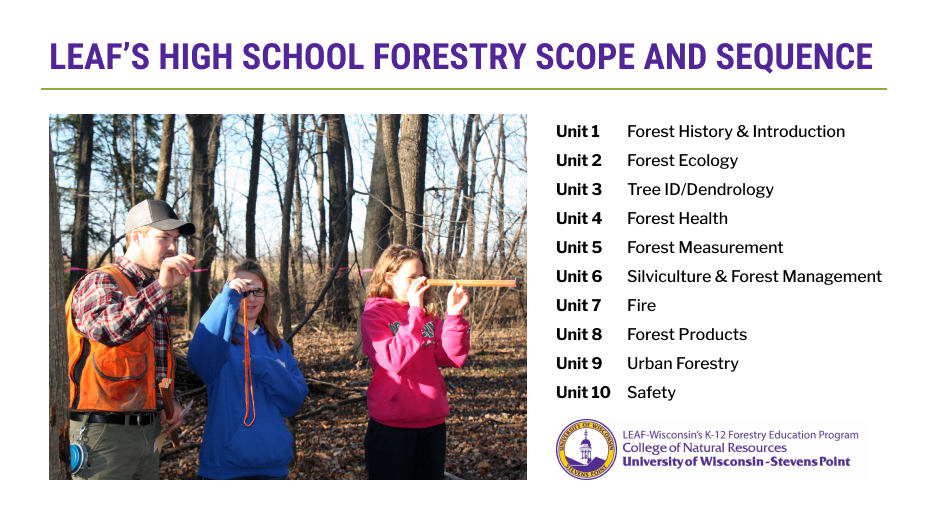
LEAF Video List
For a full collection of LEAF videos follow us on YouTube!
Wisconsin’s forest products industry drives the state’s economy, providing more than 64,000 jobs and contributing more than $19 billion dollars to the state’s economy.
Forest Products Specialist Scott Lyon, Troy Brown of Kretz Lumber, and Ben Zelazoski of Zelazoski Wood Products discuss the many products that are produced right here in Wisconsin.
Wisconsin DNR Forester Steve Grant discusses the impacts of Wisconsin’s School Forest Program on workforce development and the state’s economy.
Interested in a career in forestry? Check out the forestry programs at the University of Wisconsin-Stevens Point.
Learn more about LEAF and Wisconsin’s School Forest Program.
This video can be used to teach students how to measure the diameter and height of a tree or for those needing a refresher on how to determine these measurements.
Partner Resources
The Changing of the Land was developed in 2002 under a Wisconsin Environmental Education Board (WEEB)
grant at the Central Wisconsin Environmental Station (CWES). The unit was originally distributed on CD-ROM
to fourth grade teachers in Wisconsin. A one-day field experience that complements the unit is offered by CWES.
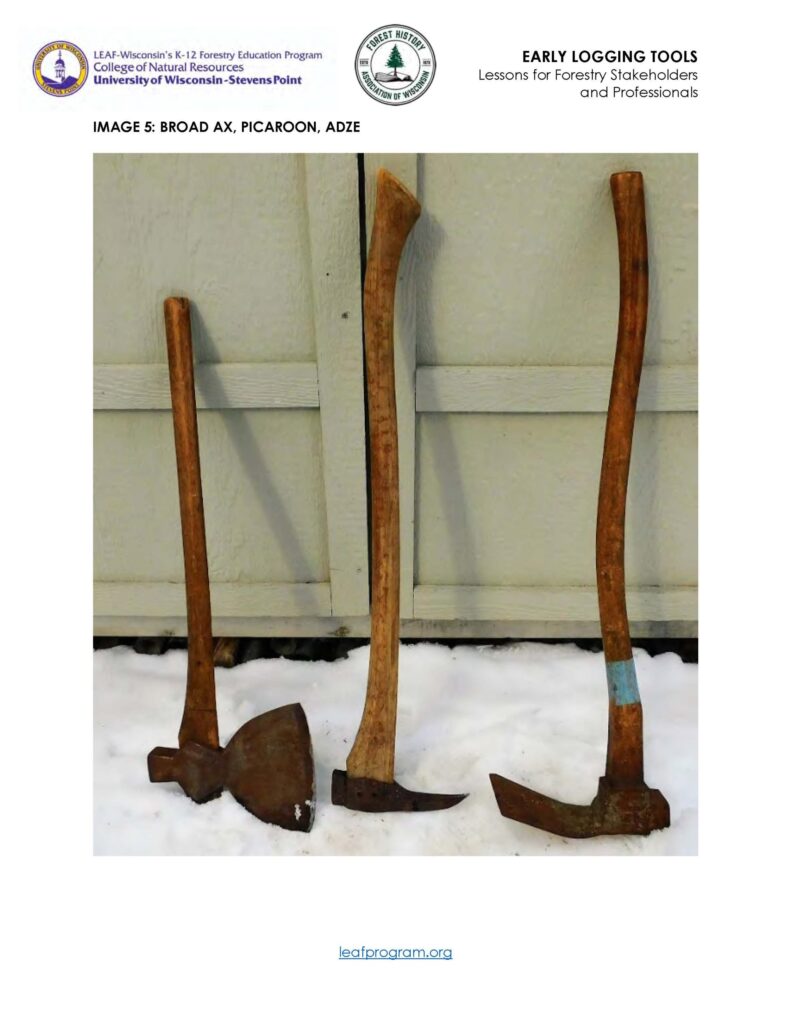
These activities help forestry stakeholders introduce students to historical tools that were used by lumberjacks and early loggers.
The activities are ideal for use in the forest and/or at field days and provide students with a hands-on opportunity to learn how the tools – and Wisconsin forests – helped build our state. Further discussions following the activities can help students understand the continued value of Wisconsin forests today and how Wisconsin has become a leader in sustainable forestry.
Invaders of the Forest was a 2005 project funded by the Wisconsin Environmental Education Board (WEEB). Project partners: Wisconsin Department of Natural Resources & The Park People: Friends of Milwaukee County Parks.
Complete Document
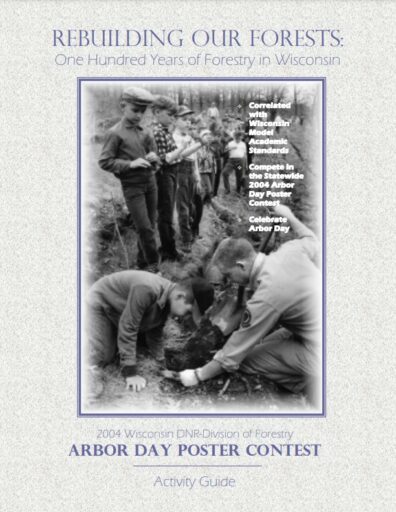
To celebrate Wisconsin’s forestry centennial in 2004, a special poster contest booklet was created that year by the LEAF Program. Activities were Wisconsin specific and reflected our state’s forest history. Because of their relevancy to Wisconsin, the activities are posted here for your use.
Wisconsin Forestree was developed in 2000 at the Central Wisconsin Environmental Station (CWES). A one-day field experience that complements the unit is offered by CWES.
If you would like a printed copy of the Wisconsin Forestree Curriculum, please email leaf@uwsp.edu with your name and mailing address.
Wisconsin Forests Forever was produced by the Wisconsin Forest Resources Education Alliance (WFREA) in 2000. Printed copies were originally for sale from WFREA and were accompanied by a CD-ROM. printed copies of the material and CDs are no longer available for purchase. Four of the 14 activities utilize the CD, the remaining 10 do not.
These materials were developed in 1999 as part of the Millennium Tree activities celebrating a Wisconsin tree being picked for the Nation’s Capitol Christmas tree. Created and produced by the USDA Forest Service, North Central Research Station; USDA Forest Service, Northeastern Area State & Private Forestry; USDA Forest Service, Office of Conservation Education; Wisconsin Department of Natural Resources, Bureau of Forestry; and Wisconsin Department of Public Instruction.
Forestry Books
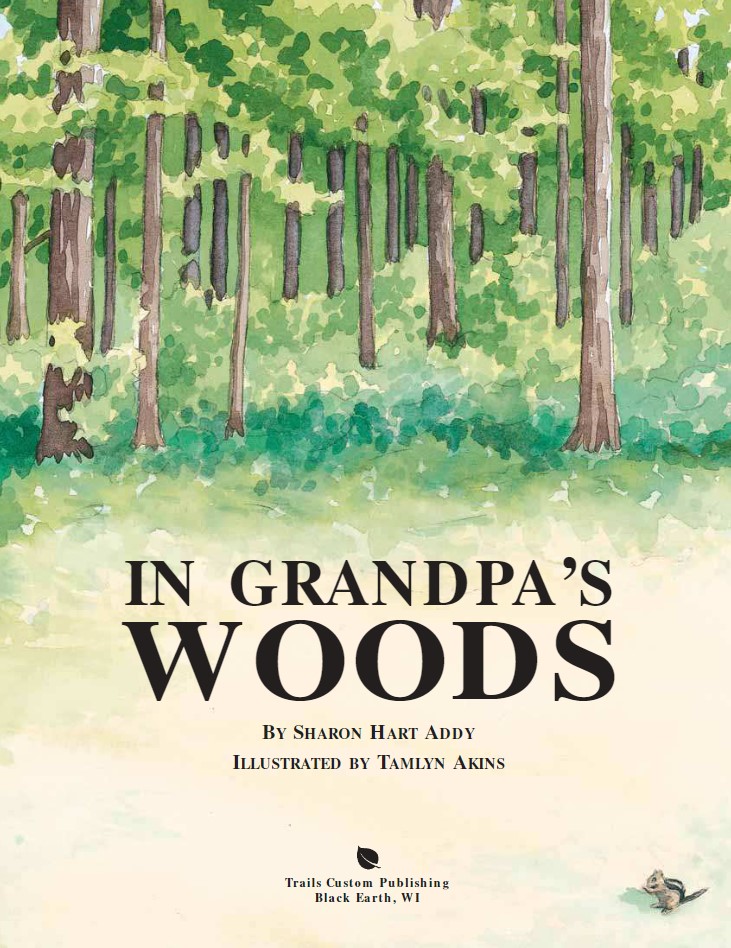
Sharon Hardt Addy
For Lower Elementary
Children can explore Grandpa’s woods with Amy and Chad as they search for the perfect location for their play structure. Along the way, adults and children will learn the basics of sustainable forestry as they follow the children on their explorations. Delightful illustrations depict Wisconsin wildlife and scenery. This children’s picture book was developed for Wisconsin’s forestry centennial in 2004.
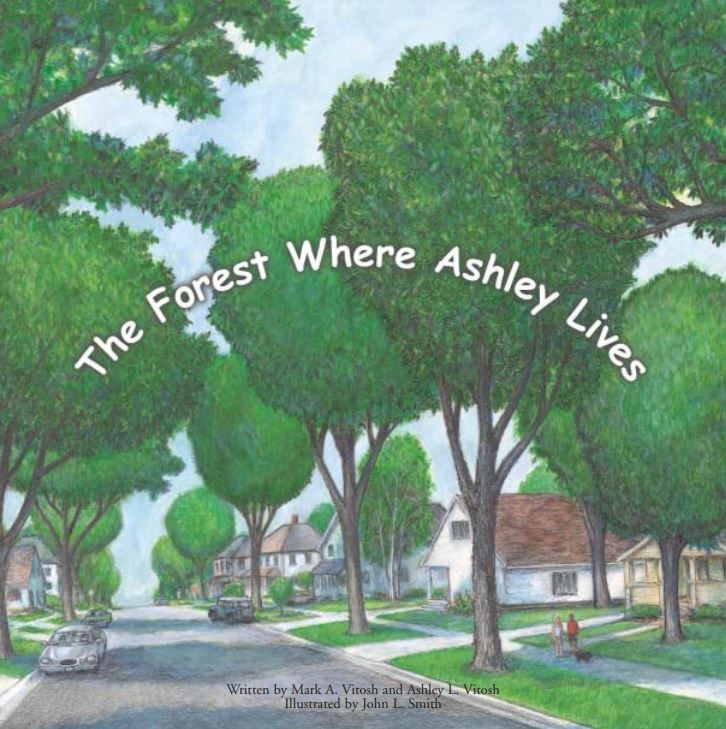
Mark A. Vitosh & Ashley L. Vitosh
For Elementary
A story about the urban forest where Ashley lives. Forest benefits are explored as well as “did you know?” facts and tree care.
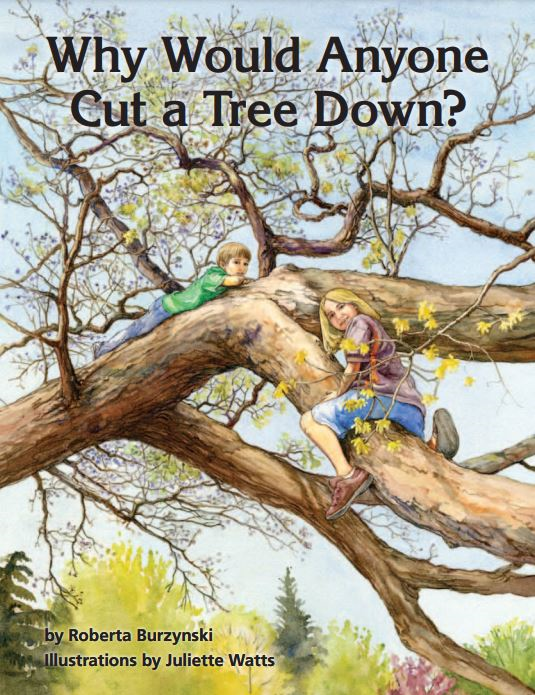
Roberta Burzynski
For 1st to 3rd grade
Some children and adults are unaware that in order to reduce tree hazards, protect other trees, or to get wood, it is necessary to cut trees. This book is intended to raise awareness of the issue. It also features tips for planting a tree.
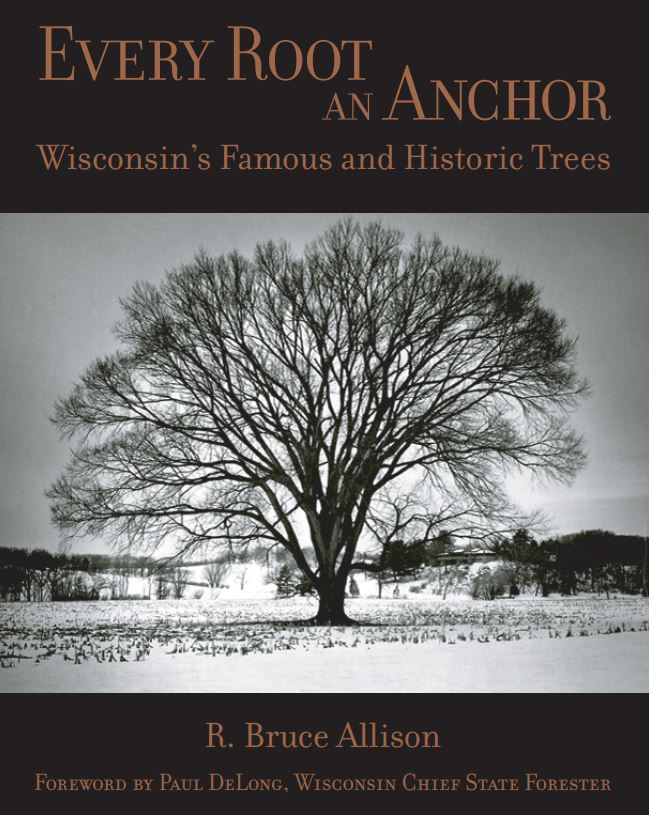
R. Bruce Allison
For Junior High – Adult
In Every Root an Anchor, writer and arborist R. Bruce Allison celebrates Wisconsin’s most significant, unusual, and historic trees. More than one hundred fascinating tales introduce us to trees in every corner of the state, some remarkable for their size or age, others for their intriguing histories.
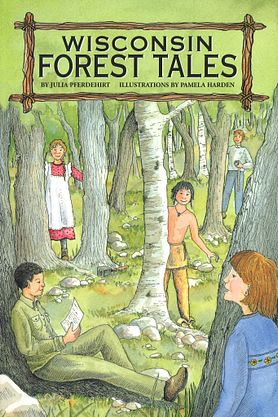
Julia Pferdehirt
For 4th grade
Wisconsin Forest Tales by Julia Pferdehirt is a fabulous collection of stories revolving around Wisconsin forest history.
This coffee table book was developed for Wisconsin’s forestry centennial in 2004.
The Society of American Foresters produced the second edition of this coffee table book for the U.S. Forest Service centennial in 2005.