
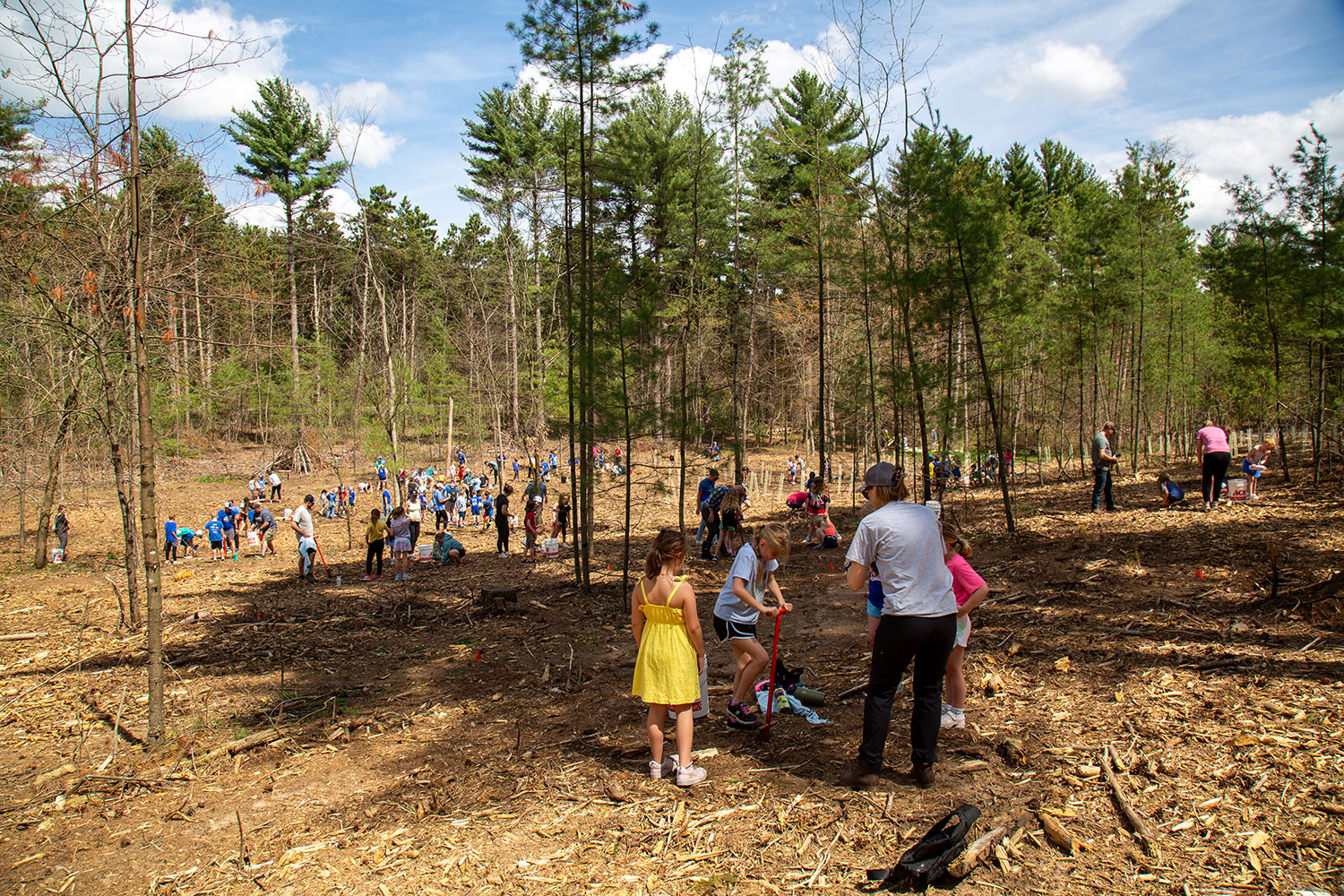
Contacts

Gretchen Marshall – Forestry & Outdoor Education Specialist
Contact Gretchen with any school forest, outdoor education, DNR forester, and registration related inquiries at 715-346-2633 or Gretchen.Marshall@uwsp.edu

Steve Schmidt – Outreach Specialist
Contact Steve Schmidt with questions about school forests, professional development, School Forest Awards, and site visits to properties at steve.schmidt@uwsp.edu.
Getting Started/Registration
A school forest is land owned or controlled by a public or private school that is registered through Wisconsin’s community forest program for educational and management use.
The Wisconsin School Forest Program, offered through a partnership between the Wisconsin Department of Natural Resources and LEAF, is a resource for all registered school forests in the state.
Learn more about the educational value the School Forest Program offers, who is eligible to apply, and the registration process.
Does your school have a registered school forest?
Interactive Wisconsin School and Community Forests Map
This interactive map shows the location and approximate boundaries* of the school forest lands and community forest lands registered with LEAF – Wisconsin’s K-12 Forestry Education Program. Use this as a resource to find and learn about different school and community forests in Wisconsin! School Forests are outlined in yellow, and Community Forests are outlined in blue.
How To Use
Navigating the interactive map is made easy using the following quick tips. Pinch, scroll, or use the + and – buttons to zoom in or out, or type a specific forest name in the search bar to find it quickly. Click the Home button to return to where you started. Looking for just one type of forest? Use the layers button located in the top right corner of the map to open a list of all available layers and click to toggle visibility. Located beneath this button are a library of base maps available to choose from, including topography and street maps. Click within the yellow or blue boundaries to see some quick facts about the forest. *Type the Latitude and Longitude from the pop-up into Google Maps to get directions to each specific school forest.
If you wish to obtain the GIS data for the Wisconsin School Forest layer, contact Gretchen Marshall at Gretchen.Marshall@uwsp.edu.
*Disclaimer: Outlines on this map are representative and are not the exact boundaries of the forest parcel. A legal boundary can only be determined by a licensed surveyor. In some cases, the forest is on the school grounds which contains non-registrable lands (i.e. buildings, athletic fields, and parking lots). The registered acres indicate the actual size of the school forest, while GIS acres are the size of the entire outline. Note that latitude and longitude points are generated at the center point of the forest parcel and may not reflect actual access points.
Map created by Michael Mills in partnership with LEAF. Updated by Morgan Westlund in 2026.
School Forest List (PDF)
School Forest Database PDF: The registered school forest list includes the name, number of acres, location, management plan and education plan dates for each registered school forest in Wisconsin.
Educational value of School Forests
School Forests are used to:
- Meet state education and national core standards
- Integrate environmental education into the curriculum
- Strengthen school and community relationships
- Provide income
- Connect teachers and students to place
- Demonstrate sustainable natural resource management
Much research has been done to show the impacts that school forests and outdoor learning have on student achievement. The resources on the page below show support for the educational value of school forests, environmental education, and outdoor learning
School Forest Registration
Why register a property as a school forest?
School forests have evolved into wonderful outdoor classrooms where students learn about the local ecosystem while engaging in lessons that span across the curriculum from math to social studies to foreign language and art. Your school forest can be used as a context and catalyst for learning.
Registered forests receive a variety of benefits. They are eligible to:
- Receive free forest management assistance from the DNR–Division of Forestry.
- Receive free seed and seedlings from the state reforestation program.
- Receive assistance from the statewide school forest education specialist.
- Join a statewide network of school forest educators that serve as a resource for all.
The school forest program is a partnership between the LEAF Program and DNR Division of Forestry. Registered school forests have access to resources, lessons, professional development, and LEAF staff members that help with the educational aspects of teaching students at the forest. Local DNR foresters, who provide services to school forests, assist with knowledge of the forest and how to sustainably maintain the land.
Who is eligible?
Any city, village, town or public school district that has legal control of forested property is eligible to apply.
Full Criteria
- Property must be owned or under legal control (e.g., lease, easement) of a municipality or school district. Land use agreements with municipalities, leases from private landowners, and conservation easements are examples of ways schools can legally register a parcel of land as a school forest. (See example Land Use Agreement)
- The school board and governing body of the municipality must adopt a resolution to dedicate a parcel as a school or community forest.
- Wisconsin statues do not establish a minimum acreage or productivity requirement. However, the property should contain at least one acre of forest.
- The municipality or school district should indicate intent to actively manage the forest.
- School districts should indicate intent to provide sustainable forestry education as a component of their programs.
- A management plan or property description must be completed and approved by your local DNR forester. (Conditional acceptance can be granted prior to completion of a management plan based on forester recommendations).
Application Procedure
- Owner (or an authorized property representative) completes an application form, attaches minutes of meeting dedicating property as school or community forest, and submits it to the local DNR forester. (If this is not school owned land, a copy of the land-use agreement and municipality’s governing board’s meeting minutes must also be included.) Download the Registration Form
- DNR forester visits site to ensure property meets criteria. Find the DNR forester who services your school forest
- DNR forester completes “DNR Forester’s Report” section and signs the application form.
- Send the application with Administrator and DNR forester signatures and the meeting minutes referenced in 1. (above) to Wisconsin School Forest Education Specialist (LEAF, 1108 Fremont Street – Room 201 SSC, Stevens Point, WI 54481).
- If land does not meet criteria, the forester sends letter of explanation to the property representative and to the Wisconsin School Forest Education Specialist indicating why it may not be registered.
- School Forest Education Specialist can conditionally approve acceptance based on forester recommendation with only the application form and meeting minutes.
- o gain final approval, a forest management plan must be completed and approved within one year of acceptance. Typically, a DNR forester creates the management plan; however, any individual, group, or organization can be involved in developing the plan. If a DNR forester does not develop the plan, it must be submitted to a DNR forester for review and approval. Find the local DNR forester who would provide assistance to your school forest
School Forest Handbook
The handbook is a resource to help turn the school forest into a vital outdoor classroom that supports diverse educational opportunities and the ability to sustainably manage the land. It will guide you through the key components of what it takes to build a school forest program. We hope this handbook will help you!
View the HandbookSchool Forest Foundation/Education Plans
School forests are incredible education resources.
Educators often recognize the uniqueness of having a school forest but struggle to understand how to use it with students. Having a written education or foundational plan for your school forest is a crucial step in developing your program.
The resources linked here will help you complete a needs assessment for your district, provide information about a planning workshop hosted by LEAF, provide the template to use for creating a foundation plan, and showcase examples of education plans completed by other school forests in Wisconsin.
The school forest education plan will act as a foundational plan that the rest of your program will be built upon. The plan will provide clear directions for development and sustenance of the school forest program. If you have any questions about foundational planning for school forest programs, please contact the Wisconsin School Forest Education Specialist with the LEAF program at 715-346-2633 or Gretchen.Marshall@uwsp.edu.
Assess Opportunities and Challenges
Before starting to create an education plan, step back and gather some information from educators, administrators, community members, parents, and students in your district. A needs assessment can provide valuable information on the opportunities and challenges of using the school forest. Use the following example as a guideline to develop your needs assessment to address your specific district’s needs. Don’t forget there are free online tools to help you conduct your survey as well that make it easier to administer and tabulate the results of the survey.
Build from a firm foundation
School forests are incredible outdoor classrooms. Do you have a firm foundation to build your school forest program upon?
Educators often recognize the uniqueness of having a school forest but struggle to understand how to use it with students. Having a written plan is a crucial step in developing your school forest program. We will look closely at the educational value of school forests, what natural resource features are on your property, connect the forest to classroom curriculum, discuss how to engage staff, and brainstorm ways to ensure learning at the school forest endures over time. Bring a team and join us for a day of foundational planning where we look at the steps needed to integrate the forest into your district’s learning objectives, gain resources, and network with other school forest educators who are looking to develop, use, and sustain their school forest programming.
An established, approved format
The school forest education plan template provides an established, approved format for school forest education plan development.
Sample Plans
The following samples serve as examples for other school forests developing their education plans. These samples are not perfect and each education plan should be developed to uniquely fit the needs of each individual school forest. Use the samples to guide your education plan development and to generate ideas for your own school forest.
- Baldwin-Woodville School Forest Education Plan
- Boscobel SF Education Plan
- Cambridge School Forest Plan
- Deerfield School Forest Education Plan
- Elmwood School Forest Plan
- Green Lake School Education Forest Plan
- Superior School Forest Education Plan
- Tomorrow River School Forest Education Plan
- Whitnall School Forest Education Plan
- Winneconne School Forest Plan
Developing your Program
School Forests in Wisconsin are unique to each district
No two school forests are the same. Each school forest is designed based upon the physical school forest property, location, and school culture. Use the resources below as ideas to build out your program and provide guidance as your school forest evolves.
The websites, photos, and descriptions give you an idea of the features, trails, and facilities found at school forests throughout Wisconsin. Examples from other school forests can be found here by visiting the links to view photos, and check out another school forest’s webpage or Facebook page. There is also information below for curricular resources you can use with students on your school forest.
If you have any questions regarding a specific feature and would like to know more about it, contact Gretchen or Steve.
School Forest Site Facilities and Features
Before planning your school forest facilities, you need to ask yourself two questions:
1. What are the needs at the school forest related to how the site will be used educationally?
You don’t need to build a large classroom with dorms if you will be doing day programs with small groups of students. Figure out your educational goals before planning your facilities. Your educational programs should dictate the buildings or features on your site.
2. How can we use the facilities to meet educational goals?
Helping students understand where our resources come from and how our lifestyle decisions impact environmental and social quality are the greatest goals of school forest education.
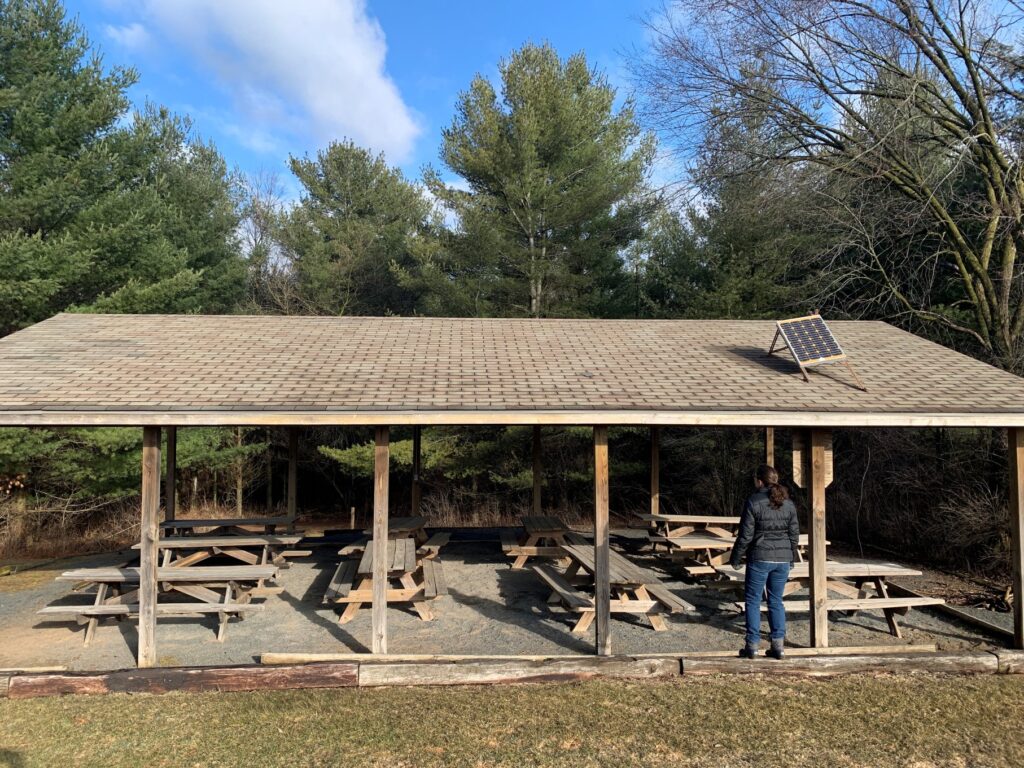
Classrooms
A variety of options – from simple shelters to “lodges” complete with classrooms and dorms – exist for classroom buildings on school forests. The most important thing to consider is how the facility will be used. Obviously, a building used occasionally to get out of the elements should be designed much differently than a building used for overnight programs. It is important to consider what programs will be conducted at the school forest before designing a facility. Below are examples and photos of education facilities on some of Wisconsin’s school forests.
Trails and Signs
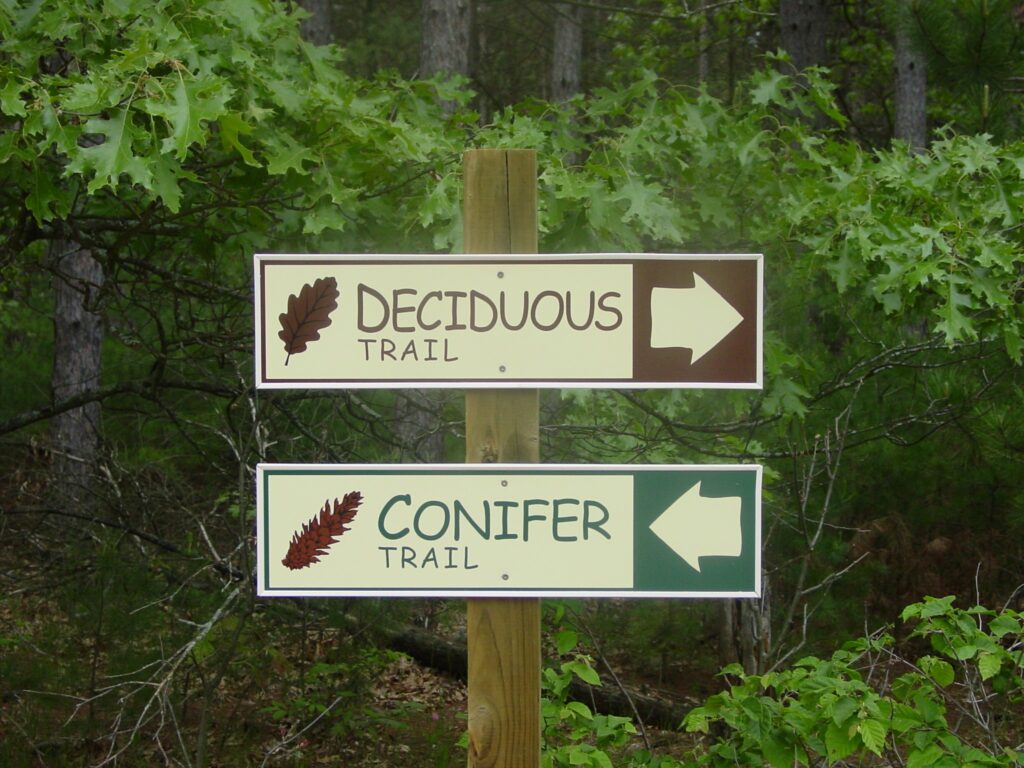
A great trail system allows students to utilize the entire school forest; lessons can be more in-depth and memorable. Trail markers help students, teachers, and the community navigate and explore your school forest. Depending on design and placement, they can greatly enhance or detract from visitors’ experiences.
Trail and Interpretive Signs
Entrance Signs
Bridges Boardwalks and Trails
Outdoor Teaching Areas
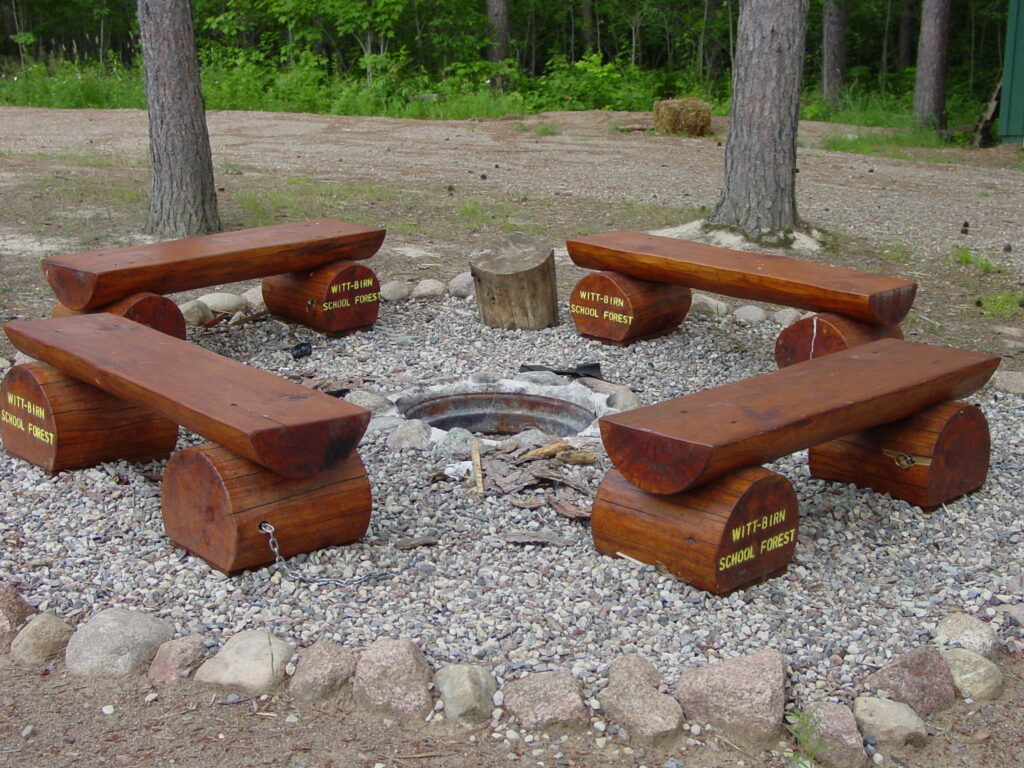
Consider where students will learn while in the forest. Is there seating available to conduct a lesson or an open area for them to run and explore?
Restrooms
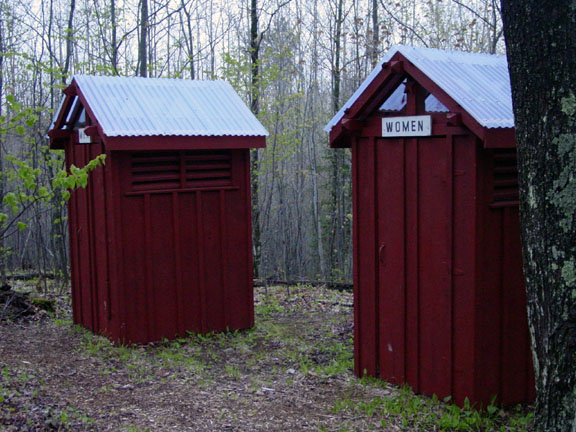
Restrooms are often an essential addition to facilities at the school forest (anyone who has spent much time with a 1st grader understands this!). The options for restrooms include rented portable restrooms, outhouses (from traditional to “modern”), to bathrooms built into the classroom or dorm. You will want to consider number and frequency of people using them, access (do you want people to go into a building to use the restroom), and location. Options for waste disposal include a vault system (in which waste is pumped out periodically), septic system (percolation into the ground), or composting toilets. Check with your county Planning & Zoning Department or Health Department for regulations regarding restrooms in your area.
Restroom Facilities
Vandalism
Vandalism can be a concern at any outdoor education site, but its occurrence is rare. Don’t let it discourage your school forest plans.
This PDF provides some helpful suggestions to discourage vandalism.
Sample School Forest Media
School Forest Websites
- Bjornson Education Center (Menomonie)
- Boston School Forest (Stevens Point)
- Cedric A. Vig Outdoor Classroom (Rhinelander)
- Giezendanner (Baldwin-Woodville)
- Jackson School Forest (Madison)
- Marshfield School Forest
- McFarland School Forest
- Medford School Forest
- Nels P. Evjue School Forest (Merrill)
- Rahr Memorial School Forest (Manitowoc)
- Severson Learning Center (Cambridge)
- Southern Door County School Forest
- Superior School Forest
- Wausau School Forest
- Whitnall (Greenfield)
WWOA School Forest Profiles
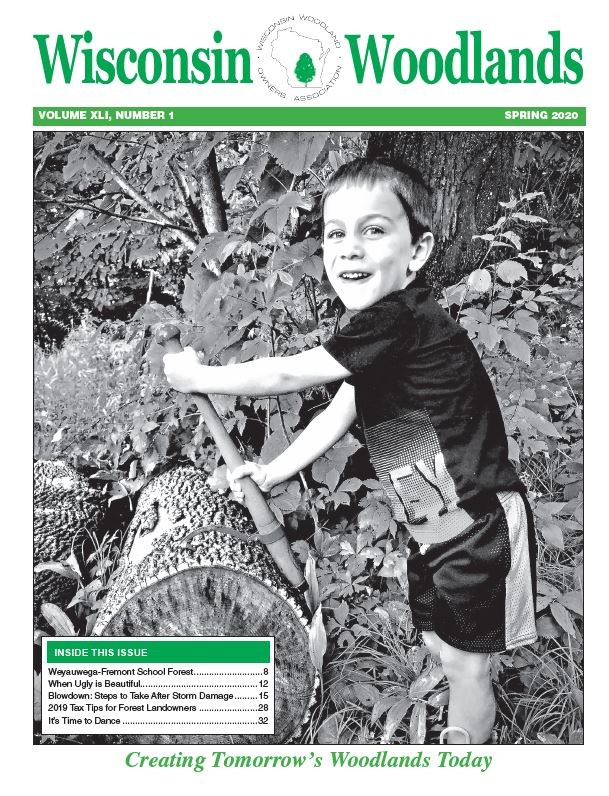
The Wisconsin Woodland Owners Association partnered with LEAF to spotlight school forests in several issues of Wisconsin Woodlands, their member newsletter.
Curriculum and Lessons
LEAF Lessons
Portions of the LEAF lessons were specifically designed to be done with students in the forest. To find these, look at the end of each K-12 grade band guide and you will find lessons entitled “Field Enhancement”. If you have a smaller forest adjacent to your school or want lessons to do with students on your school grounds, use the LEAF Urban Forestry Guide. LEAF’s Wildland Fire guide provides lessons designed to teach students basic wildland fire principles.
Environmental Monitoring
Citizen Science environmental monitoring projects are great ways to get students involved with relevant, real-world projects that can enhance your classroom instruction at the school forest. The information that students collect is used by citizens, scientists, and/or agencies to monitor environmental quality. Students gain ecological knowledge, learn about data collection, practice scientific inquiry, acquire observation skills, and utilize critical thinking skills. There are a wide diversity of projects in which to involve your students.
Project Ideas
JOURNEY NORTH
Seasonal change is all around us. We see it in the length of a day, in the appearance of a flower, in the flight of a butterfly. Journey North engages students and citizen scientists around the globe in tracking wildlife migration and seasonal change. K-12 students share their own field observations with classmates across North America….and updated maps within the program allow you to watch the migration of different species across the continent. Projects include studying the first signs of robins, monarchs, loons, the flowing of maple sap, and even changes in daylight.
WISCONSIN WORM WATCH
Did you know that all earthworms in Wisconsin are invasive species?! Although worms can be good for your garden, they are bad for hardwood forests which evolved without earthworms disturbing the soil. Survey your school forest for the impacts of invasive earth worms. The data collected through the Wisconsin Worm Watch survey is very valuable to Forest Health Specialists in the WDNR. Information provided in the surveys helps them understand the distribution of invasive earthworms across Wisconsin and their impact on local forests. In this lesson, students will use language arts, science, critical thinking, and math skills to participate in a citizen science project and determine if invasive earthworms are present in a forest. For more information about earthworms (including a great booklet for identifying earthworm species), visit the Great Lakes Worm Watch website. An elementary/middle school version of the lesson is also available.
Visit the Great Lakes Worm Watch Website
View the Elementary/Middle School Version
Forest Fungi Project
The Forest Fungi Project launched by the Lankau lab in Plant Pathology department at the University of Wisconsin-Madison is a citizen science initiative aimed at getting the public (that’s you!) involved in the sciences. We hope to learn more about the environmental and climatic factors controlling the distribution of fungi. We are asking for samples from every state east of the Mississippi River. The Lankau lab invites you to participate. Simply go to a forested area, identify a trees species, collect leaves, dig a hole, and collect roots and soil. Place your samples in a labeled sandwich bag and mail to the Lankau lab. During your sampling, you will be able to explore a forested area, take pictures and share in our photo log. We will display data as soon as samples are processed so you can see how you contributed to the Forest Fungi Project. More information and directions can be found at the Forest Fungi Project website.
Project Feeder Watch
Project Feeder Watch is a winter-long survey of birds that visit feeders at backyards, nature centers, community areas, and other locales in North America. FeederWatchers periodically count the birds they see at their feeders from November through early April and send their counts to Project FeederWatch. Citizens help scientists track movements of winter bird populations and long-term trends in bird distribution and abundance.
Community Collaborative Rain Hail Snow Network (CoCoRaHS)
The National Oceanic and Atmospheric Administration (NOAA) and the National Science Foundation (NSF) are major sponsors of this project. It is a national research initiative that works to measure and map precipitation (rain, hail and snow). Each time a rain, hail or snow storm crosses your area, students take measurements of precipitation from their reported location and recorded on the web site. The National Weather Service, other meteorologists, hydrologists, emergency managers, city utilities (water supply, water conservation, storm water), insurance adjusters, USDA, engineers, mosquito control, ranchers and farmers, outdoor & recreation interests, teachers, students, and neighbors in the community are just some examples of those who use this data.
Wisconsin First Detector Network (WIFDN) (for Invasive Species Reporting) from UW Extension
Did you know that not all green is good? Some of the most common plants you encounter in your daily lives are having a devastating impact on Wisconsin’s iconic landscapes. These species were introduced through human activity and are therefore classified as invasive species. Invasive species can be plants, animals, insects, fungi, or diseases. Wisconsin First Detector Network is a citizen science-based program designed to provide a platform to support invasive species early detection and monitoring in Wisconsin. WIFDN provides training on invasive species biology, impacts, and identification in order to demonstrate the importance of invasive species issues.
WIFDN also supports several hands on volunteer projects in order for participants to actively contribute to statewide invasive species monitoring. All of the information collected through volunteer projects goes directly to invasive species experts with the USDA, the University of Wisconsin, land managers, and is made publicly available.
Visit the WIFDN Website
Download the Free Early Detection Network App for Reporting Invasive Species
Project BudBurst
Every plant tells a story. Whether you have an afternoon or a whole season, you can make an important contribution to a better understanding of changing climates. We are a national network of people monitoring plants as the seasons change. Making observations of when plants leaf, flower, and fruit is the heart of Project BudBurst. There are 2 ways you can observe plants — Regular Reports and Single Reports. Both approaches provide useful data.
Water Action Volunteers
Water Action Volunteers (WAV) is a statewide program for Wisconsin citizens who want to learn about and improve the quality of Wisconsin’s streams and rivers. The program is coordinated through a partnership between the Wisconsin Department of Natural Resources and the University of Wisconsin – Cooperative Extension. Citizens, civic groups, 4-H clubs, students and other volunteer groups are participating in WAV programs across the state. It consists of three parts: stream monitoring, river clean ups and storm drain stenciling. In addition, the program offers a variety of water-related educational materials for educators.
Wisconsin’s Volunteer Carnivore Tracking Program
Because carnivores such as wolves, fisher, and bobcats are often secretive and occupy very large home ranges, it is difficult to monitor them by direct observation. The Wisconsin DNR relies on your observations of the number and location of tracks to help them estimate the abundance and distribution of carnivores.
Visit the Wisconsin’s Volunteer Carnivore Tracking Program Website
Who’s Who of Citizen Monitoring Wisconsin
The Who’s Who of Citizen-based Monitoring in Wisconsin is a directory of citizen programs and organizations in Wisconsin that focus on the monitoring of natural resources. You can search by county to find on-going monitoring projects in your area.
Monarch Larva Monitoring Project
The Monarch Larva Monitoring Project involves citizens in collecting data that will help to explain the distribution and abundance patterns of monarch butterflies in North America.
Lost Ladybug Project
Across North America ladybug species composition is changing. Over the past twenty years native ladybugs that were once very common have become extremely rare. During this same time ladybugs from other parts of the world have greatly increased both their numbers and range. We’re asking you to join us in finding out where all the ladybugs have gone so we can try to prevent more native species from becoming so rare.
Garlic Mustard
Garlic mustard is one of the most aggressive woodland invasive species. Within a few years it can completely dominate invaded areas and suppress other plants and limit tree and shrub regeneration. For information on identification, known (official) range of occurrence, and control methods, visit the WDNR’s garlic mustard website.
The Cerceris Project
Emerald ash borer is notoriously difficult to detect when infestations are light. Early detection of emerald ash borer can provide the opportunity to save many of the high value ash trees in the area. The Cerceris project uses a native stingless wasp to do most of the work for us. (Cerceris fumipennis) or Cerceris for short, is a predatory wasp that feeds on wood boring beetles and loves to build its solitary nests in bare compacted soil, such as baseball diamonds. They also have a habit of dropping a certain percentage of their prey near the entrance to their underground burrows.
Do you have access to baseball diamond(s) on or near your property? By walking around baseball diamonds and picking up the discarded beetles, students can aid in the early detection of emerald ash borer! The Cerceris project also provides information about distribution of native wood boring beetles and has the potential to detect new infestations of invasive beetles not known to exist in Wisconsin. The introduction of new species of invasive beetles could be as damaging to Wisconsin’s ecosystems as emerald ash borer. The Cerceris Project is supported by UW Extension’s Wisconsin First Detector Network (WIFDN).
View a Short Video About The Cerceris Project
If you are interested in learning more or participating, please contact Tony Summers:
Phone: (608) 262-9570
Email: asummers2@wisc.edu
High School Forestry Class Scope and Sequence
This “by teachers, for teachers” resource produced by LEAF brings together forestry course syllabi, curriculum maps, PowerPoint presentations, lessons, and other useful resources. Click the link below to view the whole Scope & Sequence formatted in a google spreadsheet.
School Forest Science Connections
Implement relevant science concepts and activities in your school forest!
Special Note: The concepts that are not linked to a lesson can be taught at the school forest. We are looking for lessons submissions for those concepts. If you have a lesson you’d like us to include, submit it (preferably in Microsoft Word .docx format) along with a full citation for the source to Gretchen Marshall for review.
Special thanks to WSST for partnering on this project.
Biology
- Foundations of Biology:
- Water
- Biochemistry
- Scientific Method (research projects)
- Characteristics of Life (living/non-living, biodiversity – mowed lawn vs school forest)
- Microscopes (pond study)
- Ecology:
- Succession (LEAF Program lesson with flow chart)
- Invasive Species Ecology
- Earthworm Watch
- Animal Tracking
- Biomes
- Energy Transfer
- School Forest Ecology Observations
- School Forest Soil Study
- Pond Abiotic and Biotic Field Results
- Cells
- Photosynthesis (measure light intensity, cover, compare at different times of the year; paper chromatography with tree leaves; pigmentation)
- Osmosis and cellular transport: How does Round-up destroy cell tissues?
- Genetics
- DNA and Mendelian genetics (look at genetics of native tree species)
- Phenotypes of School Forest Organisms
- Endangered Species
- Evolution
- Biodiversity
- Seed Dispersal-Evolutionary Advantage
- Taxonomy
- Specimen Collections
- Leaf Collection
- Bark Casts: create casts of tree bark to identify trees by bark texture
- LEAF Tree ID Activity
- School Forest Tree Identification
- School Forest Taxonomy Investigations
- Kingdoms of Life in the School Forest
- Bacteria and Viruses (decomposition)
- Protists (soil, pond microscope studies)
- Animal (identification; winter and summer physiological adaptations)
- Fungi (tree disease)
- Plants
- Plants (edibles, cell specialization, pollen, plant reproduction, seed adaptations)
- Outdoor Plant Scavenger Hunt – parts of a plant and classification
- Biology Plant Scavenger Hunt
- Monocot and Dicot Study at the School Forest
- Water From Trees – Transpiration Lab
- Bark Casts: create casts of tree bark to identify trees by bark texture
- LEAF Tree ID Activity
- School Forest Tree Identification
- Human Body
Chemistry
- Classification of Matter
- Measurement
- Moles
- Extrapolation
- Atoms and their Structure
- Soil Properties
- Nuclear Chemistry
- Chemical Reactions
- Soil Lab – Soil Properties (nutrients, bonding)
- School Forest Soil Study
- Toxins and Poisons in the Environment
- Toxic Animals and Plants
- Density
- pH
- Water Testing
- Soil Lab
- Plant Requirements for Growth
- Soap’s Effects
- Oxidation/Reduction Reactions
- Soil Studies
- Bioluminescence
- Organic Chemistry
- Phenols
- Toxic Plants
- Esters
- Distillation
- Water Chemistry
- Metals and Minerals
- Natural Dyes
- Bonding
- Snowflakes
- Soil Properties
- Nutrients in the Soil
Human Anatomy And Physiology
- Digestive System
- Skeletal and Muscular Systems
- Deer Leg Dissection – locate parts of the integumentary, skeletal, and muscular systems
- Similar Skeletons Studying School Forest Mammals
- Circulatory System
- Heart Rate in Outdoor Work/Exercise
- Respiratory System
- Allergens
- Vectors/Disease
- Population Study of Deer Ticks
- Nervous System
- Eyes: Night Vision and Adaptation
- Miscellaneous
Physical Science
- Chemistry Basics
- Introduction to Physics
- Motion/Direction/Vectors
- Orienteering
- Speed and Distance
- Mapping
- Gas Laws
- Weather
- Light
- Diffraction in Ponds and Streams
- Measuring Light Differences in Ecosystems
- Measuring Light Penetration in Water (using Sechhi disks)
- Snow Blindness and Snow’s Reflective Properties
- Friction
- Snowshoeing
- Cross-Country Skiing
- Sledding and Tubing
- Simple Machines
- Timber Harvesting: How are machines designed to minimize impacts on the landscape?
- History of Logging Equipment
- Levers and Cant-hooks
- Electricity/Energy
- Solar Power
- Trees that Generate Heat
- Work
- Heat
- Water
- Waves/Sound
- Echolocation
- Decibel Research in Different Habitats
- Noise Reduction Capacity of Trees
Physics
- Acceleration
- Aerodynamics
- Aerodynamics of Seed Dispersal
- Birds in Flight
- Miscellaneous
- Soil Compression
- Maple Sap Flow
- Work
- Harvesting Pine vs. Oak
Hands-on Forestry Kits
Forestry kits are available for you to borrow at no cost. These kits contain supplemental lesson materials, fiction and non-fiction books focused on Wisconsin forests, and equipment for students to use when exploring in the forest. Check out the diversity of kits for use at your school forest.
Sustaining your School Forest
Ensuring your school forest program is successful for years to come depends on a solid foundation set by your school district. The resources below showcase examples of tools, information, and materials from other schools that you can utilize to help build and maintain learning experiences at your school forest. Modify these examples and implement based on your district’s needs.
SCHOOL FOREST POLICY
Having solid, set policies for your school forest property and its use are crucial to the success and longevity of the program.
The following topics and examples will provide a beneficial foundation for your programs.
Wisconsin’s Community Forest Law
School forests are a particular kind of community forest owned or controlled by school districts. The first community forest law was passed in 1927. The law was updated in 1949 and 1965. Official text of the law can be found in Section 20 of Chapter 28.
School Board School Forest Resolution
When registering land as a school forest, the school board should adopt a resolution dedicating the land to be used as a school forest.
You can find examples of resolutions here for Mount Horeb.
Land Use Agreements
A school district does not have to own property to have an official school forest. A district just needs to have legal control of a piece of property and land use agreements allow for this option. With a land use agreement, the school district is entering into an agreement with a municipality to allow that property to be used as a school forest by the district.
School Forest Funds
Whenever possible, we encourage districts to set aside a separate school forest fund for any income produced by or at the school forest instead of having the money go back to the district’s general fund. This separate school forest fund should support educational activities at the school forest.
Facility Use and Rental Agreements
Hunting in School Forests
Hunting is an important tradition and tool to control deer and other wildlife species in Wisconsin. Wisconsin Act 290 was created to clarify the issue of hunting on school forests. The statute specifically provides school boards the opportunity to allow hunting on school forests. The statute also amended related statutes (including “Gun-free school zones” and “Dangerous weapons other than firearms on school premises”) to allow for exceptions when a school board allows hunting on its school forests.
School Forest Position Descriptions
School forests are managed by districts in a variety of different ways. Very few districts can support full-time coordinators or even have a position devoted to the school forest program. However, here you will find some position descriptions for school forests that are fortunate to have a staff member dedicated to the school forest. Some of these documents are dated and the positions may not be accurate at this time.
School Forest Advisory Committee Bylaws
Establishing a school forest committee is perhaps the most important activity to assist in the development and maintenance of the program. The committee should include individuals that represent diverse grade levels, subject areas, administration, and community partners.
School Forest Management
The two main pillars of school forests are sustainable management of the forest and using the property for education. One benefit of being a registered school forest is access to a local DNR forester who can provide management services for the property. DNR foresters are able to answer questions about the trees on your property, create a management plan, and help you implement any management prescriptions that are recommended to keep your forest healthy. Find your local DNR forester by using the DNR’s Forestry Assistance Locator. Select your county and then look for the name of the DNR “Service Forester” that appears at the bottom of the page.
- Suring School Forest Stewardship Plan (Oconto Co)
- Suring School Forest Stand Map
- Suring School Land Exam
- Whitnall School Forest Management Plan (Milwk.Co)
- Reedsville School Forest Management Plan (Manitowoc Co)
Assessing the success of your school forest
Evaluating the effectiveness of your school forest program is a crucial component in a thriving and growing school forest program. Only by understanding where your strengths and weaknesses are, will your program be able to reach its full potential. The following tools will allow you to collect important data and information from others in your district. Use the information you collect to compile a report about the success of the school forest for your school board.
- School Forest Use Tracking Tool (Google Sheet – Updated 8/25): Copy this Google Sheet and use it to keep track of the total number of students, teachers, and community members (including parent chaperones) that use your school forest each year, as well as the activities they engage in at the forest.
- School Forest Field Trip Report Form (Google Form – Updated 8/25): The purpose of this form is for you to create a copy that meets the needs of your district, then share it with staff members who utilize the school forest with students. Post-field trip evaluations will indicate the success of the lessons and the field trip overall and will help track information related to your school forest usage.
- School Forest Staff & Community Use Report Form (Google Form – Updated 8/25): The purpose of this form is for you to create a copy that meets the needs of your district, then use it to record relevant information about staff and community use of the forest.
- School Forest Needs Assessment: A needs assessment can provide valuable information on the opportunities and challenges of using the school forest. Allow teachers, administrators, school staff, students, parents, and community members to complete the assessment to get the greatest diversity of opinions. Use the following example as a guideline to develop your needs assessment to address your specific district’s needs. Don’t forget there are free online tools to help you conduct your survey as well that make it easier to administer and tabulate the results of the survey.
- Annual Wisconsin School Forest Survey Results: Each year the Wisconsin School Forest Program sends a survey to each school forest to gather statewide school forest information. The survey asks about school forest educational use, use by community members, and school forest financial spending. Click the link to view a summary of the statewide survey results.
Professional Development
Providing opportunities for your staff to become comfortable and knowledgeable about the school forest is a key component to the success of your program. LEAF offers the following opportunities to help ensure educators feel confident in using the school forest as an extension of their classroom.
Contact Gretchen Marshall at Gretchen.Marshall@uwsp.edu for more information about school forest professional development offerings.
School Forest Foundational Planning Workshop
Do you have a firm foundation to build your school forest program upon? Educators often recognize the uniqueness of having a school forest but struggle to understand how to use it with students. Having a written plan is a crucial step in developing your school forest program. We will look closely at the educational value of school forests, what natural resource features are on your property, connect the forest to classroom curriculum, discuss how to engage staff, and brainstorm ways to ensure learning at the school forest endures over time.