
- Kits are available to formal and non-formal educators in Wisconsin.
- For shippable kits (which is most of them), shipping is available within Wisconsin for addresses more than 30 miles from Stevens Point. Note: Shipping outside of Wisconsin is not available.
- The WCEE is waiving the costs of shipping kits for borrowers for the 2025-2026 school year. Borrowers may still choose to be invoiced for the cost of shipping to support the WCEE’s mission of making quality hands-on resources equitably available across the state.
- For more detailed answers to common kit questions, visit our Kits FAQ.
Scroll to explore our collection of environmental education kits. and borrow one for your classroom, club, or nature center today.
General Environmental Education Kits
K-3 Bat Kit
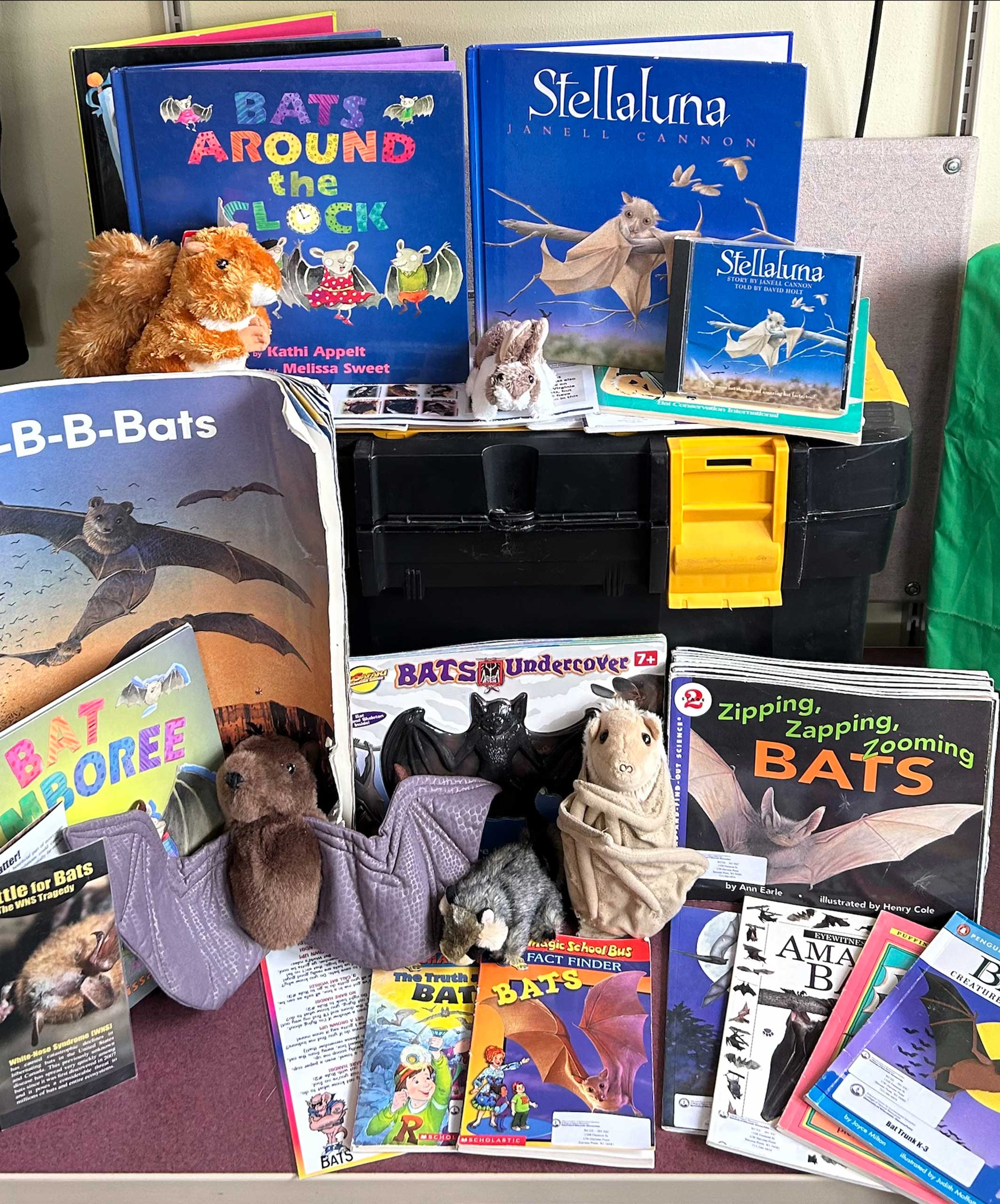
Explore the world of bats in grades K through 3!
The K-3 Bat Kit contains a teacher’s guide to help the educator share information about bats, as well as many bat-friendly books, posters, and videos.
What’s in the box?
Activity Books
- Bats – A Creativity Book for Young Conservationsists
- Bats – Thematic Unit
- Educator’s Activity Book About Bats
- LEAF K-1 Lesson 5 “Animals Need Forests Too”
Books
- Stellaluna book with CD
- Shadows of Night
- Bat Jamboree
- Bats on Parade
- Batty Riddles
- Bats Incredible
- What is a Bat?
- Extremely Weird Bats!
- Bats Around the Clock
- B-b-b-bats!
- The Magic School Bus: The Truth About Bats
- Bats Undercover
- The Magic School Bus: Fact Finder BATS
- Zipping, Zapping, Zooming Bats (9)
- Bats: Swift Shadows in the Twilight
- Amazing Bats
Activites
- Bat Handling Rap Card (laminated)
- Bat House Model (1/2 size)
- White-Nose Syndrome in Bats (laminated)
- Battle of Bats Brochure (laminated)
- Mounted Plexiglass (enclosed) bat
- Stellaluna puppet
- Bat Kit Videos laminated sheet with URL’s
- Amazing Bat Trivia
Posters
- Bats of America
- Bats of the Great Lakes Region
- Fruit Bat Skeleton
- Sleeps All Day
The kit includes an Echometer for measuring bat echolocation. The Echometer must be plugged into a phone or tablet USB-C port and requires the Wildlife Acoustics Echometer app to use. The Echometers were generously made available by the Wisconsin DNR Bat Program, on permanent loan from Virginia Tech researchers at Langwig Lab and Disease Ecology and Conservation Lab.
4-6 Bat Kit

Explore the world of bats in grades 4 through 6!
The 4-6 Bat Kit contains a teacher’s guide to help the educator share information about bats, as well as many bat-friendly books, posters, and videos.
What’s in the box?
Activity Books
- Bat Kit Activities Binder
- Educator’s Activity Book About Bats
- Discover Bats!
- Bat Mural Folder (Guide, Key, Copy pages)
Books
- Golden Guide to Bats of the World
- Bats of the United States
- Extremely Weird Bats!
- Bats Strange & Wonderful
- The Bat Poet
- What is a Bat?
- How Bats “See” in the Dark
- Bats: Mammals That Fly
- Bats A to Z
- Bats Undercover
- A Little Brown Bat Story
- The Magic School Bus: The Truth About Bats
- Silverwing (6 copies) & Study Guide
Activites
- Bat Handling Rap Card (laminated)
- Bat House Model (1/2 size)
- White-Nose Syndrome in Bats (laminated)
- Battle of Bats Brochure (laminated)
- Mounted Plexiglass (enclosed) bat
- Cactus Café Book with Puppet
- Bat Kit Videos laminated sheet with URL’s
- Amazing Bat Trivia
Echo Activity
- Bat Bandana (2)
Little Brown Bat – What’s Your Habitat?
- Cardstock Green Trees and Brown Snags
- Blue Fabric – Steam
- Two Yards of Green Fabric for Story Cloth
- Bitty the Bunny
- Cuddlekins Mini Raccoon
- Plastic Measuring Worms (5 pieces)
- Stuffed Bat
- Fabric Leaves
- Plastic Mini Ants (5)
- Stuffed Squirrel
- Large Popsicle Sticks for Story Characters
- Plastic Travel Container
Posters
- Bats of America
- Bats of the Great Lakes Region
- Fruit Bat Skeleton
- Sleeps All Day
The kit includes an Echometer for measuring bat echolocation. The Echometer must be plugged into a phone or tablet USB-C port and requires the Wildlife Acoustics Echometer app to use. The Echometers were generously made available by the Wisconsin DNR Bat Program, on permanent loan from Virginia Tech researchers at Langwig Lab and Disease Ecology and Conservation Lab.
7-12 Bat Kit
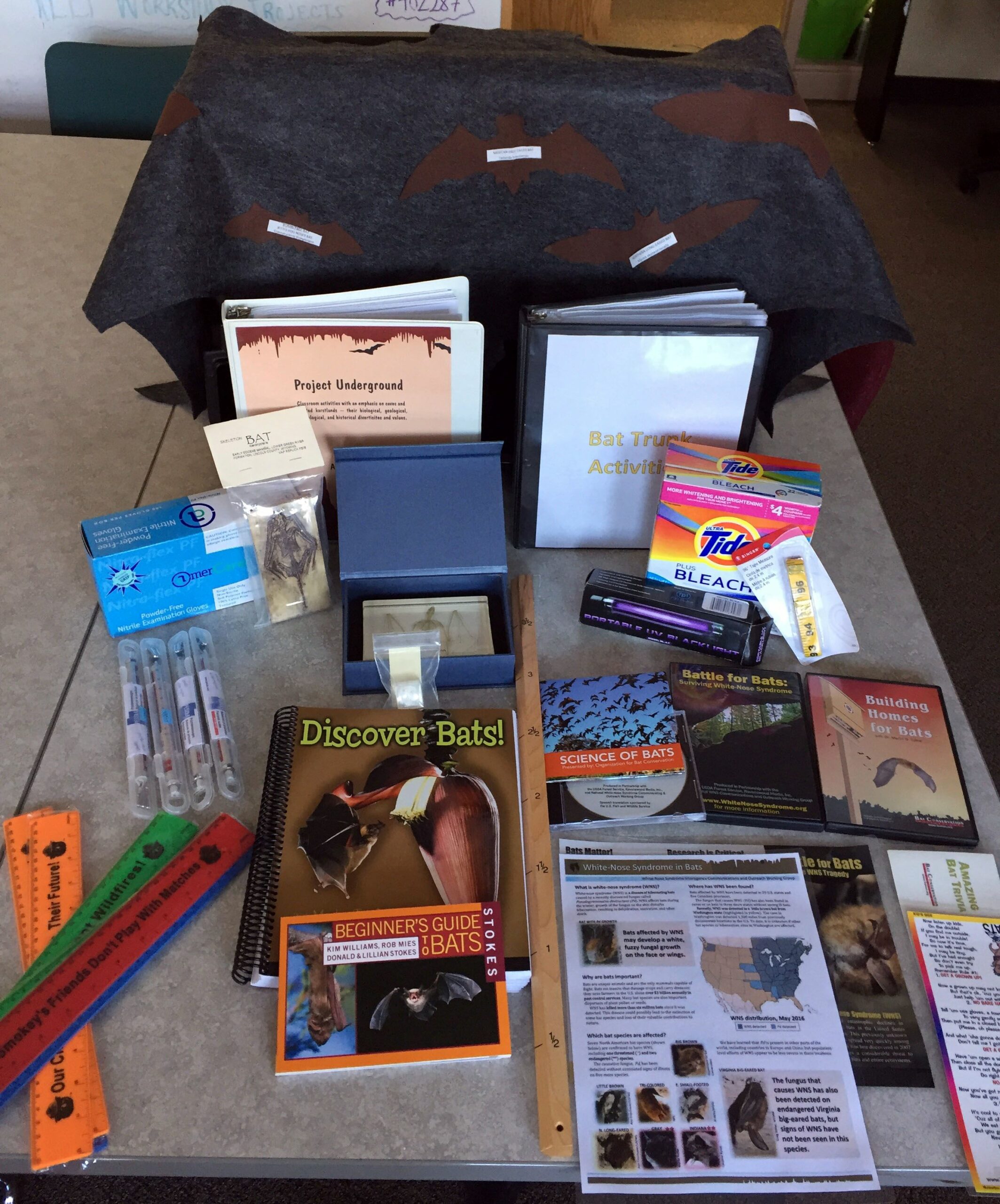
Explore the world of bats in grades 7 through 12!
The 7-12 Bat Kit contains a teacher’s guide to help the educator share information about bats, as well as lesson materials, activities, and media.
What’s in the box?
lesson materials
- Bat Trunk Activities
- Project Underground Curriculum Guide
- Discover Bats!
- Tree scale/cruising stick
Activites
- Working the Night Shift
- Nitrile exam gloves
- 7 felt bat models
- 4 spring scales
- 7 rulers
- Paper bags
- There is a Fungus Among Us
- Fabric tape measure
- Detergent
- Beginner’s Guide to Bats
- Portable black light
- AA batteries
media
- Battle for Bats DVD (English/Spanish)
- Building Homes for Bats DVD
- Science of Bats DVD
- Bat skeleton plaque
- Bat skeleton display
- Bat skull replica
- Battle for Bats brochure
- Bat facts
- Laminated White-Nose Syndrome flyer
- Laminated bat card
- Bats of Eastern North America poster
- Bats of Eastern North America brochure
- Large felt bat model
The kit includes an Echometer for measuring bat echolocation. The Echometer must be plugged into a phone or tablet USB-C port and requires the Wildlife Acoustics Echometer app to use. The Echometers were generously made available by the Wisconsin DNR Bat Program, on permanent loan from Virginia Tech researchers at Langwig Lab and Disease Ecology and Conservation Lab.
Bird Monitoring Kit
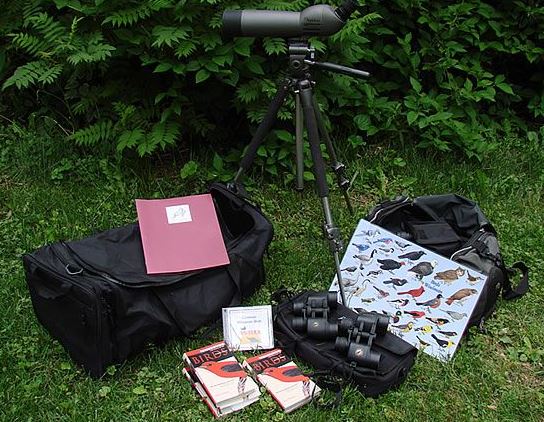
Build observational skills!
The bird monitoring kit contains the tools to help introduce birds to students, build observational skills of birds in nature, and help them gain more knowledge about birds.
What’s in the box?
- 1 Educator’s Guide
- 16 Binoculars (Each pair has 4 lens caps)
- 1 Spotting Scope
- 5 Birds of North America Field Guides
- 1 Backyard Bird Book for kids
- 3 Birds of Wisconsin Placemats
- 1 Tripod
Braiding Sweetgrass Kit
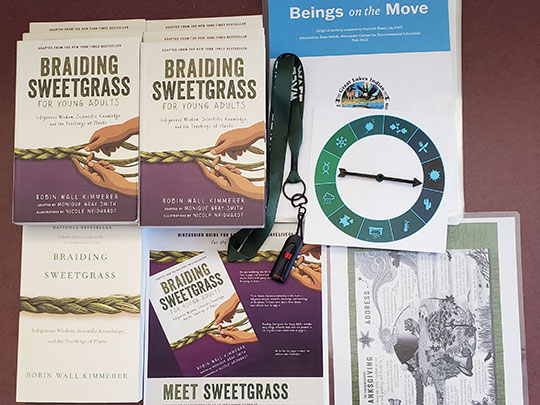
Dive into indigenous perspectives of the environment!
Dive into indigenous perspectives of the environment though Braiding Sweetgrass by Robin Wall Kimmerer. This kit includes a class set of the Young Adults’ edition adapted by Monique Gray Smith, along with a digital copy of the audiobook of the original edition, read by the author, and a reference copy of the original edition to accompany it. Extend learning with connections to the Ojibwe and Menominee tribes in Wisconsin through the “Beings on the Move” activity, which looks at how climate change may impact culturally important beings in our state.
What’s in the box?
- Braiding Sweetgrass for Young Adults (32 copies)
- Braiding Sweetgrass
- Braiding Sweetgrass audiobook in mp3 format on USB drive
- Discussion Guide
- Thanksgiving Address poster
- Beings on the Move cards and spinner
Enhance Your Kit Experience!
Braiding Sweetgrass for Young Adults Teaching Guide and Thanksgiving Address
Emerald Ash Borer Kit
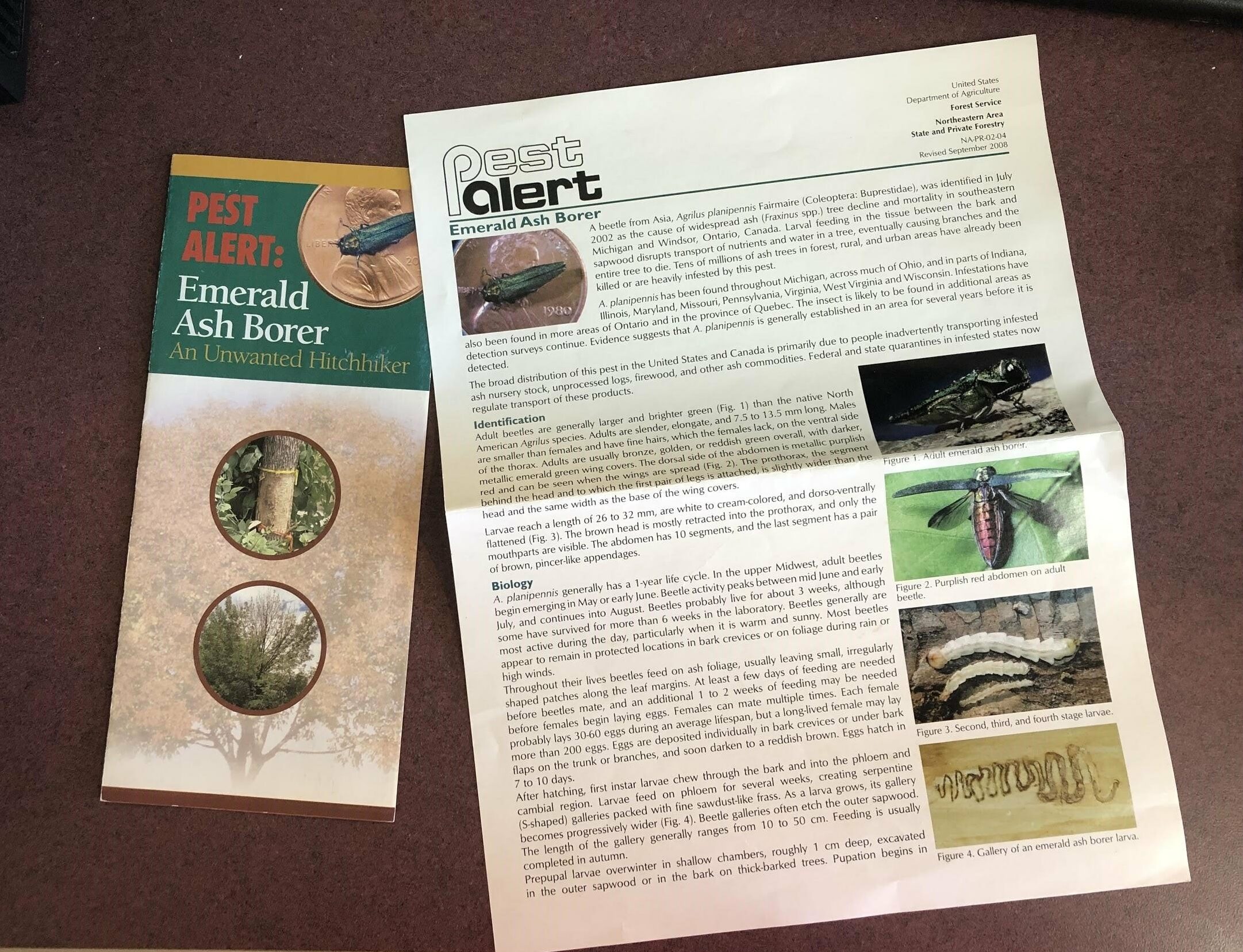
Recognize the signs of infestation!
This identification kit will give you the skills to recognize the signs of an Emerald Ash Borer (EAB) infestation. You will also learn where these beetles came from and why they are causing so many problems. The kit includes adult and larval samples of the beetle, along with bark samples showing typical EAB galleries. More information on EAB in Wisconsin
What’s in the box?
- Emerald Ash Borer adult in glass vial
- Emerald Ash Borer larva in glass vial (2)
- Piece of ash bark with exit hole
- Piece of ash bark showing Emerald Ash Borer galleries
- Emerald Ash Borer: The Green Menace brochure
- DVD: EAB, The Green Machine
- Bulletin: Pest Alert (flyer and brochure)
- Bulletin: Diagnostic Facts
- Article: Emerald Ash
- Emerald Ash Borer Identification Guide (2)
- Wisconsin Wildlife Cards (2)
- Report Emerald Ash Borer (2)
- Emerald Ash Borer Field Guide (4)
- Lesson QR Codes
Enviroscape
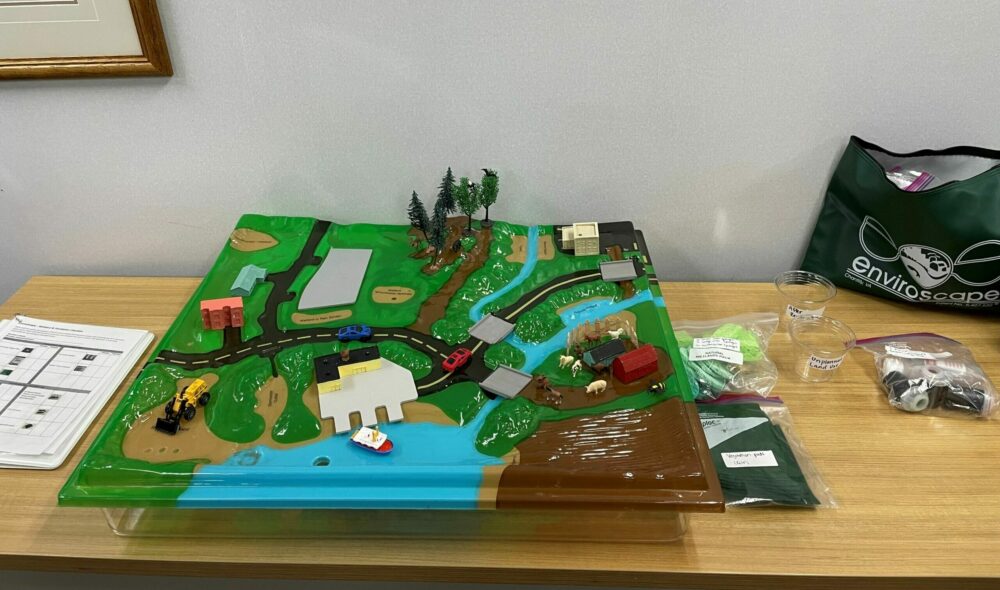
Visually demonstrate stormwater runoff!
We all live in a watershed with water pollution coming from many sources. This model allows you to visually demonstrate what stormwater pollution and runoff look like. Borrow the Enviroscape Watershed/Nonpoint Source Model to use in your classroom!
This item cannot be shipped. You must pick it up and drop it off.
What’s in the box?
wetland Kit Equipment
- Enviroscape Zipper Bag
- 2 Spray Bottles
- User Guide
- Water tray Container
- Landscape Map
Zipper Bag Materials
- Oil and Sludge Bottle + Cocoa Mix
- 3 Round Shakers:
- Brown = oil and sludge
- Green = fertilizer
- Red = pesticides
- Extra Powder (3 red, green, and brown)
- Container (1)
- Extra Mini Binder Clips
- 12 Tall Trees
- 2 Round Trees
- 10 Vegetation Pads
- Eco-spout (4 pieces)
- Constructed Wetlands and Vegetation pack
- 6 oval sponges
- 10 rectangular sponges
- Wetland Roots (Q-tips)
- Plastic Spoon Sponge
- Plastic Measuring Cup
- Natural Wetland pack
- 6 small oval sponges
- 4 large oval sponges
- 10 rectangular sponges
- 3 Plastic Cups
- Mesh Bag
Water Tray Materials
- Clay Stick
- 8 Farm Animals
- 8 Wetland Animals
- Water Trough (plastic lid)
- 5 Plastic Plugs
- 2 Golf Flags
- 2 Cars (red and blue)
- Shopping Mall Parking Lot
- 3 Bridges
- Boat Marina
- Apartment Building
- Factory with clear blue tube connected
- Plastic House
- Ranch House
- Shopping Mall
- Boat
- Construction Vehicle
- Fence
- Plastic clear tube
- Red Barn
- Rubber Plug
- Marina Building
Fish Hotel Kit
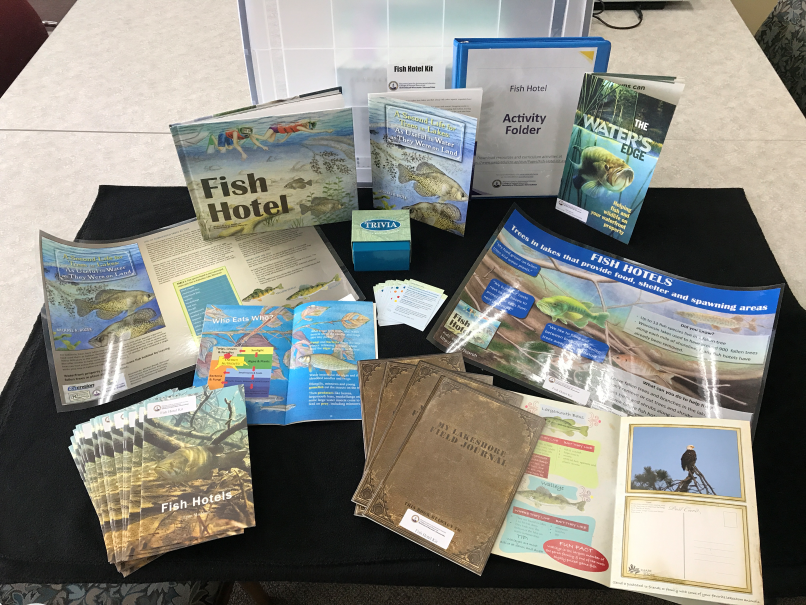
Enter the fish community!
Explore the effects of shoreline trees on Wisconsin fish species with the Fish Hotel Kit. The kit developed by the University of Wisconsin-Division of Extension Center for Land Use Education at the University of Wisconsin – Stevens Point contains a variety of instructional materials designed to help students learn about the benefits of leaving trees in lakes. Trees in lakes not only provide areas for fish to spawn but also offer shelter to help some species protect their incubating brood. Large submerged trees can host entire fish communities! Recommended for educators of grades K-8.
What’s in the box?
- A Second Life for Trees in Lakes – Teacher resource booklet
- My Lakeshore Field Journal*
- Fish Hotel, fiction – Full-color, hardcover picture book*
- Fish of Wisconsin Field Guide
- Water’s Edge – Teacher resource booklet
- Fish Hotels, non-fiction (20 student copies) – Full-color, companion booklet
- Fish Hotel Lesson Plan
- Wisconsin Lakes Trivia Game
- Fish Hotels Poster
- A Second Life for Trees Poster
- Game Fish of Wisconsin Poster
- Little Fishies of Wisconsin Poster
- Large Mouth Bass Plush Toy
- Video links to short videos of fish swimming through real fish hotel
*The books marked by an asterisk are tailored to the Wisconsin standards for science for grades 3-5 (Standards SCI.LS1 and SCI.LS2) but have been used with a wide variety of audiences, including camps and special education classrooms.
Enhance your kit experience
Download Curriculum and Resources from The Center for Land Use Education’s website.
Fishing For Fun
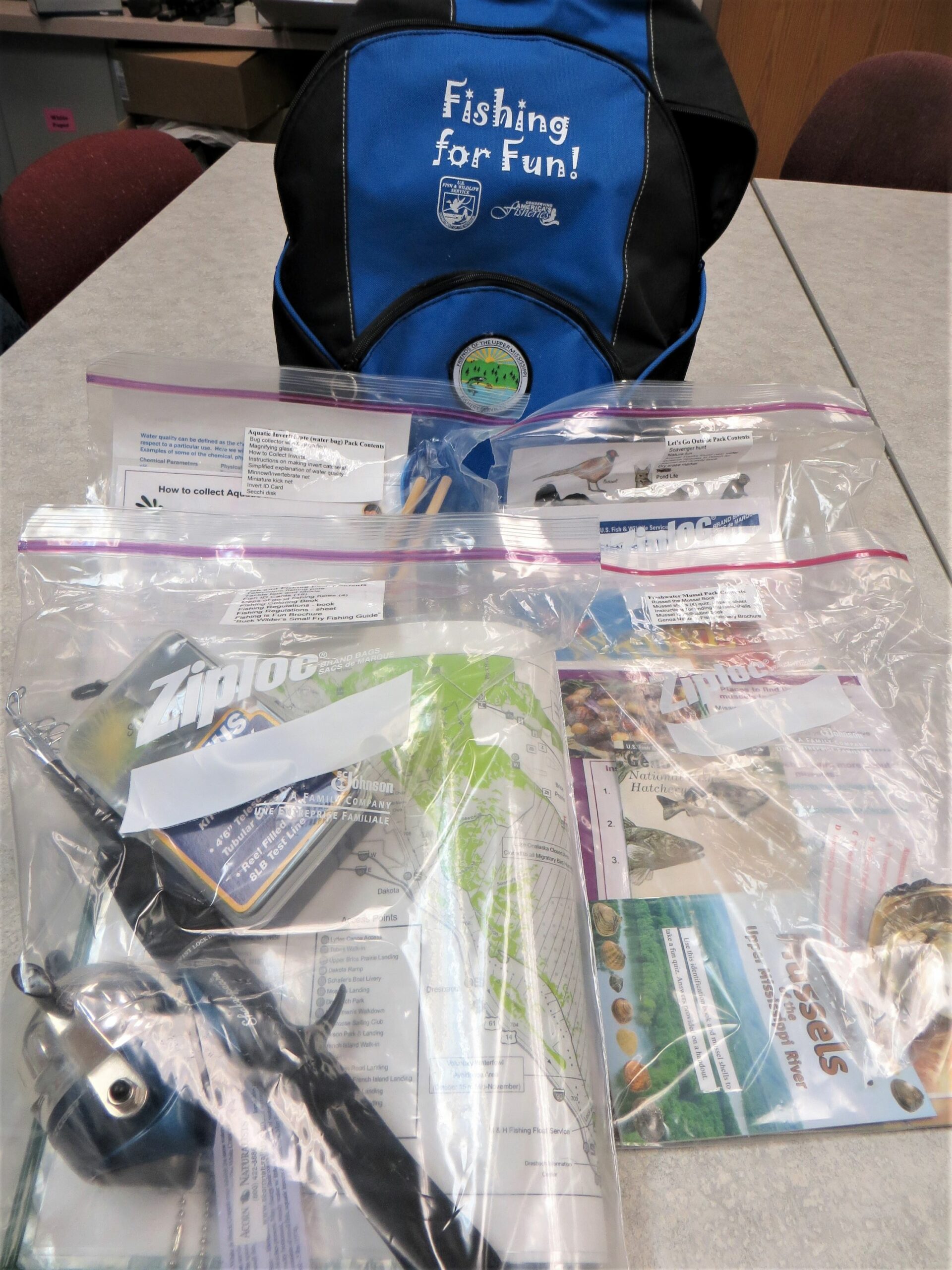
Dive in to an aquatic adventure!
These kits are assembled and maintained by the U.S. Fish & Wildlife Conservation Office in La Crosse, WI, and its friends group, Friends of the Upper Mississippi Fishery Services. The packs are also available in the greater La Crosse area through libraries in the Winding Rivers Library System. Backpacks have an aquatic theme with hands-on activities relating to fishing, freshwater mussels, aquatic invertebrates, and spending time near water bodies.
What’s in the box?
- Telescopic Fishing Pole
- “Buck Wilder’s Small Fry Fishing Guide”
- Tackle Box with tackle (includes approximately: 4 bobbers, 15 leaders, 8 sinkers, 30 hooks (3 sizes), 12 plastic worms, 1 green stringer, 8 lures, 3 spinners)
- Fish ID Cards
- Fishing is Fun Brochure
- Fishing Coloring Book
- Maps of good fishing holes (3)
- WI Fishing Regulations
- Scavenger Hunt
- Animal Tracks commonly found near water
- Pond Life Golden Guide
- Dry Erase Marker
- Thermometer/Compass
- Russel the Mussel Book
- Mussel shells (4) & Quiz
- Where to visit to see mussels/shells
- Mussel ID Book
- Genoa National Fish Hatchery Brochure
- Bug collector with 4x magnifiers
- Green minnow/invertebrate net
- Magnifying Glass
- Miniature Kick Net
- Instructions on making invert catchers/water quality
- Invert ID – homemade (laminated)
- Secchi Disk
Great Lakes Invasive Species Identification Kit
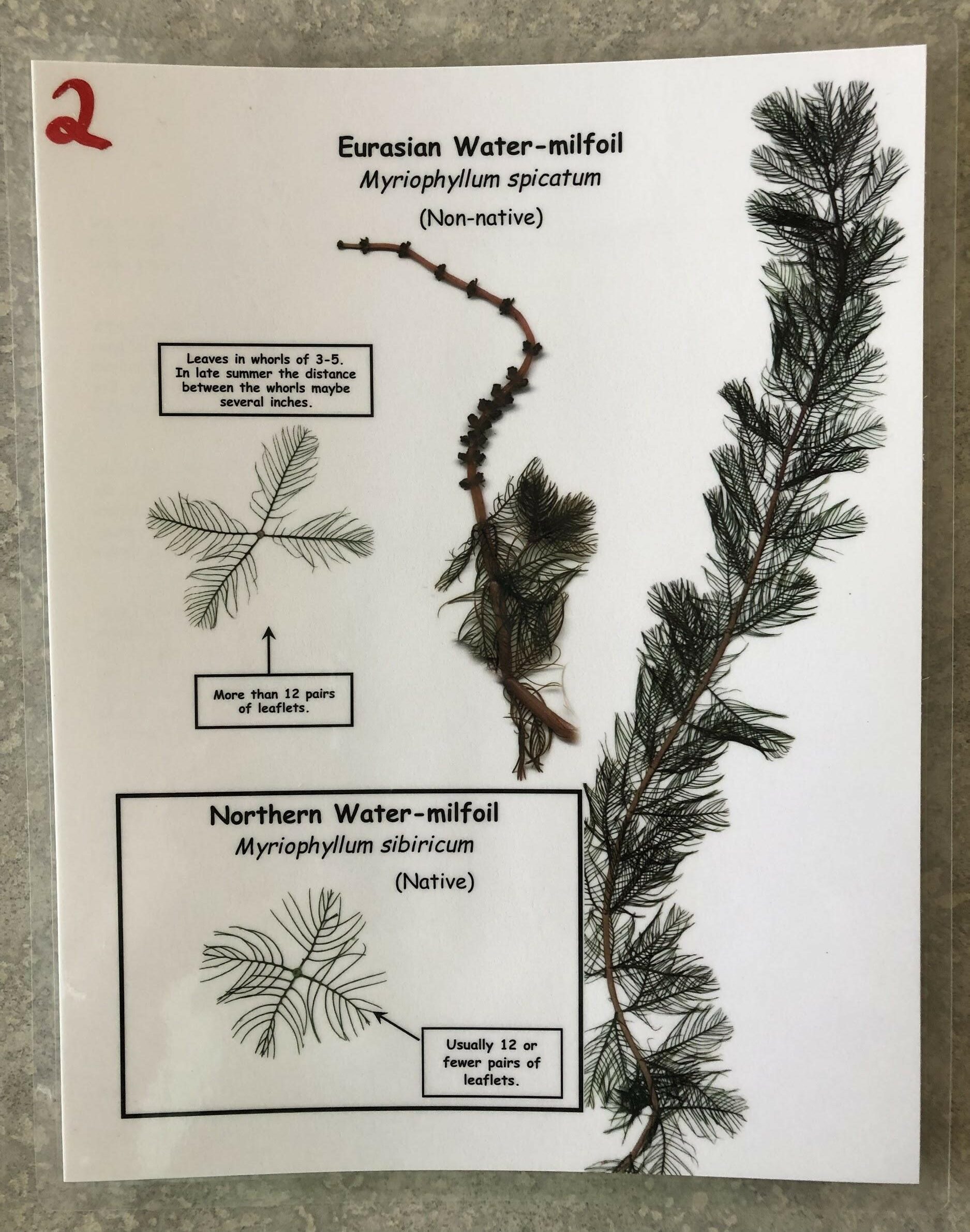
Learn about invasive species!
This kit can be used to help teach students of all ages how to recognize some of the most common invasive species that are harming the Great Lakes. An activity guide is also included to help you learn why these species are causing problems and how to stop their spread. The kit includes 12 preserved examples of both animal and plant species.
What’s in the box?
- Teacher’s Guide
- Bingo Chips
- 12 Specimen
- Round Goby
- Eurasian Milfoil
- Smelt
- Zebra Mussel
- Purple Loosestrife
- Pondweed Curly Leaf
- Rusty Crayfish
- Lamprey
- Ruffle
- Alewife
- Spiny Water Flea
- Quagga Mussels
Groundwater Model Kit
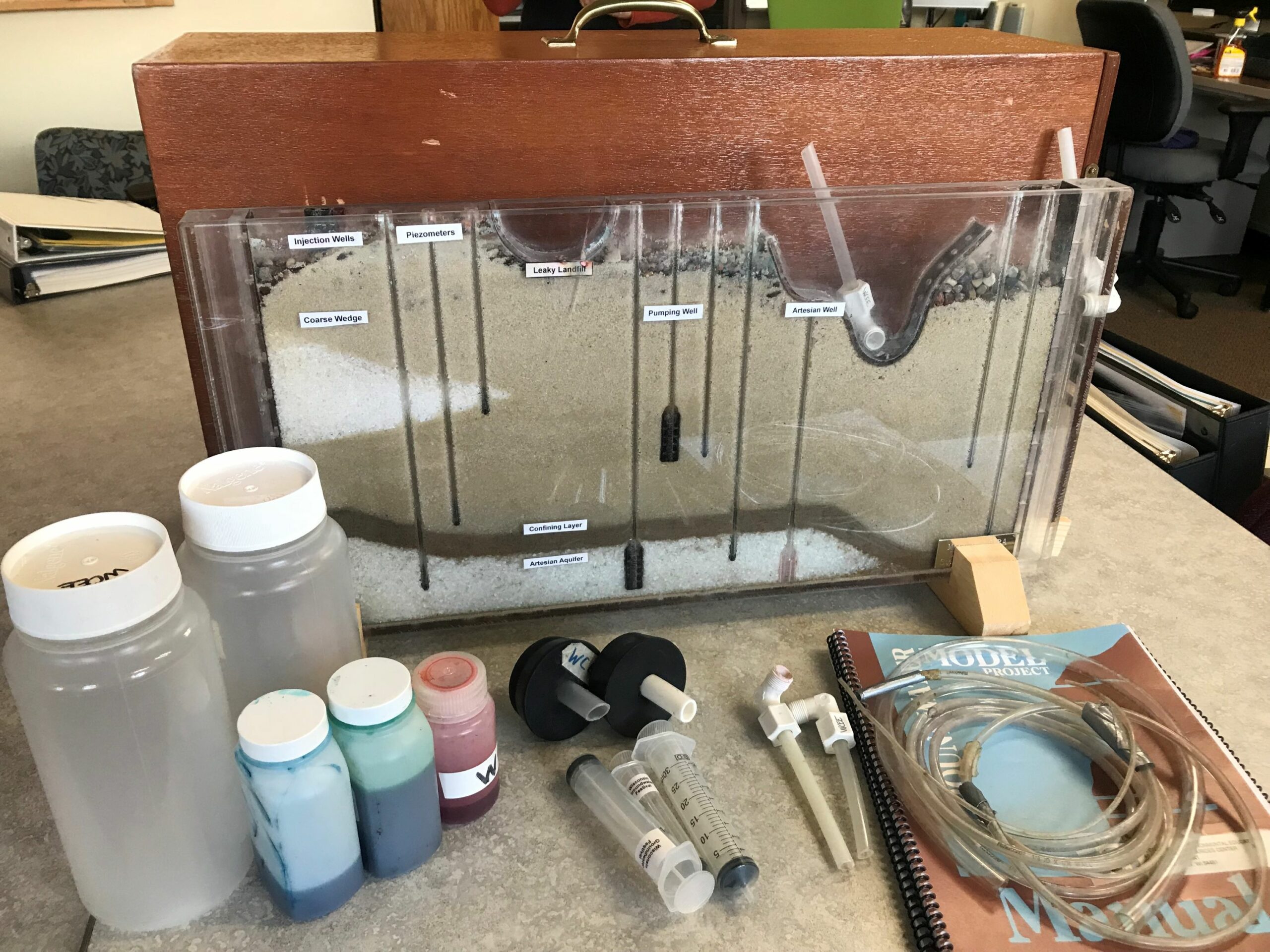
Try this interactive demonstration!
The Groundwater Model is an interactive classroom tool designed to show the flow of water and toxins through differing gradients. It can be used in front of the classroom and is easily used by students themselves. It demonstrates the flowage through confined and unconfined aquifers as well as the effects of pumping these aquifers.
This item cannot be shipped. You must pick it up and drop it off.
What’s in the box?
- Pitcher
- Water Bottles, Lids, Plugs (2)
- Dyes (red, blue and green); Mixed Dye (2 red, 2 green, 1 blue)
- Syringes – 30cc Large (2) & 10cc Small (2)
- Eyedroppers (2)
- Strings of Tubing (2 large, 2 long, 1 small, 2 tiny)
- Outlet Tubes (attached to model) (2)
- 5 Tips
- Educational Manuals
- Groundwater Model (in carrying case)
- 3 Vis-à-vis Markers (red, black and green)
Enhance your kit experience
- A Decade of Wisconsin Water Withdrawals – StoryMap courtesy of Wisconsin DNR, Water Use Section
- CD Custom Workshop – information on how to purchase your own Groundwater Model. Note: This link is provided for convenience and does not constitute an endorsement or recommendation.
- Groundwater Model Workshop – workshops on how to use the model are usually run every spring. Apply in January or early February. Additional resources on the groundwater model, links to demonstration videos, and more resources on water in Wisconsin are available at the bottom of the page.
Healthy Indoor Spaces Kit
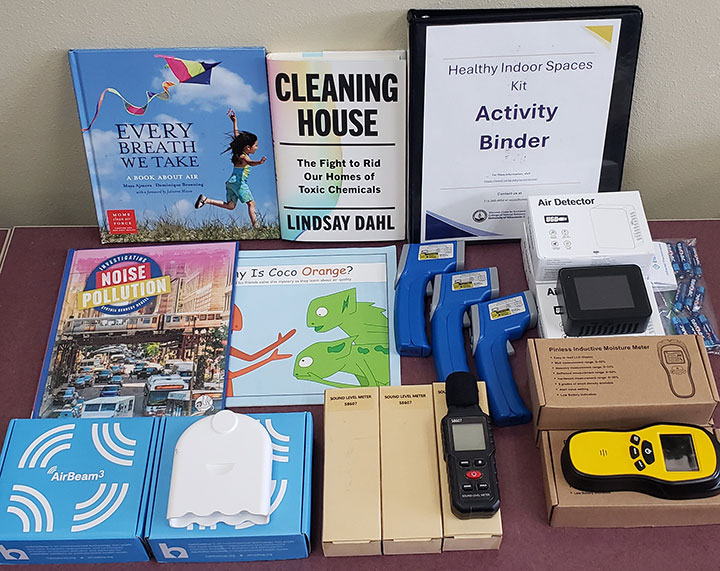
How healthy is your classroom?
The Green & Healthy Schools Healthy Indoor Spaces Kit provides resources for educators and students to conduct an investigation of environmental health in their school. When a school environment is unhealthy, students may be exposed to harmful pollutants and chemicals that may cause their health, attendance, and academic performance to suffer. “Environmental health” is a broad topic and covers many areas including cleaning and maintenance, mold and moisture, chemical and environmental contaminant hazards, ventilation, and pests and pesticides. This kit includes tools to measure noise levels, temperature, moisture, air quality, carbon dioxide, and humidity levels. Using these tools, students have the opportunity to investigate whether their school is a healthy place to learn and make recommendations about areas that need attention. Classrooms and schools are encouraged to use this kit to support earning a Healthy Spaces Badge from Green and Healthy Schools Wisconsin.
What’s in the box?
- Decibel meter (3)
- IR thermometer (3)
- AirBeam 3 air quality monitor with charger (2)
- Moisture meter (3)
- CO2 detector with charger (3)
- Every Breath We Take
- Investigating Noise Pollution
- Cleaning House
- Why is Coco Orange?
- Spare batteries
Enhance your kit experience
Impervious Surfaces Kit
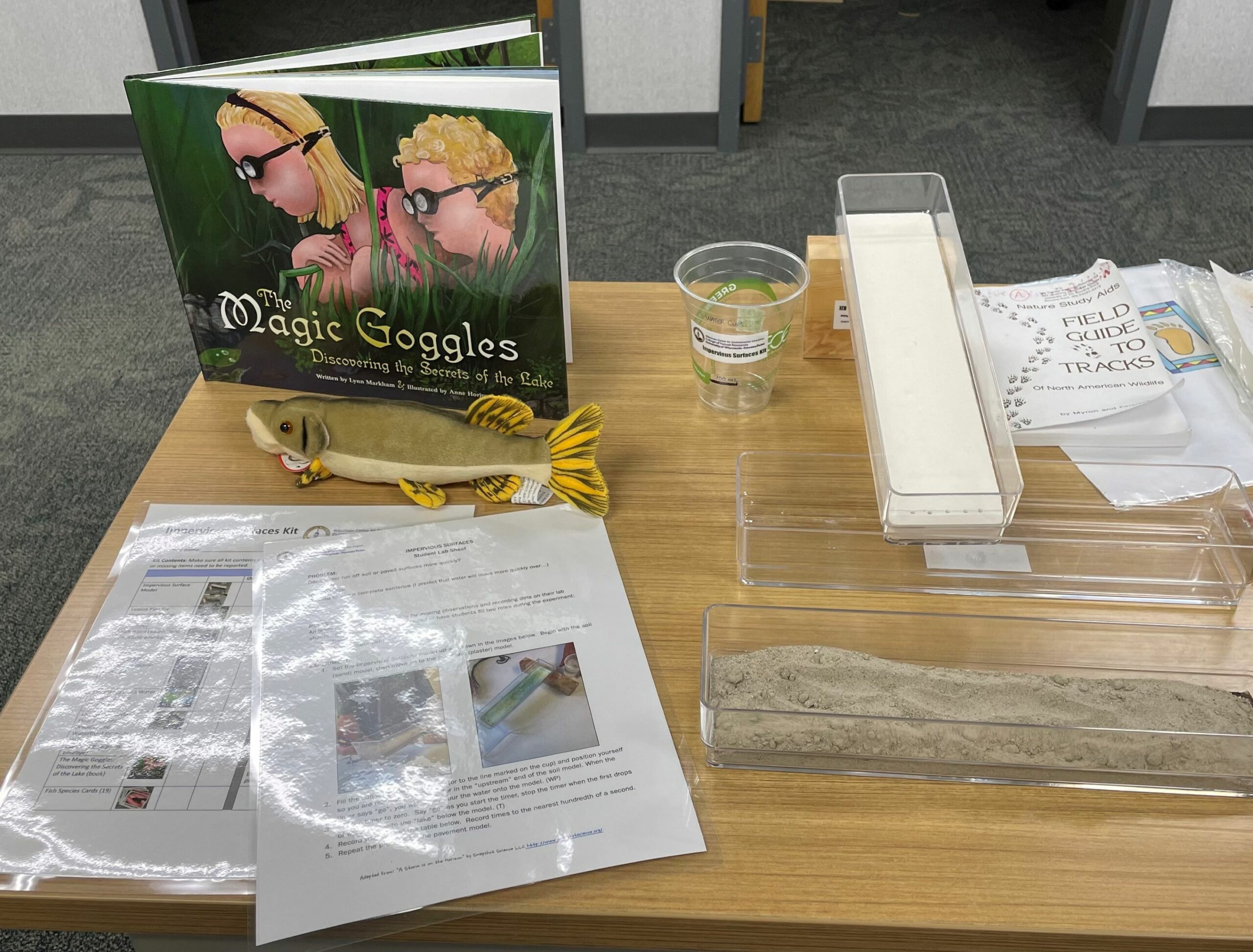
Follow the rain water’s path!
Examine what happens to rain as it travels across pervious and impervious surfaces. This kit contains materials for a surface demonstration along with resources and posters that can be used to help students understand run-off and the impact it has on our lakes, rivers, and streams and the fish that live there.
What’s in the box?
- Impervious Surface Model
- Fish Hotels Poster
- Lesson Plan for Impervious Surface Model
- Second Life for Trees in Lakes Poster
- Fish Hotel Lesson Plans
- Game Fish of Wisconsin Poster
- Follow the Drop Lessons
- Little Fishes of Wisconsin Laminated Poster
- Laminated USGS Water Cycle
- Impervious Surfaces Laminated Poster
- Impervious Surfaces: How They Impact Fish, Wildlife, and Waterfront Property Values
- Northern Pike Plush Toy
- The Magic Goggles: Discovering the Secrets of the Lake Book
- Protecting Your Waterfront Pamphlet
- Fish Species Cards (19)
Enhance your kit experience
Curriculum and Resources (Understanding Community Systems Impervious Surfaces and Flood Control Lesson)
Microclimates of Wisconsin Kit
Examine the microclimate!
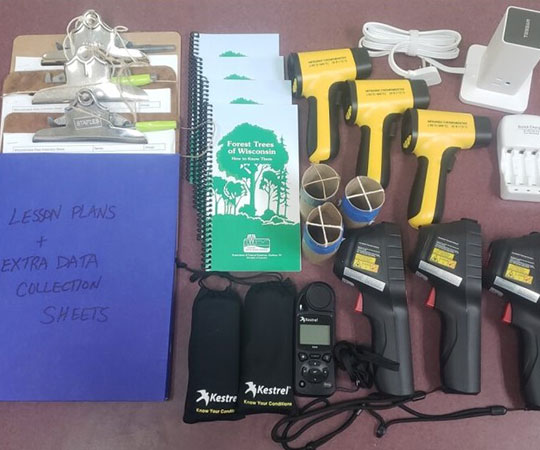
Designed for 4th-12th grade youth, this kit explores the concept of microclimate using the tools of forestry and meteorology to answer the Essential Question, “How does microclimate influence what living things are found in different habitats?” Youth will record microclimate data, search for animal signs, and identify plants to contrast two different habitats, and then predict how changes in microclimate might impact where populations of living things are found.
This kit was generously provided by Upham Woods Outdoor Learning Center with support from the Rural Partnerships Institute at the University of Wisconsin-Madison.
What’s in the box?
- Kestrel Weather Meters (6)
- IR thermometers (6)
- Thermal cameras (6)
- Clipboards (7)
- Forest Trees of Wisconsin (7)
- Densiometers (10)
- Beings on the Move cards and spinner
- Lesson Folder
- Golf pencils
- USB charging station
- Thermal camera charging cords (6)
- Rechargeable battery port
- Rechargeable batteries
Enhance your kit experience
Sand County Almanac Kit
Be inspired by Aldo Leopold!
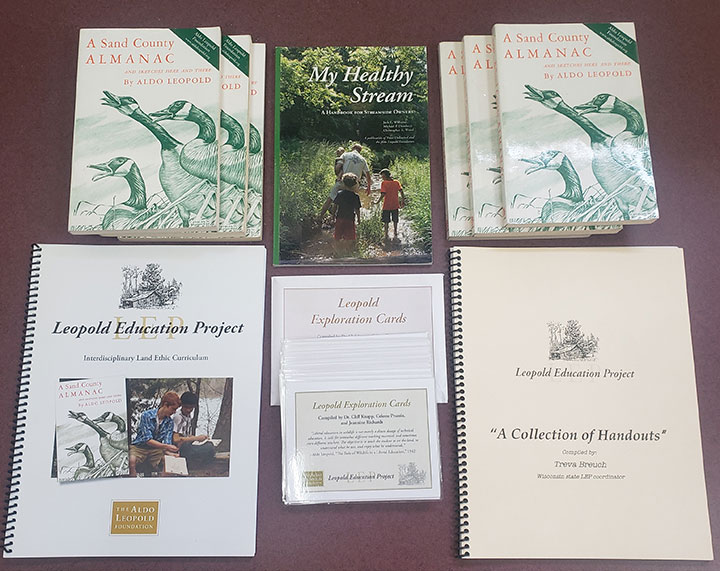
The Sand County Almanac Kit is based around Aldo Leopold’s influential writings and provides resources and opportunities for students to engage with their environment, building an understanding of their connection to the natural world. This kit can teach students of all ages about their environment and the interconnectivity of everything within the natural world. This kit contains 25 copies of A Sand County Almanac, as well as Activity books and Exploration Cards that create a chance to explore the text and connect it with interactive outdoor experiences.
What’s in the box?
- 25 copies of A Sand County Almanac by Aldo Leopold
- 31 Leopold Exploration Cards
- Leopold Education Project “A Collection of Handouts”
- Interdisciplinary Land Ethic Curriculum
- 2 copies of My Healthy Stream by Williams, Dombeck, and Wood
Waste Investigations Kit
Positively influence the future!
The Green & Healthy Schools Waste Investigations Kit provides resources for educators and students to conduct a waste analysis in their school. Schools generate significant amounts of waste, from paper and computers to food and books. By learning about alternatives such as recycling and composting, schools have an opportunity to save on costs and positively influence the future of the school and district, while protecting the environment. Classrooms and schools are encouraged to use this kit to support earning a Waste Badge from Green and Healthy Schools Wisconsin.
What’s in the box?
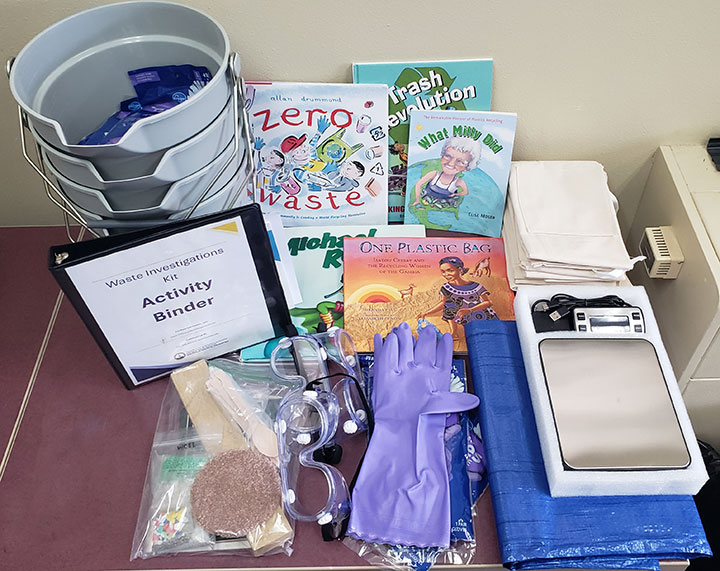
- Aprons (6)
- Safety goggles (6)
- Rubber Gloves (6 pairs)
- Scale and charger
- Buckets (4)
- Tarp
- Sample recycled plastic products
- Sample plastic alternatives products
- Sample waste reduction signage
- What Milly Did
- Zero Waste: How One Community is Leading a World Recycling Revolution
- Michael Recycle
- Trash Revolution: Breaking the Waste Cycle
- One Plastic Bag: Isatou Ceesay and the Recycling Women of the Gambia
Enhance your kit experience
Water Investigations Kit
Protect the water supply!
The Green & Healthy Schools Water Investigations Kit provides resources for educators and students to conduct a water investigation in their school. Safeguarding water quality protects both human health and the environment. Conserving water saves money on utility bills. Many practices that protect water can be implemented for little or no cost and offer real-world knowledge to students about their part in the water cycle. This kit includes tools to measure the temperature and water flow rates from faucets, consider how rainfall affects the need for outdoor water, and discuss the effects of over-salting roads and sidewalks on water salinity. Classrooms and schools are encouraged to use this kit to support earning a Water Badge from Green and Healthy Schools Wisconsin.
What’s in the box?
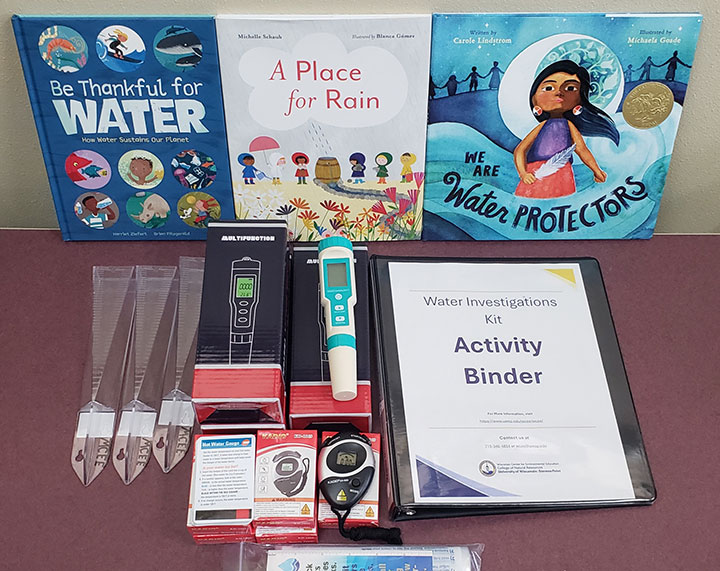
- Water flow measuring bags (20)
- Rain gauges (3)
- Hot water gauge cards (10)
- Stopwatches (5)
- Water salinity testers (3)
- Sample water flow regulators for shower/sinks (3)
- A Place for Rain
- We Are Water Protectors
- Be Thankful for Water
Enhance your kit experience
Wildlife Furs Kit 1
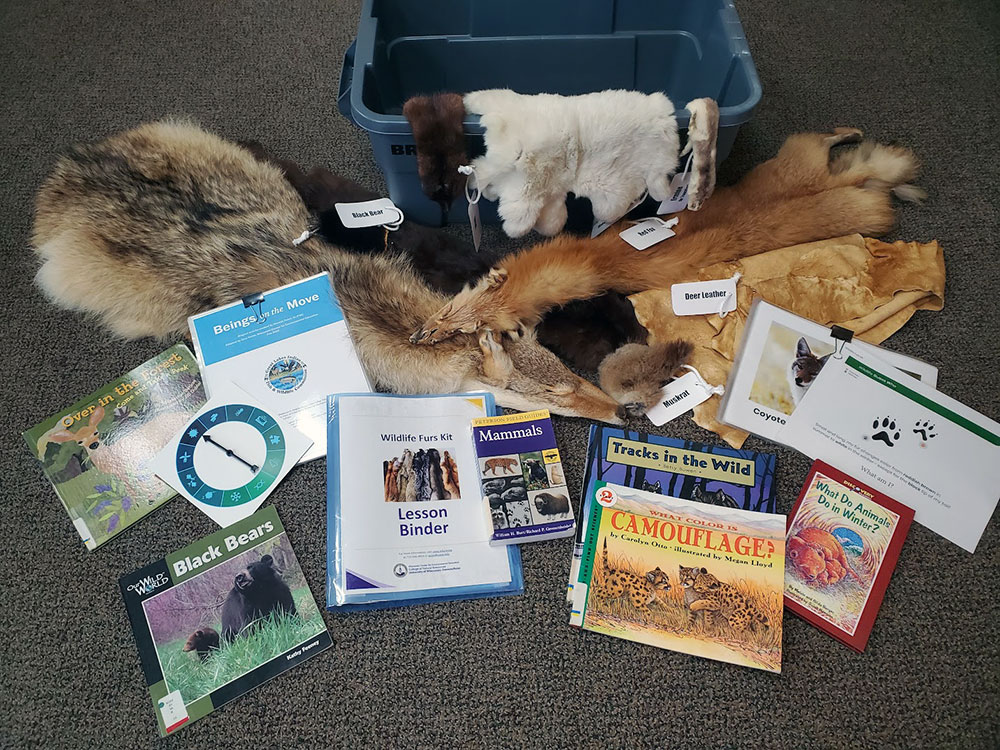
Engage students with a tactile experience!
Investigate the furbearers of Wisconsin with real fur from eight different species (red fox, mink, snowshoe hare, black bear, pine marten, ermine, muskrat, and coyote), along with tanned deer leather. Picture books and a field guide can supplement LEAF lessons about wildlife in forests. Beings on the Move, a KEEP activity, also considers how climate change impacts may affect these culturally-important species.
Furs are from the Outdoor Heritage Education Center.
What’s in the box?
- Lesson Binder
- Furs
- Red fox fur
- Mink fur
- Deer leather (2)
- Snowshoe hare fur
- Black bear fur (2)
- Pine marten fur
- Ermine fur
- Muskrat fur
- Coyote fur
- Books
- What Do Animals Do in Winter?
- What Color is Camouflage?
- Black Bears
- Tracks in the Wild
- Over in the Forest
- Mammals Field Guide
- Beings on the Move game and spinner
- Wildlife Guess Who cards
- Animals Need Forests Too | A LEAF Forestry Lesson for grades K-1 in PDF | Students explore what the forest provides for its animal residents. Cooperatively, students create a forest ecosystem with their classmates, and enter the forest as animals in search of food, water, shelter, and space.
- Biodiversity and the Forest Connection | A LEAF Forestry Lesson for grades 7-8 in PDF | Students develop a definition for biodiversity. They analyze pictures of three ecosystems (forest, prairie, wetland) to determine their unique qualities and interconnections and then represent this on a Venn diagram. Finally, they use a jigsaw puzzle as a metaphor to illustrate why biodiversity is important and discuss Wisconsin’s role in world biodiversity.
- Ecosystem Extravaganza | A LEAF Forestry Lesson for grades 5-6 in PDF | Students learn about ecosystem functions and the types of organisms found in ecosystems. Students complete a diagram of photosynthesis and use calculations to follow the flow of energy through producers and consumers. Students read to learn about the water cycle and carbon cycle and create their own diagrams of the processes.
- Forest Energy Flow | A LEAF Forestry Lesson for grades 2-3 in PDF | Students are introduced to the idea that trees create their own food energy. By acting out the flow of energy, students learn how producers and consumers interact. As a conclusion, students draw their own comic strip about the adventures of Zippy the Energy who lives in a forest
- Forest Habitat Scavenger Hunt | A LEAF Forestry Lesson for grades 2-3 in PDF | Students go on a scavenger hunt and play a game to learn about habitat needs of organisms in a forest.
- Observing Forest Interactions | A LEAF Forestry Lesson for grades 2-3 in PDF | The class explores the living and nonliving parts of a forest while on a hike. Students spend individual quiet time observing and drawing parts of a forest. The lesson concludes with opportunities for students to act out and share what they observed.
- Searching for Basic Needs | A LEAF Forestry Lesson for grades K-1 in PDF | Students explore what an imaginary animal needs to survive and decide if it could live on their playground. Then, students look at the needs of real animals that may live in their schoolyard.
- Sensing the Forest | A LEAF Forestry Lesson for grades K-1 in PDF | Students learn about living and nonliving parts of the forest through a series of sensory activities. The lesson concludes with each student using his or her senses of touch, smell, and hearing to investigate a tree while blindfolded.
- Studying Forest Layers | A LEAF Forestry Lesson for grades 5-6 in PDF | Students observe the structural layers of a forest and draw a color-coded picture. They also embark on two exploration activities to discover which animals can be found in each of the forest layers.
- What Makes a Forest | A LEAF Forestry Lesson for grades 2-3 in PDF | Students match plant species with forest ecosystems and learn that living things are influenced by the nonliving things around them. They create a song or skit to show what they have learned about living and nonliving connections. The students conclude the lesson by creating a mural of different types of Wisconsin forests.
- What Makes a Forest? | A LEAF Forestry Lesson for grades 5-6 in PDF | Students learn about earth systems and what makes a forest ecosystem. Students choose animals and plants they think can be part of a forest ecosystem. They also learn about forest layers by acting out and discussing each layer.
- What’s in a Forest? | A LEAF Forestry Lesson for grades K-1 in PDF | Students learn that forests have living and nonliving parts by going on a walkabout and playing a game of Forest Memory. An art project and discussion help students make connections between different parts of the forest. Throughout the lesson, students are immersed in the idea that they, too, are part of the forest!
Wildlife Furs Kit 2
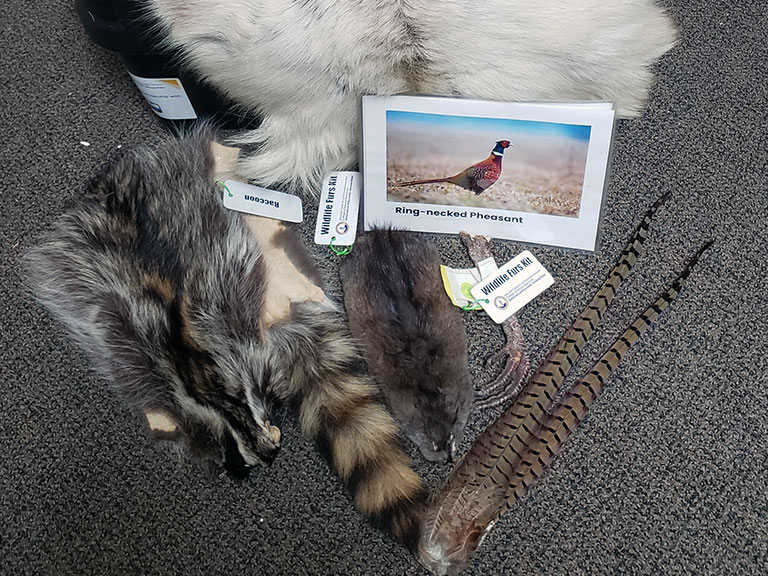
More furbrearers to investigate!
Investigate the furbearers and birds of Wisconsin with real fur, hide, and feathers from six different species — elk, raccoon, pheasant, turkey, beaver, and muskrat. Beings on the Move, a KEEP activity, also considers how climate change impacts may affect these culturally-important species.
What’s in the box?
Lesson Resources
- Lesson Binder
- Beings on the Move game and spinner
- Wildlife Guess Who cards
Furs
- Raccoon Fur
- Pheasant Tail Feathers
- Turkey Food with Spur
- Turkey Tail
- Muskrat Fur
- Elk Hide
- Beaver pelt in hoop (only available for borrowers checking the kit out in person)
Please see Wildlife Furs Kit 1 for a list of suggested lesson materials.
Wildlife Tracks Kit
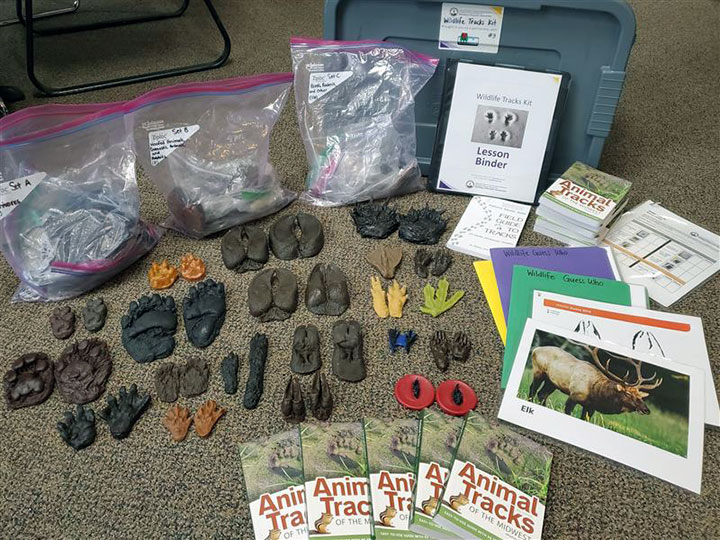
Track down new information!
These North American wildlife tracks can be used to supplement your lessons on ecosystems, develop creative art projects, or enhance animal information sheets in your classroom or nature center. Each track is life size and anatomically accurate, and is made from durable resin.
Each of the three kits (Kit 1, Kit 2, and Kit 3) is identical, and each includes all three sets of tracks (Set A, Set B, and Set C).
What’s in the box?
- Lesson Binder
- Field Guide to Tracks Book (1)
- Animal Tracks of the Midwest Book (10)
- Wildlife Guess Who Cards (43)
- Wildlife Tracks:
- Set A – Carnivores
- A.1: Red Fox – 2 pieces
- A.2: Coyote – 2 pieces
- A.3: Timber Wolf – 2 pieces
- A.4: Wolverine – 2 pieces
- A.5: Black Bear (yearling and adult) – 3 pieces
- A.6: Bobcat – 2 pieces
- A.7: Badger – 2 pieces
- A.8: Fisher – 2 pieces
- A.9: Mink – 2 pieces
- A.10: Weasel – 2 pieces
- A.11: River Otter – 2 pieces
- A.12: Sea Otter – 2 pieces
- A.13: Striped Skunk – 2 pieces
- A.14: Spotted Skunk – 2 pieces
- A.15: Raccoon – 2 pieces
- A.16: Cougar – 2 pieces
- Set B – Hoofed Animals, Domesticated Animals and Rabbits
- B.1: Elk – 2 pieces
- B.2: White-Tailed Deer – 2 pieces
- B.3: Caribou – 2 pieces
- B.4: Bison – 2 pieces
- B.5: Pronghorn Antelope – 2 pieces
- B.6: Domestic Pig – 2 pieces
- B.7: Domestic Sheep – 2 pieces
- B.8: House Cat – 2 pieces
- B.9: Moose yearling – 1 piece
- B.10: Jack Rabbit – 2 pieces
- B.11: Cottontail Rabbit – 2 pieces
- Set C – Birds, Rodents and Other
- C.1: Coot – 1 piece
- C.2: Canada Goose – 1 piece
- C.3: Crow – 1 piece
- C.4: Blue Jay – 1 piece
- C.5: Ring-Necked Pheasant – 1 piece
- C.6: Pocket Gopher – 2 pieces
- C.7: Porcupine – 2 pieces
- C.8: Beaver – 2 pieces
- C.9: Muskrat – 2 pieces
- C.10: Grey Squirrel – 2 pieces
- C.11: Woodchuck – 2 pieces
- C.12: Opossum – 2 pieces
- C.13: Armadillo – 2 pieces
- C.14: Snapping Turtle – 2 pieces
- C.15: Bald Eagle – 1 piece
- C.16: Great Horned Owl – 1 piece
- Set A – Carnivores
KEEP Energy Education Kits
AgriSolar Kit
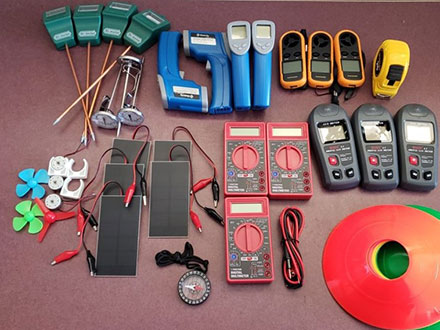
Connect agriculture with sustainable energy!
Solar panels and farming don’t have to be mutually exclusive. The purpose of KEEP’s AgriSolar Kit and lessons (coming soon) are to help students explore how land can be used for both agriculture and solar energy production. With miniature solar panels, students can investigate the impact of panel angle on solar production and create test circuits to run fans and buzzing bees. After examining the potential benefits of establishing agrivoltaic farms in their communities and creating a scale drawing of an AgriSolar farm, students can then use the tools in the kit to investigate how solar panels can influence the temperature, moisture levels, and other characteristics of the land under and near them.
(Ground-mounted solar panels not included.)
What’s in the box?
- Disc cones (25)
- Anemometers (12)
- Soil Moisture Meters (12)
- Solar Panel Stands (12)
- Light Meters (12)
- IR Thermometers (12)
- Motors, fans, felt bees (12 each)
- Soil Thermometers (12)
- Digital Multimeters (12)
- Solar Panels (12)
- Compass
- Tape Measure
- Tractor Toy
- Red and Black Ropes
- Solar Relay Cards
- Electricity Sort Strips (12 sets)
- Lesson and Activity Guide
Enhance your kit experience
Blower Door Kit
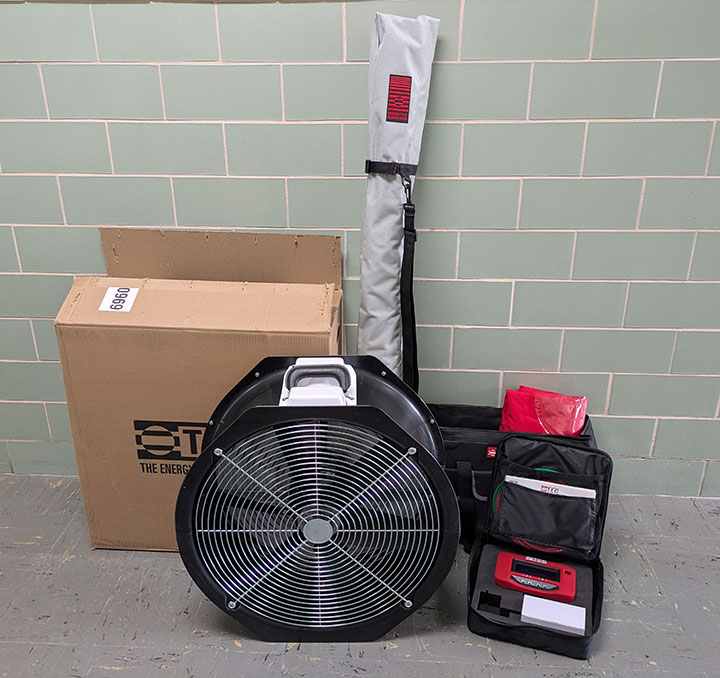
Borrower must be trained in blower door testing!
A component of home energy efficiency testing, a blower door can determine how much air can enter or escape from a home, allowing homebuilders and owners to determine whether additional insulation or air sealing is necessary. This can improve the efficiency of home heating and cooling, saving energy and money.
This kit cannot be shipped and is not housed at the WCEE in Stevens Point. It must be picked up in person from the Habitat for Humanity ReStore in Mauston (N3696 US-12, Mauston, WI 53948).
What’s in the cases?
- Blower Door Accessory Case
- Single Fan Nylon Panel (red)
- Fan Speed Controller
- DG-1000 Digital Pressure and Flow Gauge Kit
- DG-1000 Digital Pressure and Flow Gauge, in red plastic case
- Charger, with alternate plugs
- Parts Bag with Fan Control Cable, Digital Gauge Extension Tube, and Plastic Hose Connectors
- 15’ Green Hose
- 10’ Red Hose
- Carrying Case
- 30’ Clear Tubing
- Gauge Board with Clamp
- Wind Tee
- Overview Booklet
- Model 3 Fan
- Ring A
- Ring B
- No flow plate
- Cardboard carrying box
- Aluminum Frame Carrying Case
- 96” Vertical Pieces (2)
- 45” Horizontal Pieces (2)
- 45” Crossbar with Velcro Strap
- Gauge Hanger Bar
Enhance your kit experience
Discovering Energy in Nature Kit
Investigate energy outdoors!
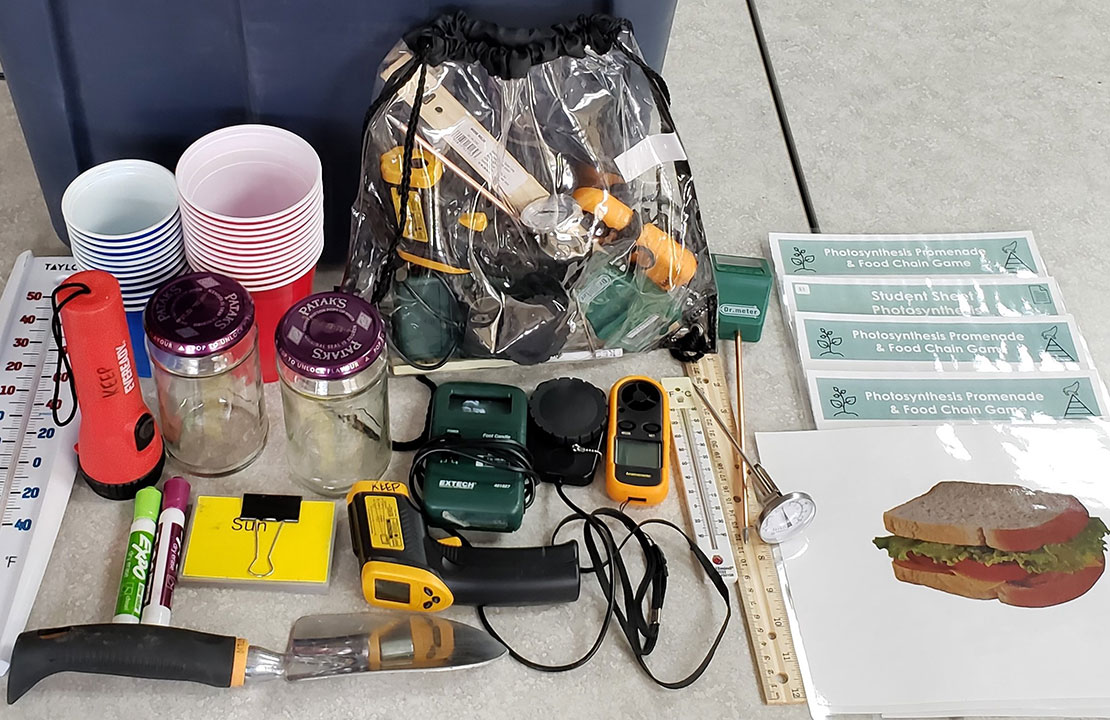
The Discovering Energy in Nature Kit provides the resources necessary for educators to make use of KEEP’s Discovering Energy in Nature (DEN) bundle of lessons. Filled with the materials to run Taking Temperatures, Energy Use in an Ecosystem, Photosynthesis Promenade and Food Chain Game, and Beings on the Move, this is a great way to investigate energy outdoors.
Please note that this kit does not include consumables. You must provide your own popcorn or cotton balls in order to run the Food Chain Game.
What’s in the box?
- 6 trowels
- 6 analog thermometers
- 6 soil thermometers
- Jumbo demonstration thermometer
- 6 pinwheels
- 6 anemometers
- 6 rulers
- Flipchart paper
- Plastic cups in three sizes
- 2 whiteboard markers
- 2 glass jars
- Plastic wrap
- 6 light meters
- 6 infrared thermometers
- Soil moisture meter
- Laminated lesson pages
- Colored name tags
- Flashlight
- Beings on the Move cards and spinner
Enhance your kit experience
Visit the DEN Lessons on our Energy Lessons page for lessons to use with this kit.
Elementary Energy Explorations Kit
Flip the switch on energy literacy!
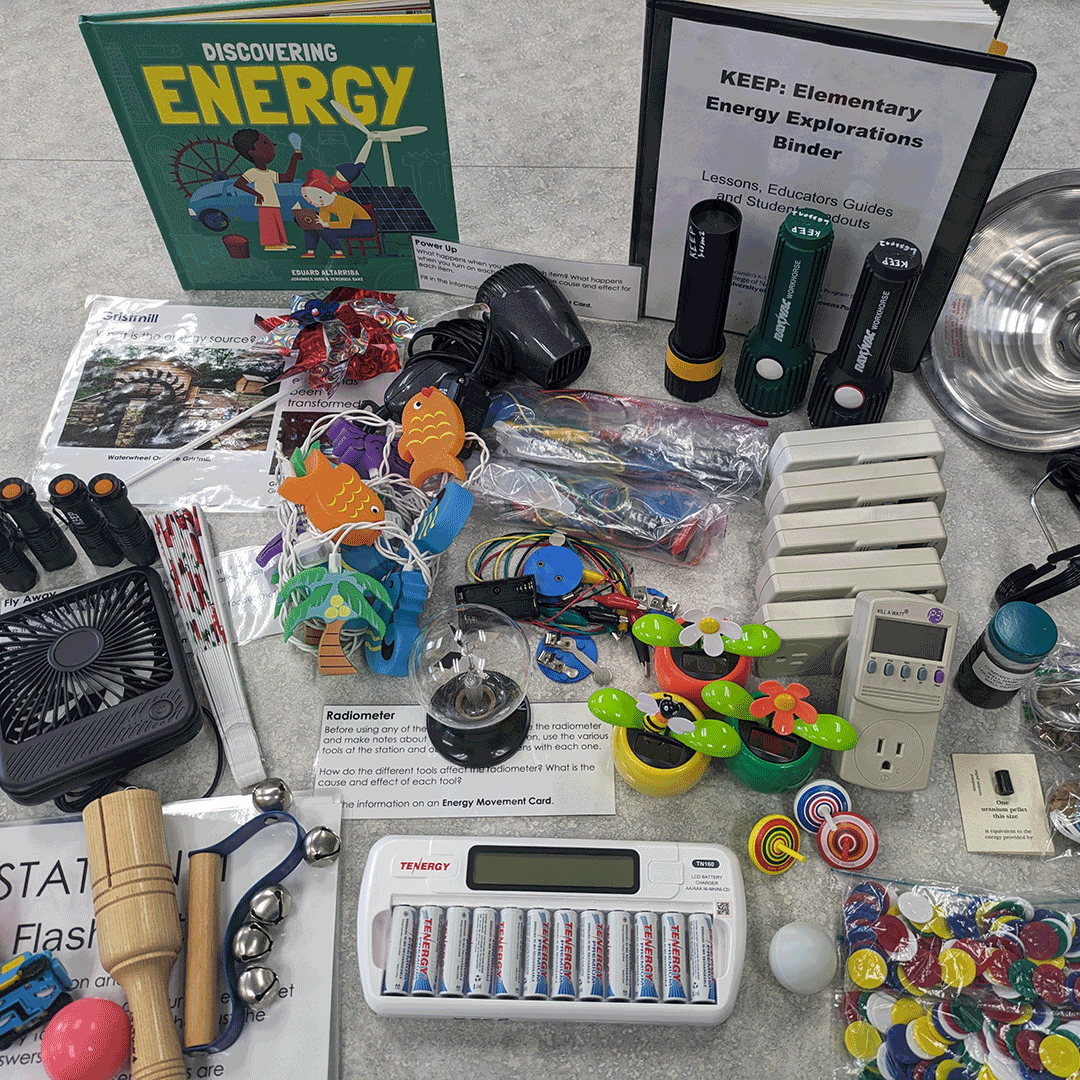
KEEP’s Elementary Energy Explorations is a series of lessons that challenge students to explain the phenomenon of how flipping a light switch leads to filling a room with light. Students explore what energy and electricity are; where electricity comes from; the impact getting our energy has on the environment; how electricity gets to our homes and buildings; and how circuits and switches work.
This kit contains all the non-consumable materials needed to run the nine lessons in the Elementary Energy Explorations series. The lessons are written in 5E format at a 4th grade level, however are appropriate to use with a range of students from 3rd grade up through middle school – especially if this is one of the first times students are participating in energy-related lessons and activities. While it is still possible to use each of the lessons independent of the Elementary Energy Explorations series, KEEP recommends completing them together to help increase the energy literacy of your students. All lessons feature a Google slideshow presentation, educator resource/guide and student sheet.
Educators need to provide their own consumable materials for some of the lessons. Please see the Educator Resource Guide for each lesson to determine what consumables are needed.
What’s in the box?
general kit supplies
- 10 flashlights (with rechargeable batteries; if the batteries die, please use one of the chargers to charge the batteries)
- 2 battery chargers
- 24 AA rechargeable batteries (not including the batteries in the flashlights)
Lesson 1 – Evidence of Energy – contents
- Flashlights (2, one for station 1 and one for station 8)
- Bouncy balls (5)
- Wind-up toys (3)
- (2) Wooden instruments
Bag of various sized rubber bands - Timer (strawberry)
- Sleigh bells (2)
- Solar powered toy
*Note: Handwarmers for station 10 not provided in kit; please use your own or do not use this station.
Lesson 2 – Classroom Energy Flow – contents
- Solar power toys (6)
- Disassembled solar power toy (1)
- 3 Flashlights (different from those in the “General Kit Supplies”)
*Note: Each group will also need 1 flashlight from the “General Kit Supplies.”
Lesson 3 – Waterwheels, Windmills & Turbines – contents
- Pinwheel
- Sample Turbine
- Laminated photographs of waterwheels, windmills, and turbines
- Anemometer
- Fan
*Note: Educators must supply consumable materials for creating turbines (see educator guide/student sheet)
Lesson 4 – Digging for Coal – contents
- 6 bags with the following: (1 coal sample, 2 wood samples, 4 magnifiers)
- How Coal is Formed samples
*Note: Educators must supply consumable materials for the digging for coal activity (see educator guide/student sheet)
Lesson 5 – Renewable Energy Resources -contents
- Energy Resource Examples:
- Non renewables: Coal, “mock” uranium pellet, petroleum (no natural gas/ methane example)
- Renewables: Solar, wind (use anemometer/ pinwheel from lesson 3), no hydro or geothermal
- 6 Bags of Poker Chips that Include:
- 88 multi-colored poker chips (not green) [Challenges 1 & 2; remove 17 for challenges 3 & 4)
- 12 green poker chips [challenges 1 & 2; add 17 more green for challenges 3 &4)
- 6 bags of 17 additional green poker chips [challenges 3 & 4)
*Note: Educators need to provide their own timer.
Lesson 6 – Station Break – contents
- Tops (7); 6 for student groups/ 1 for educator
- Non renewables: Coal, “mock” uranium pellet, petroleum (no natural gas/ methane example)
- Renewables: Solar, wind (use anemometer/ pinwheel from lesson 3), no hydro or geothermal
- Station Break Stations
- Telephone: string and cup telephone and station card
- Fly Away: electric fan, hand-held fan to wave, small pieces of paper, and station card (place this station near an outlet)
- Puddles: station card (educator must provide own materials for this station)
- Power Up: string of lights, hair dryer, and station card
- Radiometer: radiometer, flashlight, hairdryer, hand-held fan to wave, and station card (place this station near an outlet)
- *Note: Educators need to provide their own materials for the Puddles Station.
*Note: Educators need to provide their own timer.
Lesson 7 – Electric Charades – contents
- 6 Watt Meters
Lesson 8 – Diminishing Returns – contents
- Lamp with 60/75/100-watt incandescent light bulb
- Lamp with ~10-watt LED light bulb
- 2 sets of relay materials including:
- (1) 16 oz container with 1 hole covering ~1/3 of the bottom
- (1) 16 oz container with 1 hole in the bottom
- (5) small plastic cups with 1 hole in the bottom
- (1) small plastic cup with no hole in the bottom
*Note: Educators must supply 1 gallon bucket of water for each relay and their own timer/stopwatch
Lesson 9 – Circuit Circus – contents
- (10) 1-gallon bags with the following:
- 2 bulb holders
- 4 alligator clips (1 of each color)
- 2 switches
- 1 battery holder (for 2AA batteries)
- 20 identical bulbs (+2 extra)
- Energy ball
*Note: Each group will also need 2AA batteries from the “general kit supplies.”
- *Note: group will also need 1 flashlight from the “general kit supplies.”
Energy Audit Kit
Energy auditing made easy!
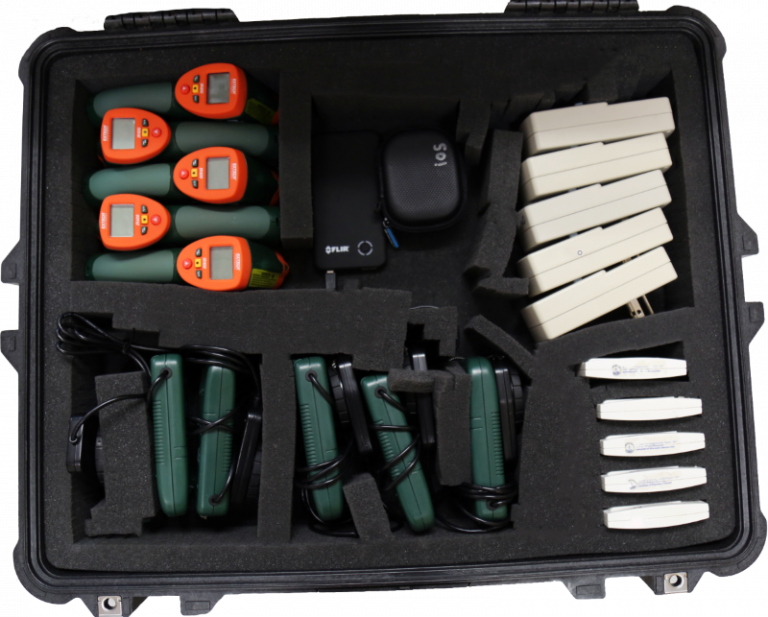
The Energy Audit Kit provides easy-to-use tools to monitor plug load, temperature and light levels in a building. In KEEP’s Building Energy Detectives lessons, students use these tools to investigate energy use in their school and identify actions to reduce energy loss and lower consumption, fostering a more sustainable future. Lessons seamlessly integrate technology into the math and science curriculum, making real-word applications of energy conservation both engaging and educational.
What’s in the box?
- 5 watt meters
- 5 Infrared thermometers
- 5 light meters
- 5 digital indoor thermo-hygrometers
- 1 thermal imaging camera for smartphone or tablet*
- 1 battery charger for thermal imaging camera attachment
- 1 heavy-duty carrying case
- 1 set of related curriculum activities
*Must download the FLIR ONE app for apple or android to turn your phone or tablet into a thermal camera. Check to see if your device is compatible with the FLIR ONE Gen3
Enhance your kit experience
Visit the Building Energy Detectives lesson bundle on our Energy Lessons page for lessons to use with this kit.
Additional resources
- School Energy Investigations – Temperatures
- School Energy Investigations – Lighting
- School Energy Investigations – Appliances
- School Energy Investigations – Mini Energy Audit
- Home Energy Investigations – You will need the Energy Audit Kit – Take Home
- Energy Audit Best Practices
Tool Videos
Reserve this kit from our partners
Reserve the We Energies Energy Audit Kit from REFLO
Host site contact: Lisa Neeb – Reflo • 414-949-7356 • lisa.neeb@refloh2o.com
Reserve the WPS Energy Audit Kit from Brown County Extension & Einstein Project. (Located at Brown County STEM Innovation Center)
Host site contacts: Melinda Pollen – UW-Extension Brown County • melinda.pollen@wisc.edu OR Kim Lemberger – Director of Learning at the Einstein Project • kim@einsteinproject.org
CESA 3 educators may reserve an Energy Audit Kit from CESA 3
Host site contacts: Tom Martin – Youth Apprenticeship Coordinator • 608-822-2154 • tmartin@cesa3.org OR Darla Burton – RCP coordinator • 608-822-2147 | dburton@cesa3.org
CESA 10 educators may reserve an Energy Audit Kit from CESA 10
Host site contacts: Kristin Rosenberg – Instructional Media Center Consultant • 715-720-2067 • krosenberg@cesa10.org OR Jesse Schwingle – Educational Consultant – Instructional Technology Coach • 715-720-2133 • jschwingle@cesa10.org
Energy Audit Kit – Take Home
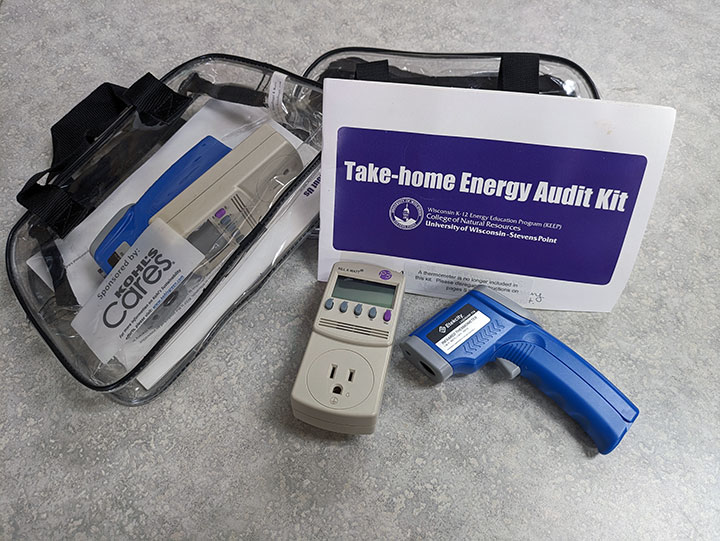
Explore energy uses in the home!
Have students go beyond the classroom to explore the energy they use daily. This kit includes the tools and information needed to explore various energy uses in the home, including how many appliances pull phantom loads in your home.
What’s in the box?
- 30 student take-home vinyl bags, each with:
- A watt meter
- An infrared thermometer
- An investigation booklet
- Activity folders
Enhance your kit experience
Energy Detectives – The Mystery of Snow
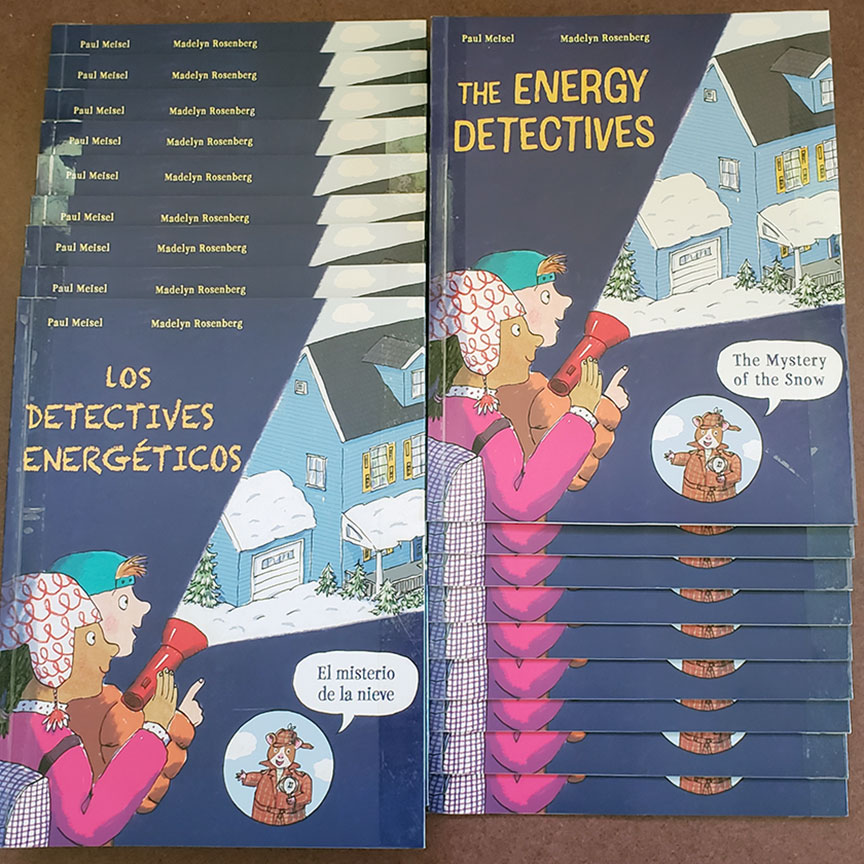
Sleuth out energy efficiency!
Engage students with the importance of energy conservation through this book in the Energy Detectives series. In The Mystery of the Snow, Annabeth and Charlie become energy detectives to discover where energy is wasted in a home. The book is available in a class set of both English and Spanish books.
Energy Detectives is a project of Cooler Communities, funded by the Harold Grinspoon Charitable Foundation, which donated all the copies of the book included in these kits. For more information, to view the full curriculum developed for the books, and to order free copies of the books for your classroom, please visit energydetectives.org.
What’s in the box?
- 25 copies of The Energy Detectives: The Mystery of the Snow
- 25 copies of Los Detectives Energéticos: El misterio de la nieve (Spanish version)
- Lesson binder
Energy Detectives – Secrets of the Sun
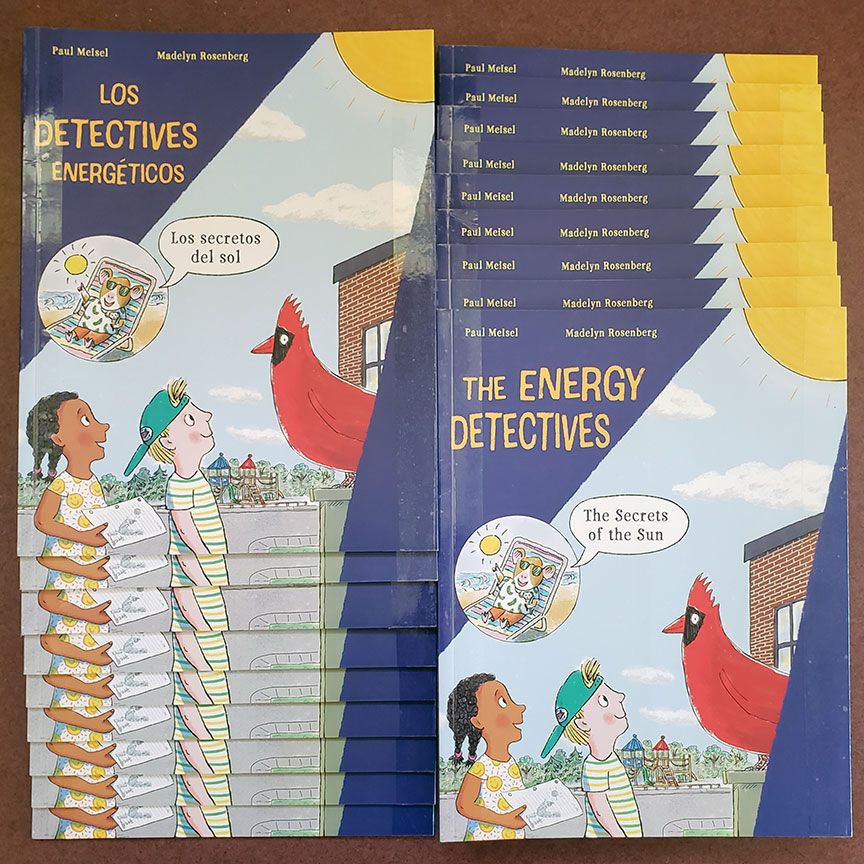
Sleuth out energy efficiency!
Engage students with the importance of energy conservation through this book in the Energy Detectives series. In The Secrets of the Sun, Annabeth and Charlie explore passive and active forms of solar energy. This book is available in a class set of both English and Spanish books.
Energy Detectives is a project of Cooler Communities, funded by the Harold Grinspoon Charitable Foundation, which donated all the copies of the book included in these kits. For more information, to view the full curriculum developed for the books, and to order free copies of the books for your classroom, please visit energydetectives.org.
What’s in the box?
- 25 copies of The Energy Detectives: The Secrets of the Sun
- 25 copies of Los Detectives Energéticos: Los secretos del sol (Spanish version)
- Lesson binder
Green Energy Snap Circuits Kit
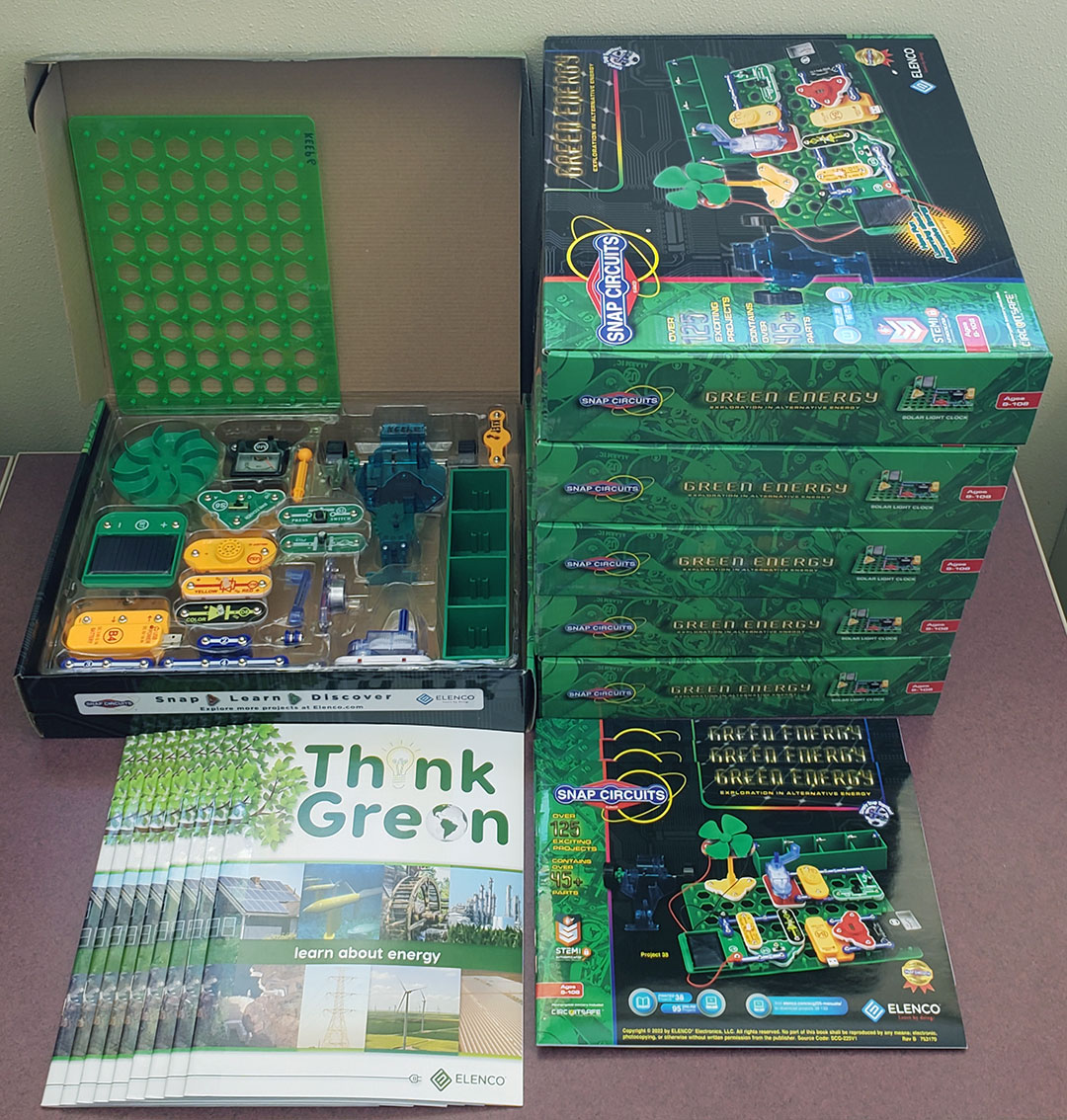
Spark interest in circuits!
The Green Energy Snap Circuits Kit contains six Elenco Snap Circuits® Green Energy sets. The sets contain materials to learn about circuit-building and clean energy, including a solar panel, wind turbine, water turbine, rechargeable battery, and electric car base. Each set also has a manual with information about using the different parts and dozens of sample projects. The kit also contains a class set of the associated Think Green educational manual to learn about different types of clean energy.
Materials were donated by Carol and Andy Phelps.
What’s in the box?
- 6 sets of Elenco Snap Circuits® Green Energy
- 30 copies of Think Green: Learn about Energy
- 1 manual of additional resources
Enhance your kit experience
Hand-Crank Generator
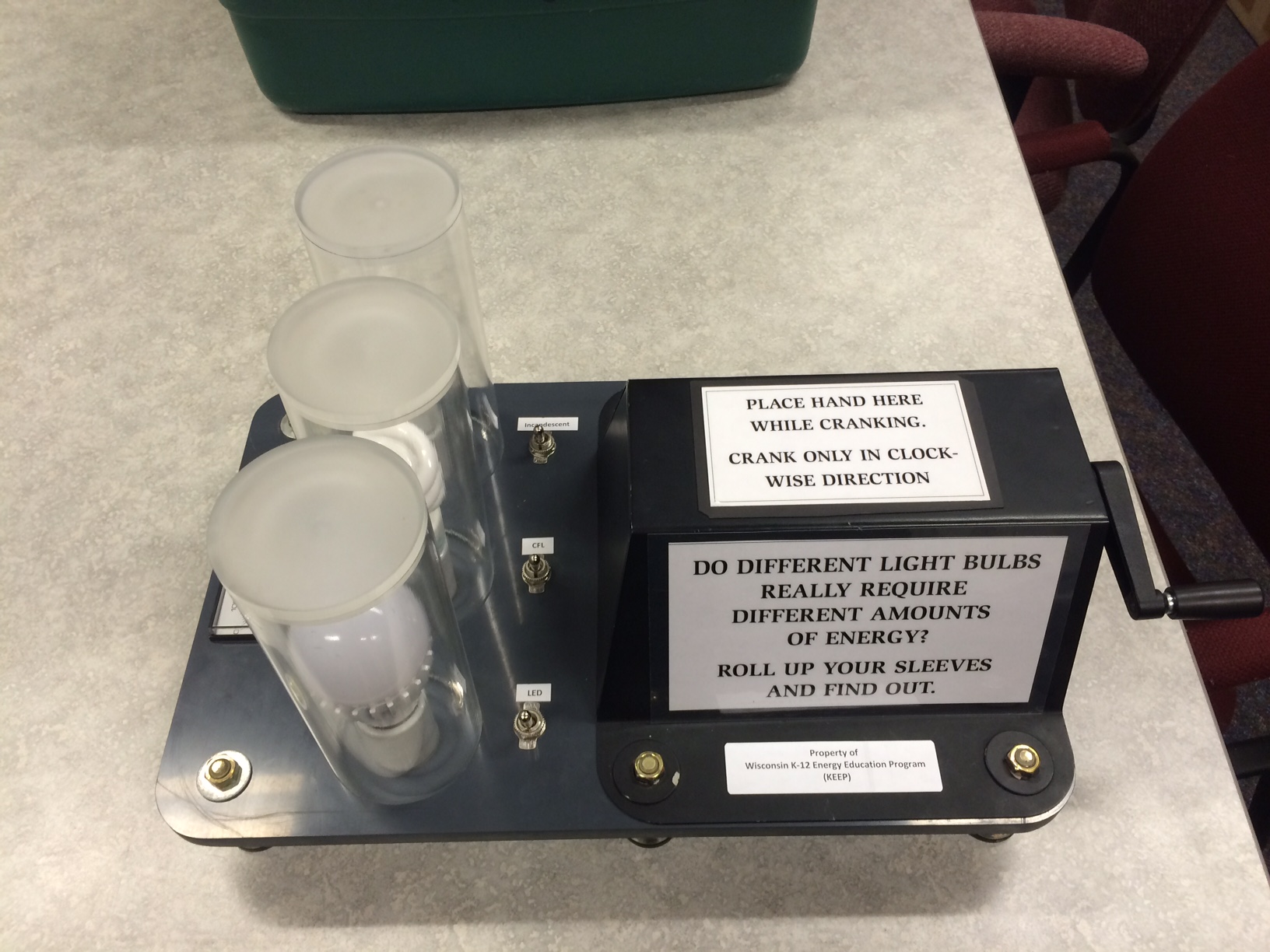
Transform muscle power into electrical energy!
The Hand-Crank Generator is a great tool for learning the difference between an incandescent light bulb and a light-emitting diode (LED). Use your cranking power to discover how much energy it takes to light up two different light bulbs. As you crank, a generator transforms your muscle power into electrical energy.
What’s in the box?
- Hand Crank
- LED Light Bulb (2)
- Incandescent Light Bulb (2)
- Plastic Protective Cylinder (2)
- CFLs and Mercury – What you need to know Flyer
Pedal Power
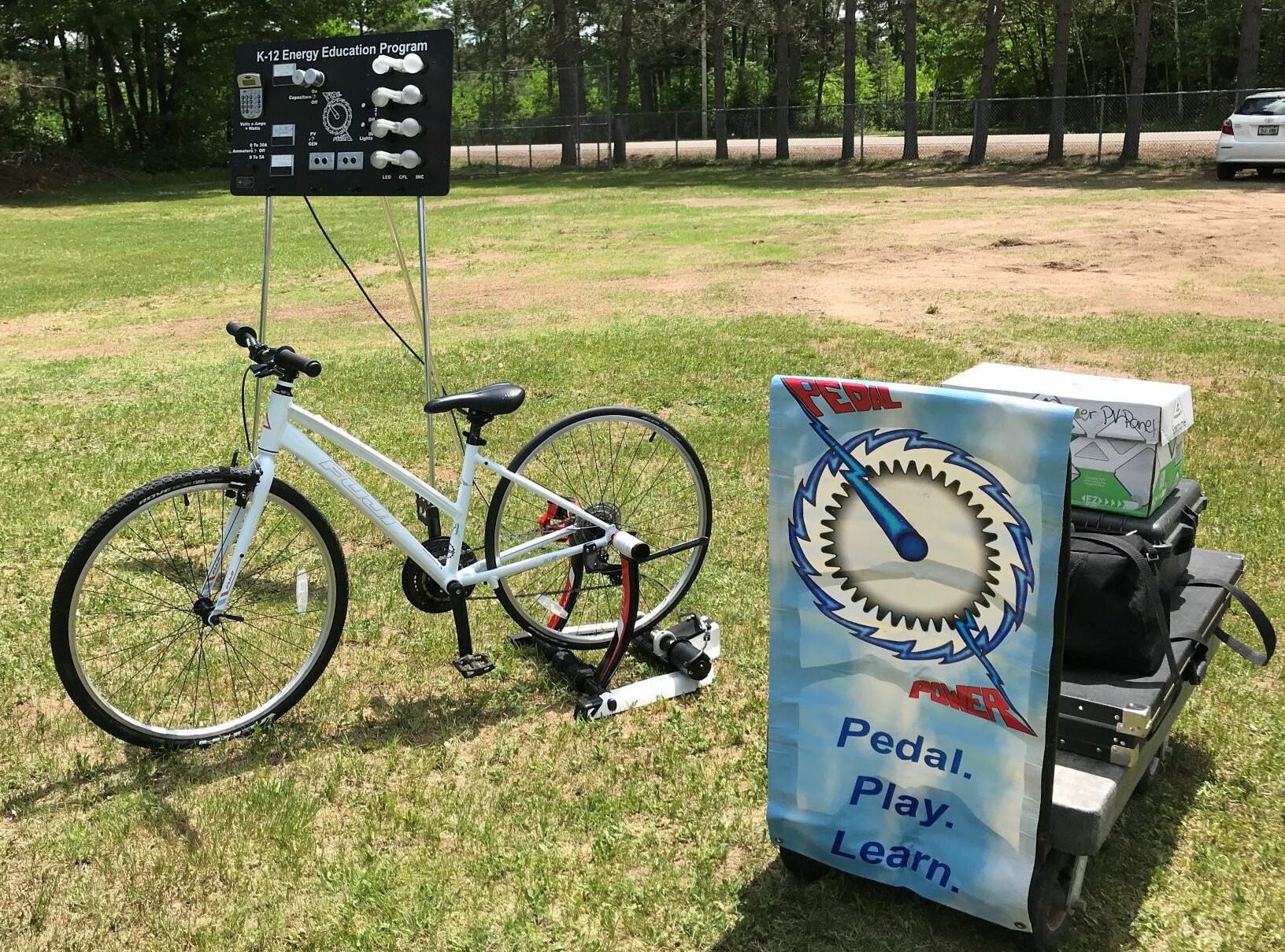
Pedal. Play. Learn.
The Pedal Power® is a tool that you can use in your classroom to teach about energy production, use, and conservation. Students can actually ride a stationary bike to power a generator, which in turn powers an incandescent light bulb, a compact fluorescent light bulb (CFL), a LED light bulb, a hair dryer, a radio, and a fan. A photovoltaic (PV) panel is available for use to power the equipment above as well.
What’s in the box?
- Bicycle Stand with Generator & Bike (minimum 24″ wheel)
- Pedal Power Display Board & Power Cord
- Telescoping Outer Display Legs (2) & Inner Display Legs
- Light Bulbs (Incandescent, Fluorescent, and LED – 5 each)
- Spare 25 AMP Fuses (2)
- Electric Fan & Electric Hair Dryer
- Radio and Power Adapter
- Owner’s Manual
Reserve this kit from our partners
Crandon
Forest County Potawatomi. For educators in the Crandon, Laona, and Wabeno districts. Contact Tyler Lorenz at Tyler.Lorenz@fcp-nsn.gov or 715-478-4507 for more information. To reserve, please fill out this reservation form.
Fennimore
Pedal Power is available to schools who subscribe to the CESA #3 Media Center/van service.
Click here to reserve.
Host site contact:
Tom Martin
tmartin@cesa3.org or 608.822.2154.
Madison
Madison Gas & Electric (MGE) has a Pedal Power available to their customers. Please contact Mario Garcia at jgarciasierra@mge.com or call 608.252.4742.
Milwaukee
Keep Greater Milwaukee Beautiful, 1313 W Mt. Vernon Ave., Milwaukee, WI 53233. Contact Betsy Bolte for more information, at 414.272.5462. To reserve, please fill out this reservation form.
Solar Careers Kit
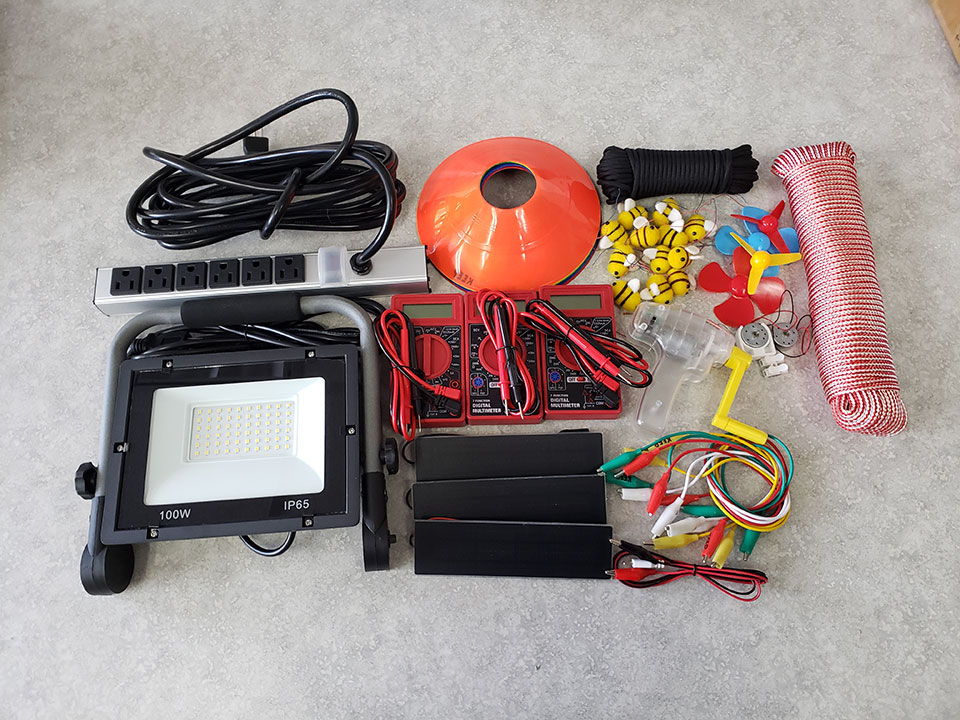
For energy professionals to use in community engagement!
This energy career exploration kit is designed for energy professionals to use in community engagement and outreach. The Solar Relay activity gets students moving as they act out the role of electrons in a solar panel. Students can then try out the skills of a solar installer by experimenting with how adjusting the angle and direction of a solar panel will affect its output, followed by creating simple circuits with small loads. The activity also includes advice and suggestions for industry professionals who may have limited experience working with students.
Note: Waived shipping is not offered for this kit. Borrowers who are unable to pick up and return the kit in person in Stevens Point are asked to pay $70 to cover the cost of shipping this kit.
What’s in the box?
- Disc cones (25)
- Solar panels (12)
- Digital Multimeters (12)
- Alligator clips (24)
- Buzzing bees (15)
- Fans (motors, blades, and stands) (18)
- Small lights (15)
- Power strip
- Hand Crank Generators (4)
- Black rope
- Red rope
- Work lights (2)
- Spare batteries and screwdriver
Enhance your kit experience
Solar Load Kit
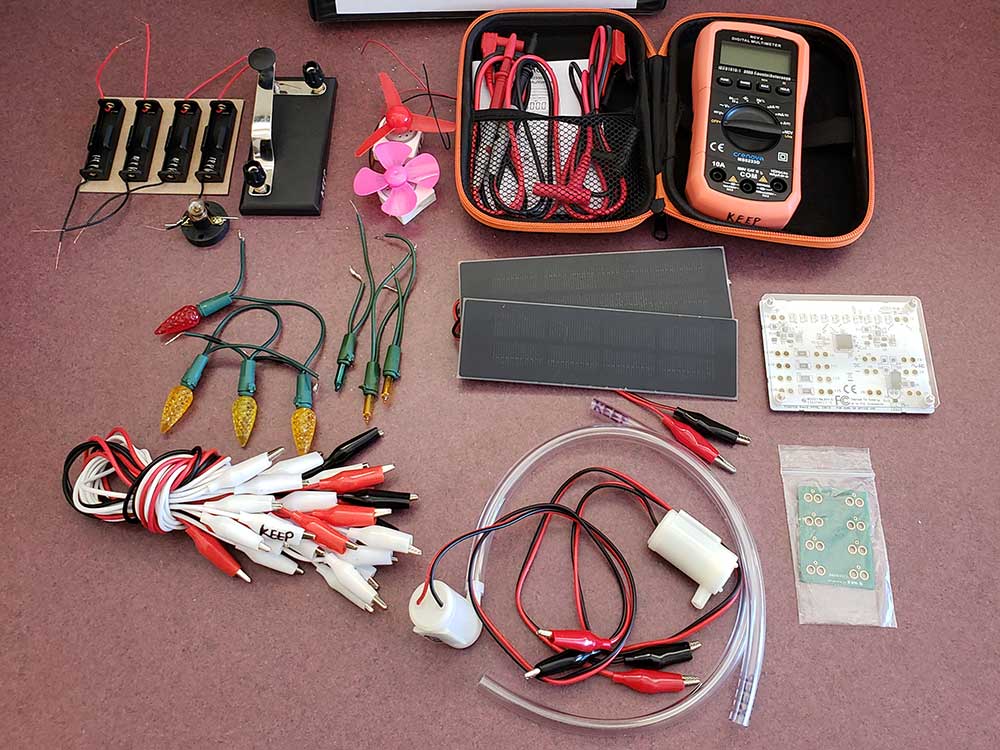
An enlightening experience!
Solar photovoltaic panels can be used to collect sunlight and turn it into clean, renewable electricity. The Solar Load Kit includes a variety of loads (appliances) that can be run off of the included solar panels and batteries. Students can experiment making simple circuits that use solar panels to run fans, lights, and water pumps.
Students can further explore current flow creating circuits in parallel and series. Explore the similarities between solar panels and batteries by using the included lessons to create circuits using either, then hook them up to multimeters and loads to test their power production.
This kit is compatible with Solar Tilt Kit 2, which expands the opportunities for experimentation with an additional dozen solar panels and multimeters.
What’s in the box?
- 18 Solar Panels
- Assorted LED and Incandescent Light Bulbs
- 12 Water Pumps and Tubes
- 12 Motors with Stands and Fan/Propeller Blades
- 6 Multimeters
- 6 LED Light Boards
- Power Output Board
- 96 Alligator Clips
- 15 Battery Holders
- 6 Switches
- 6 Battery Chargers and 72 Batteries
- 6 Mini Lightbulbs and spare bulbs and holders
- Lesson Binder
Enhance your kit experience
Solar Tilt Kit
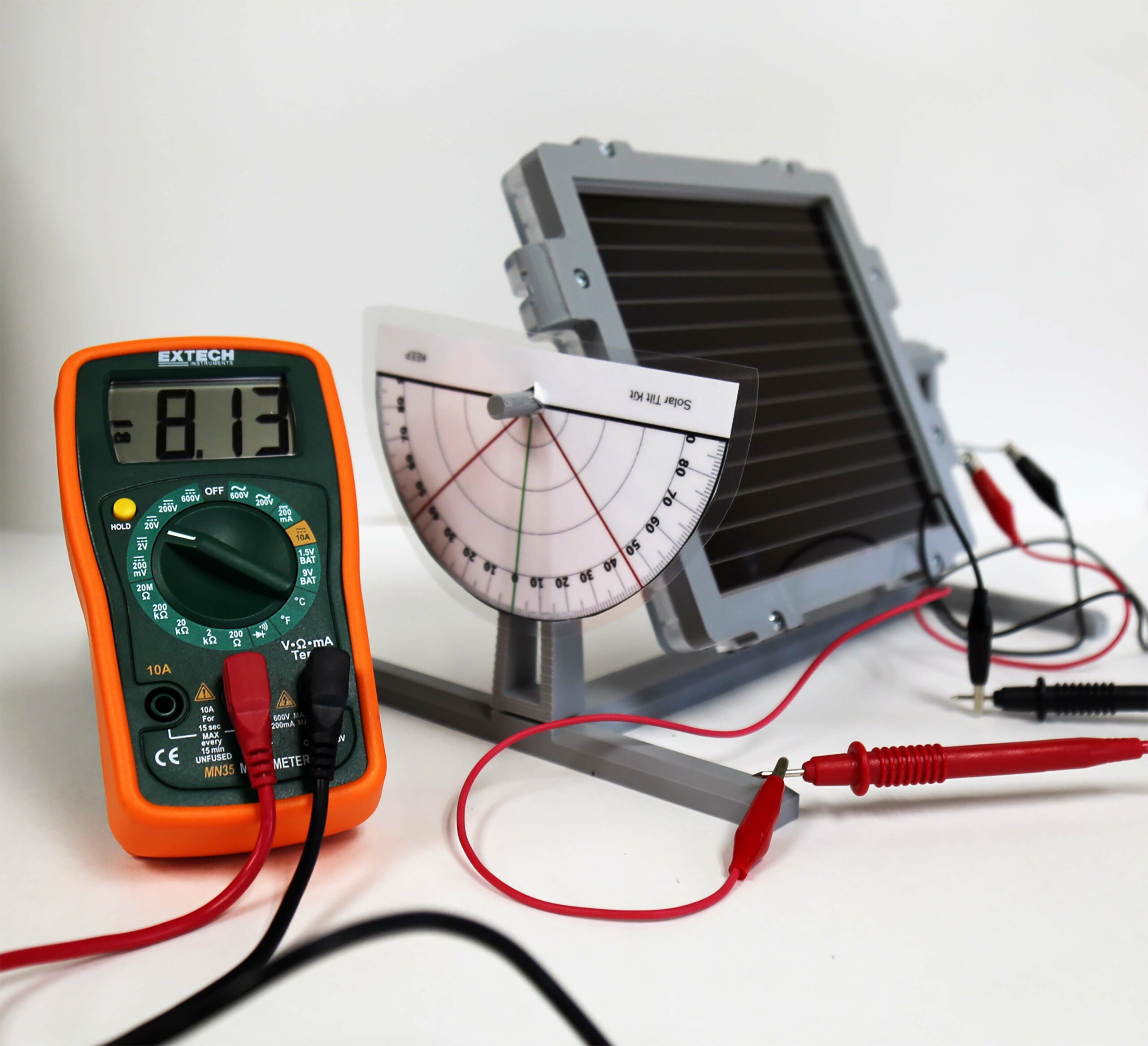
Solar power from a new angle!
Solar photovoltaic panels can be used to collect sunlight and turn it into clean, renewable electricity. The Solar Tilt Kit includes materials that will allow students to take on the role of a Solar Installer or Solar Design Engineer as they explore how solar panels can be used to generate electricity and how a variety of factors like the angle of the sun, the angle of the solar panel, cloud cover, etc. can impact the amount of electricity generated.
What’s in the box?
- 12 Solar Panels with stands
- 12 Multimeters
- 1 LED Flood/Work Light
- 12 sets of Wire Leads with Alligator Clips
- 12 Protractors
- 12 Compasses
- 6 Hand Crank Generators
- 1 Solar Power Meter/Pyranometer
- Assorted Light Bulbs (Incandescent and LED)
- Running on Sunshine
- The Inevitable Solar School
- Beings on the Move activity cards with spinner
- Cones
- OPTIONAL ITEM: Solar Pathfinder with Tripod
Solar Panel Tilt Stand design by Jacob Smith.
Protractor file pdf.
Wind Kit
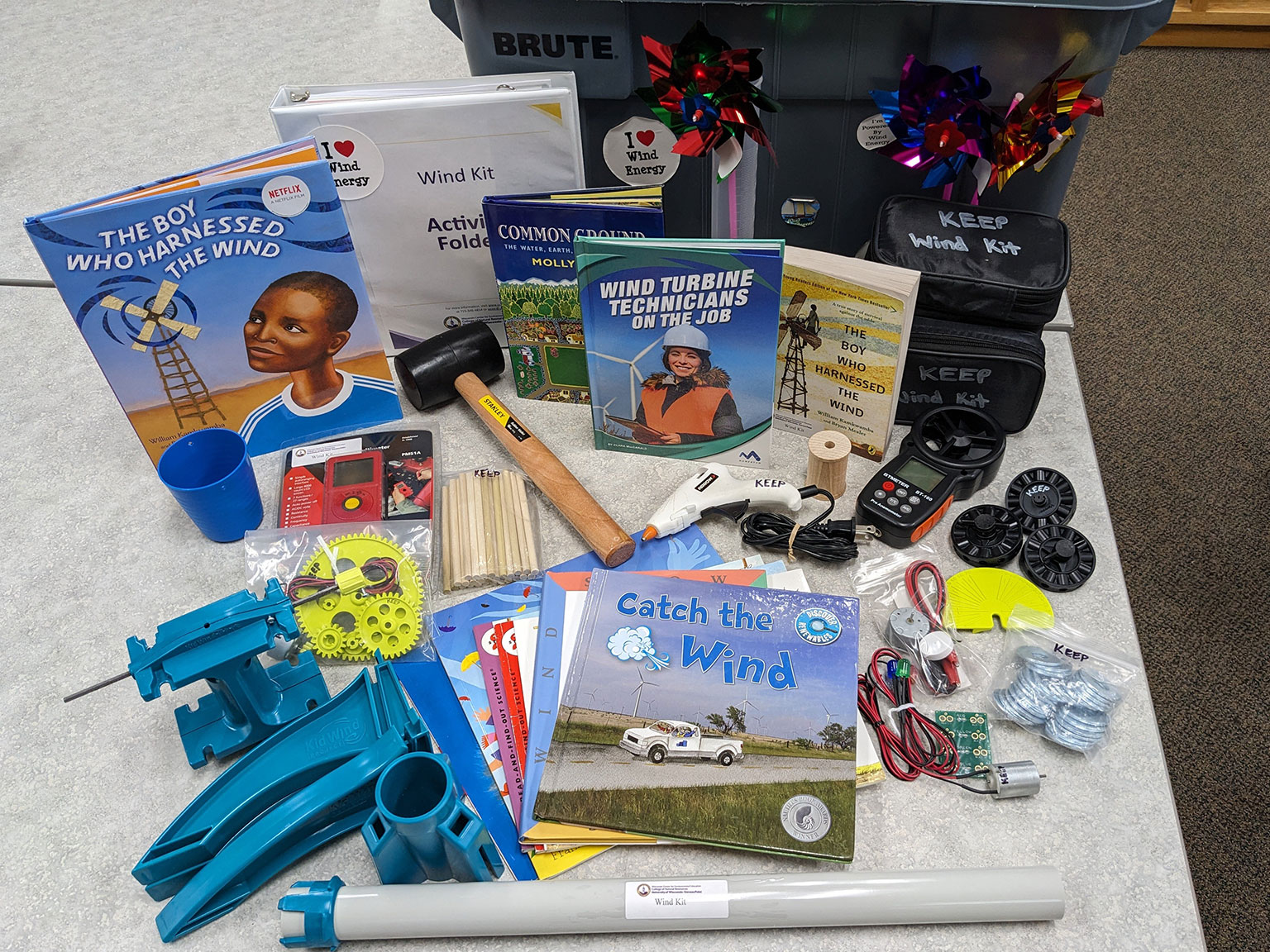
Blow your students away!
Students learn about wind through reading and hands-on activities that focus on inquiry and observation. Students learn how wind is formed and used as an energy source. They will explore ways to measure wind speed and direction and investigate how wind works and generates electricity. Students are challenged to choose the optimum blades for a turbine by collecting and analyzing data from multimeters. The kit comes with an activity binder correlated to NGSS and Wisconsin State Science Standards. This kit is recommended for K-8 students but includes activities adaptable for older grades.
Please note that this kit does not include consumables. You must provide your own material for turbine blades (e.g. cardboard or balsa wood) and mini hot glue sticks.
What’s in the box?
- 1 Activity Binder
- 5 Digital Wind Speed Meters
- 5 Pinwheels
- 1 Compass Teaching Kit with 12 Hand Compasses
- 2 Digital Pocket Multimeters
- Rechargeable Batteries
- 3 Blade Pitch Protractors
- 12 Wind Turbine Hubs
- 2 Mini Hot Glue Guns (glue sticks not included) and Extension Cord
- Supercapacitor
- Water Pump, Tube, and Graduated Cylinder
- Fan Blade
- 3 LEDs with Wires and 1 LED Board
- 2 Dowel Glue Removers and 2 Rubber Mallets
- Extra Motor Mounts, Bolts, Nuts
- 2 KidWind Wind Turbines (blade materials not included)
- Fiction and non-fiction books focused on wind energy
- Wind by Erin Edison
- The Boy Who Harnessed the Wind (picture book version) by William Kamkwamba & Bryan Mealer
- Energy Makes Things Happen by Kimberly Brubaker Bradley
- Catch the Wind by Mortenson Construction
- Like a Windy Day by Frank Asch & Devin Asch
- The Wind Blew by Pat Hutchins
- How Artists See THE WEATHER by Colleen Carroll
- Common Ground – The Water, Earth, and Air We Share by Molly Bang
- Feel the Wind by Arthur Dorros
- 2 copies of The Boy Who Harnessed the Wind (young readers edition) by William Kamkwamba and Bryan Mealer, plus 5 copies of associated laminated readings
- Wind Turbine Technicians on the Job by Clara MacCarald
- Wind Power by Tracy Vonder Brink
LEAF Forestry Education Kits
Campfire Kit

Fan the flames of learning!
Practice campfire building indoors with this plush campfire set. Make three small campfires or combine all the logs and sticks to make a single large fire while discussing different campfire structures and their uses. Finally, practice safe fire extinguishing methods with the included trowels and bucket.
What’s in the box?
- Campfire Plushies
- Brown sticks (6)
- Tan sticks (6)
- Birch logs (3)
- Brown logs (3)
- Large flames (2)
- Small flames (2)
- Black base mat
- Trowels (3)
- Lesson Packet
- Blue bucket and lid
Enhance your kit experience
Digital Herbarium Kit (K-12)
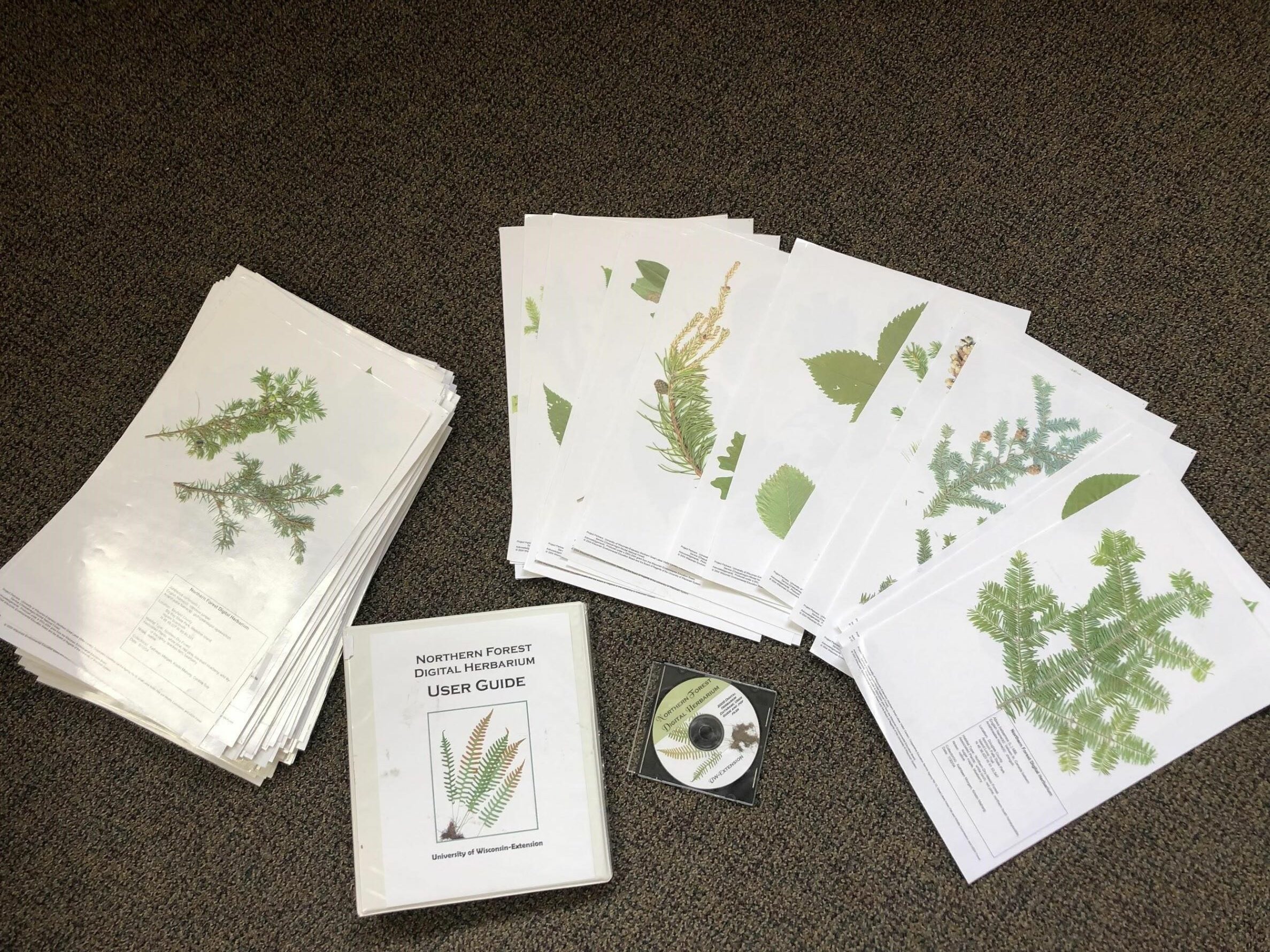
Explore Wisconsin’s nature flora!
The Northern Forest Digital Herbarium contains a digital and print archive of 200 plant specimens that includes a user guide to foster awareness, appreciation, knowledge, and stewardship of Wisconsin’s Northern Forests for learners of all ages. Each specimen is printed in color on 11×17 paper and includes its Anishinaabe name, habitat, and interesting notes. The herbarium was created by the University of Wisconsin-Extension (Northern Great Lakes Visitor Center), CESA 12, Great Lakes Indian Fish and Wildlife Commission, and USDA Forest Service.
For an online version of the Digital Herbarium, visit https://fyi.extension.wisc.edu/herbarium/northern-forest-digital-herbarium/.
What’s in the box?
- Northern Forest Digital Herbarium User Guide
- Northern Forest Digital Herbarium thumb drive and CD
- Identification Pictures (200)
Early Childhood Picture Books Kit
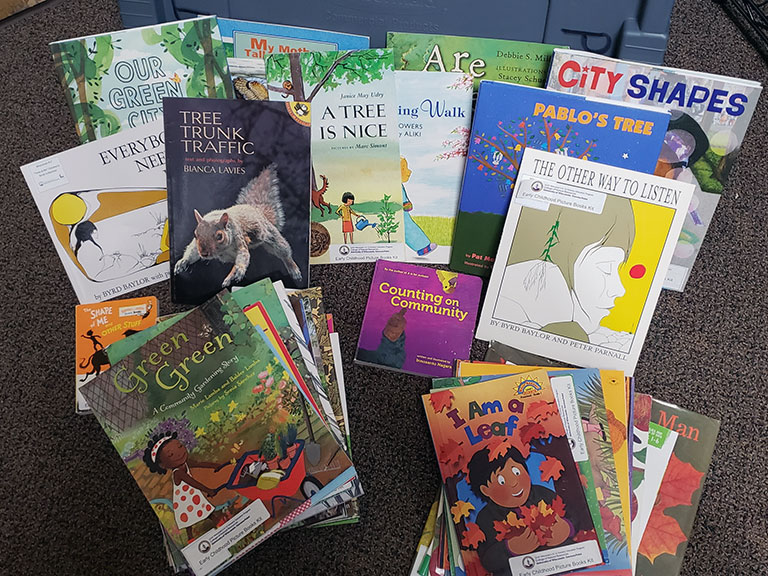
Nature-themed books for young learners
This diverse collection of picture books contains many of the titles used in activities from the Project Learning Tree (PLT) Trees & Me guide, as well as other nature-themed books for young learners.
What’s in the box?
- A Log’s Life
- A Tree for Me
- A Tree is Nice
- Are Trees Alive? (2 copies)
- Be a Friend to Trees
- City Shapes
- Counting on Community
- Everybody Needs a Rock
- Good-Night Owl!
- Green Green: A Community Gardening Story
- How a Seed Grows
- I am a Leaf
- Leaf Man
- My Forest is Green
- My Mother Talks to Trees
- Night Tree
- Our Green City
- Pablo’s Tree
- Quinto’s Neighborhood/El Vecindario de Quinto
- The Apple Pie Tree
- The Listening Walk
- The Mitten
- The Other Ways to Listen
- The Shape of Me and Other Stuff
- The Tree in the Wood
- Tickly Prickly
- Tracks in the Snow
- Tree Trunk Traffic
- We Planted a Tree
- When Sophie Gets Angry – Really, Really Angry…
- Wild Ones: Observing City Critters
- Winter Sleep: A Hibernation Story
- PLT Trees & Me Guide
Edible Forest Reference Kit
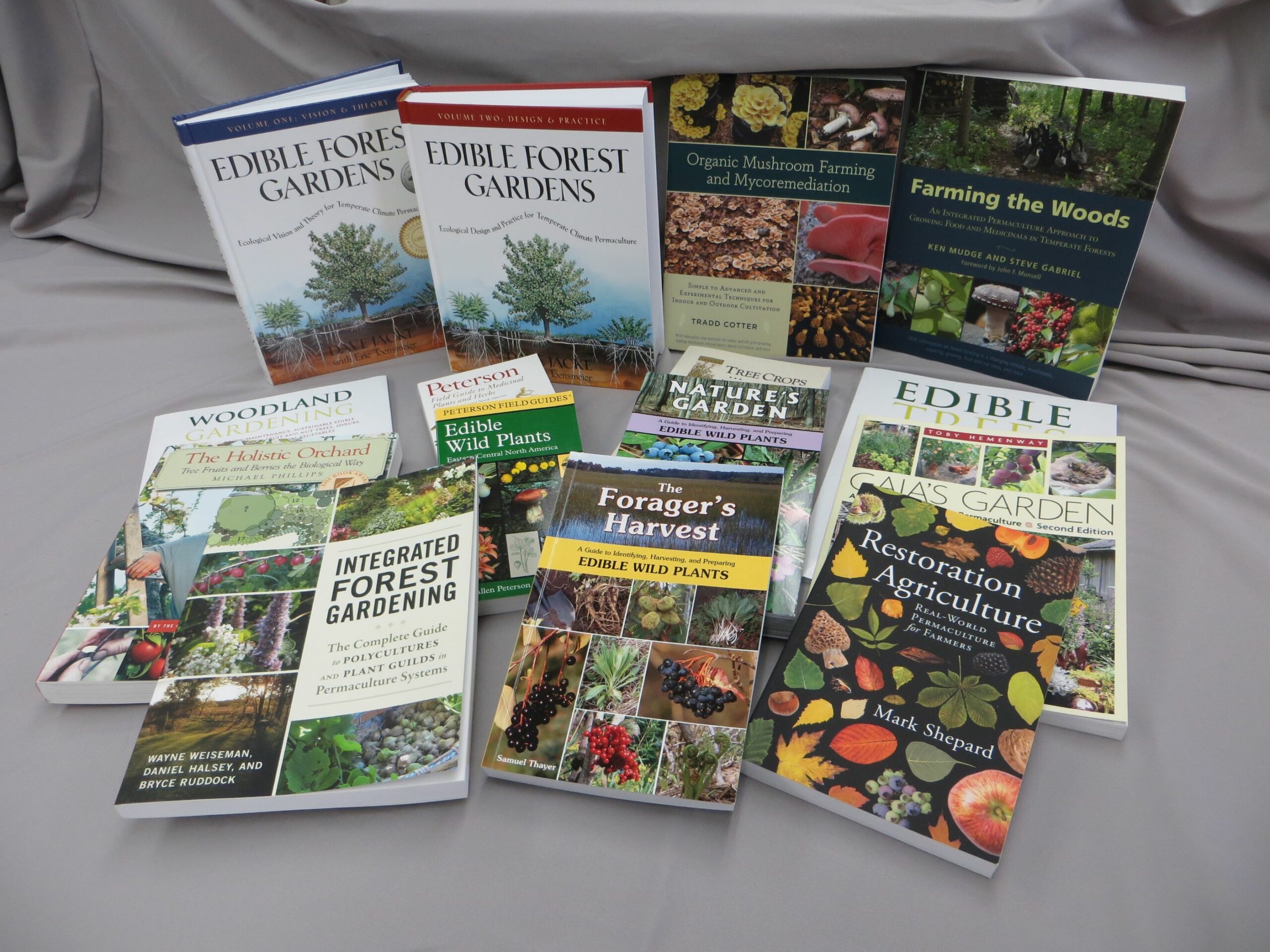
Permaculture, orchards, foraging, and everything in between!
A wide range of subjects are included in the books and other publications in this reference kit. Reference materials provide information on permaculture, orchards, foraging, and everything in between. Use the kit to help you decide what path to follow and what resources to purchase for your own use.
The kit is available for you to borrow at no cost. Funding for the LEAF Edible Forest Reference Kit was provided by the Wisconsin Environmental Education Foundation under a grant from the Wisconsin Environmental Education Board.
What’s in the box?
20 different guides and books
BioBlitz Field Guide Kit
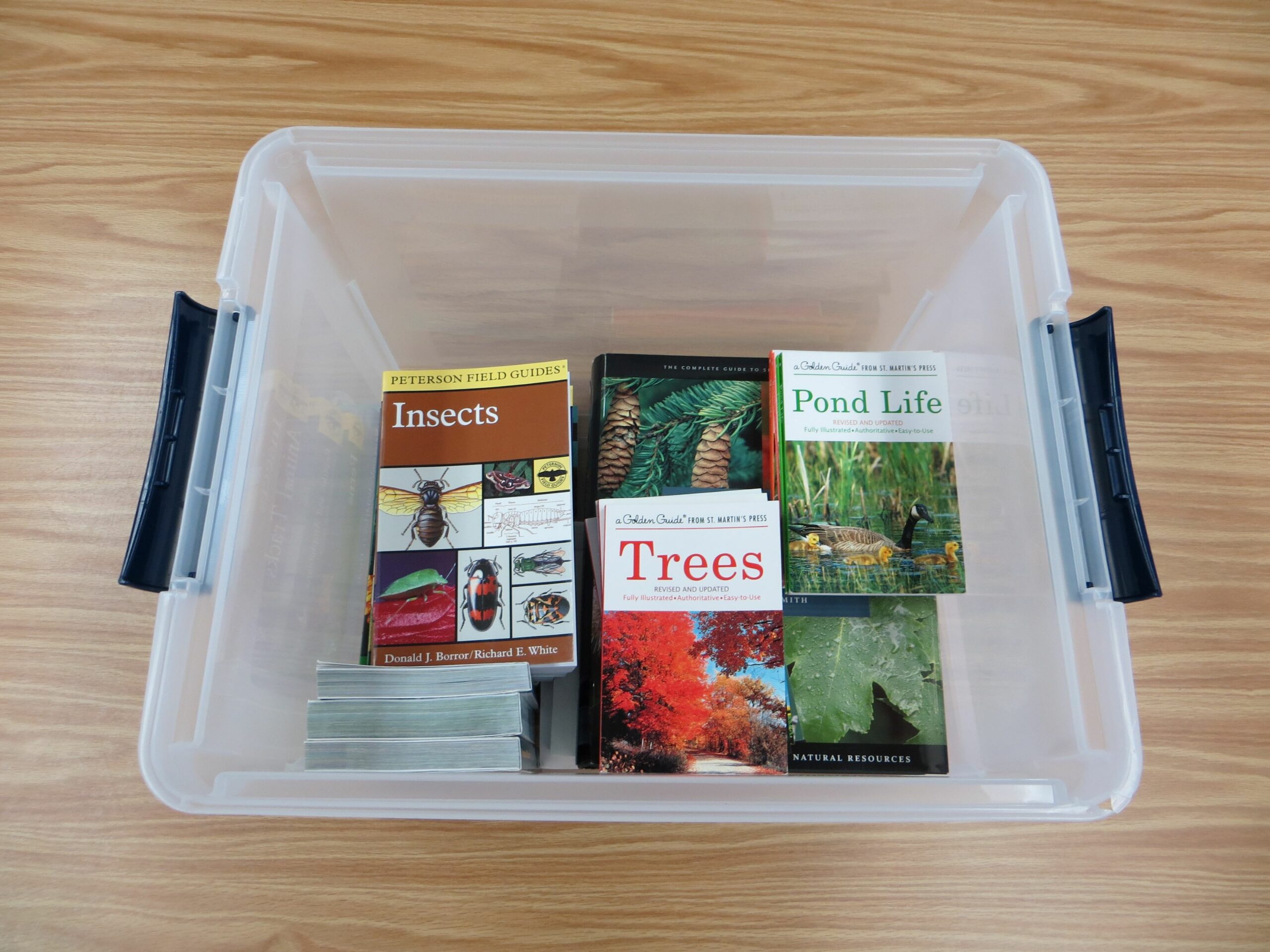
Discover butterflies, birds, bugs, and more!
A wide range of field guides are found in this kit. Search for Monarchs emerging from their chrysalis in September, go on a winter bird watching walk, improve your tree ID lesson with color photos of leaves and branches or discover the names of those creepy crawlies under that log.
What’s in the box?
- This kit includes 27 different field guides covering topics including:
- Amphibians/Turtles/Lizards
- Ferns/Trees/Shrubs/Wildflowers
- Animal Tracks/Mammals
- Birds of Wisconsin
- Butterflies/Catarpillars/Moths/Dragonflies/Insects
Forestry Careers Kit – Cards
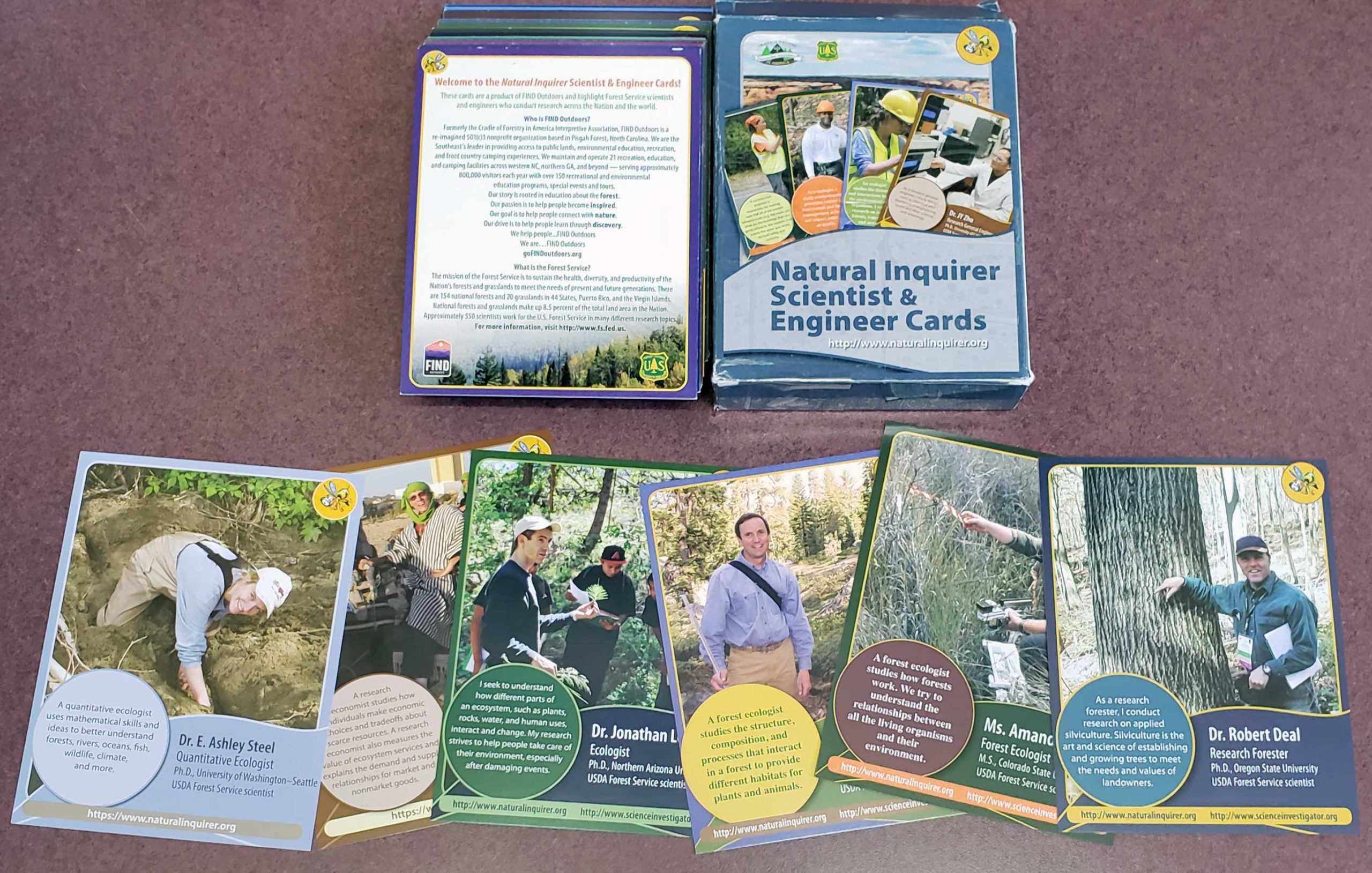
Take a look into natural resource careers!
These cards provide a look into the vast number of jobs and careers pathways within the field of natural resources. This kit contains 95 cards, each of which portrays a real natural resource professional and information about their specific job and experiences. jobs and careers pathways within the field of natural resources. This kit contains 95 cards, each of which portrays a real natural resource professional and information about their specific job and experiences.
What’s in the box?
95 Natural Inquirer Scientist & Engineer Cards
Important Shipping Information:
These cards do not follow the WCEE’s standard shipping procedures. For addresses further than 30 miles from the Center, we will mail the cards to you in a padded envelope. Please return them the same way. The WCEE will pay for mailing the cards to you, but not for the return postage.
If you request an additional kit for the same time frame, we will instead put the cards inside the second kit and ship both together using our standard shipping procedures.
Enhance your kit experience
Into the Outdoors Forest Products Lab episode – 3-5 lesson – Forest Careers in Science & Engineering
Forest Explorers – Let’s Go Outside
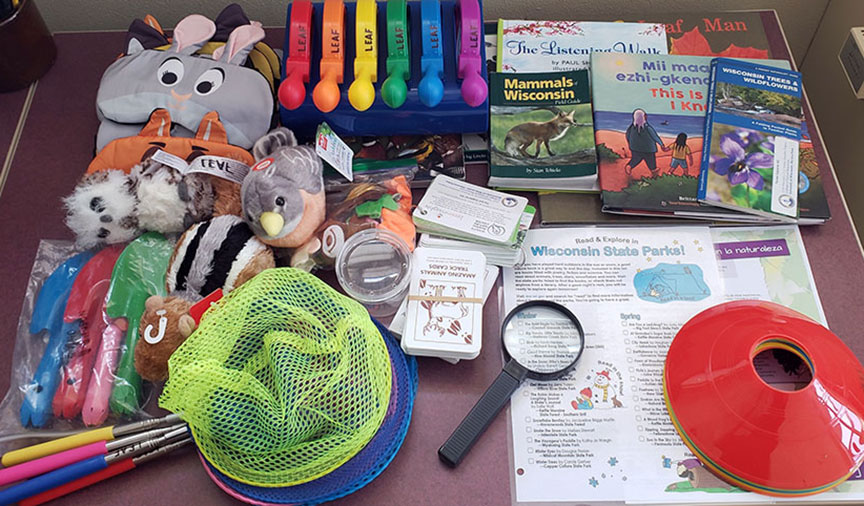
Get in touch with nature!
Help young children get in touch with nature through our Forest Explorers Kits (formerly the Forest Exploration Toolkits for Early Childhood Education). These kits are expanded with all new hands-on resources for young learners.
Let’s Go Outside includes materials to facilitate and enhance outdoor experiences, such as magnifying glasses, field guides, trowels, butterfly nets, etc.
What’s in the box?
Curriculum
- PLT Trees and Me
- PLT Family and Friends
- LEAF Field Enhancements
Books and Posters
- Field Guides (assorted)
- Folding Reference Guides
- This is How I Know
- The Listening Walk
- Leaf Man
Hands-on Resources
- Animal Track Cards
- Bug Magnifying Viewer
- Magnifying Glasses
- Nature Discovery Cards
- Trowels
- Butterfly Nets
- Blindfolds
- Marking Cones
- Plush Owl
- Plush Chipmunk
- Plush Robin
- Animal Finger Puppets
Forest Explorers – Bring Nature Inside
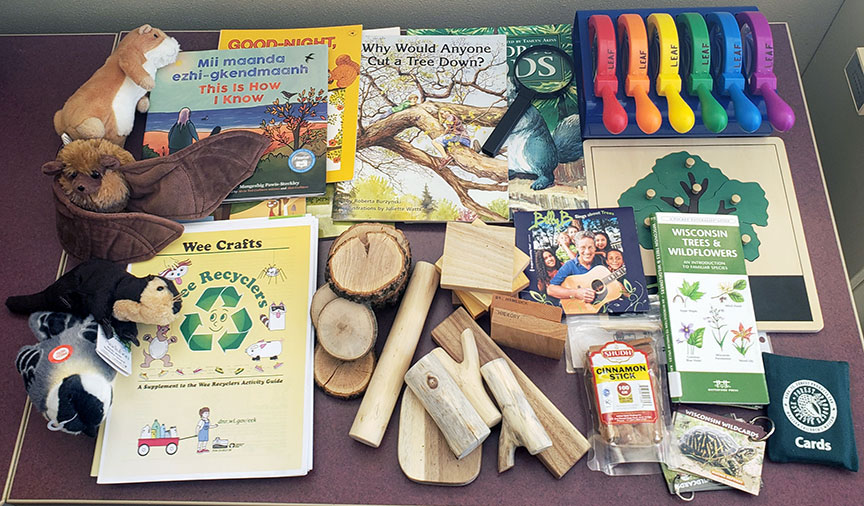
Get in touch with nature from inside the classroom!
Help young children get in touch with nature through our Forest Explorers Kits (formerly the Forest Exploration Toolkits for Early Childhood Education). These kits are expanded with all new hands-on resources for young learners.
Bring Nature Inside is perfect for times or places it isn’t practical to bring children outside, but teachers still want to give them experiences of the natural world. It has more indoor materials such as picture books, stuffed animals, and samples of natural materials.
What’s in the box?
Curriculum
- PLT Trees and Me
- PLT Family and Friends
- PLT Spanish Lessons
- LEAF Field Enhancements
- Lesson 1: “Tree Hardware”
- Wisconsin State Parks Reading List
Books and Posters
- Folding Reference Field Guides for Wisconsin’s Wildflowers and Trees
- Wee Recyclers Activity Booklet
- Wee Crafts Activity Booklet
- Billy B Sings About Trees CD
- Leaf Man
- We Planted a Tree
- Hummingbird and the Little People
- This is How I Know
- Why Would Anyone Cut a Tree Down?
- Good-Night, Owl!
- Look What I Did with a Leaf
- In Grandpa’s Woods
- Forest Trees of Wisconsin Poster
- Wisconsin’s Forest Ecosystem Poster
- Wisconsin Forestry Celebrating 100 Years of Growing and Giving Poster
- Wisconsin’s Watchable Wildlife: Rivers and Wetlands Poster
- State Tree of Wisconsin: The Sugar Maple Poster
- Watch Me Grow WDNR Poster
Hands-on Resources
- Wisconsin Wildcards
- Smokey’s Friends Wildfire Prevention Activity Cards
- Tree Memory Cards
- Tree Cookies
- Natural Wooden Blocks
- Forest Products Wooden Block Set
- Plush Bat
- Plush Otter
- Plush Groundhog
- Plush Chickadee
- Tree Puzzle
- Cinnamon Sticks
- Magnifying Glasses (7)
Forestry Education Kit
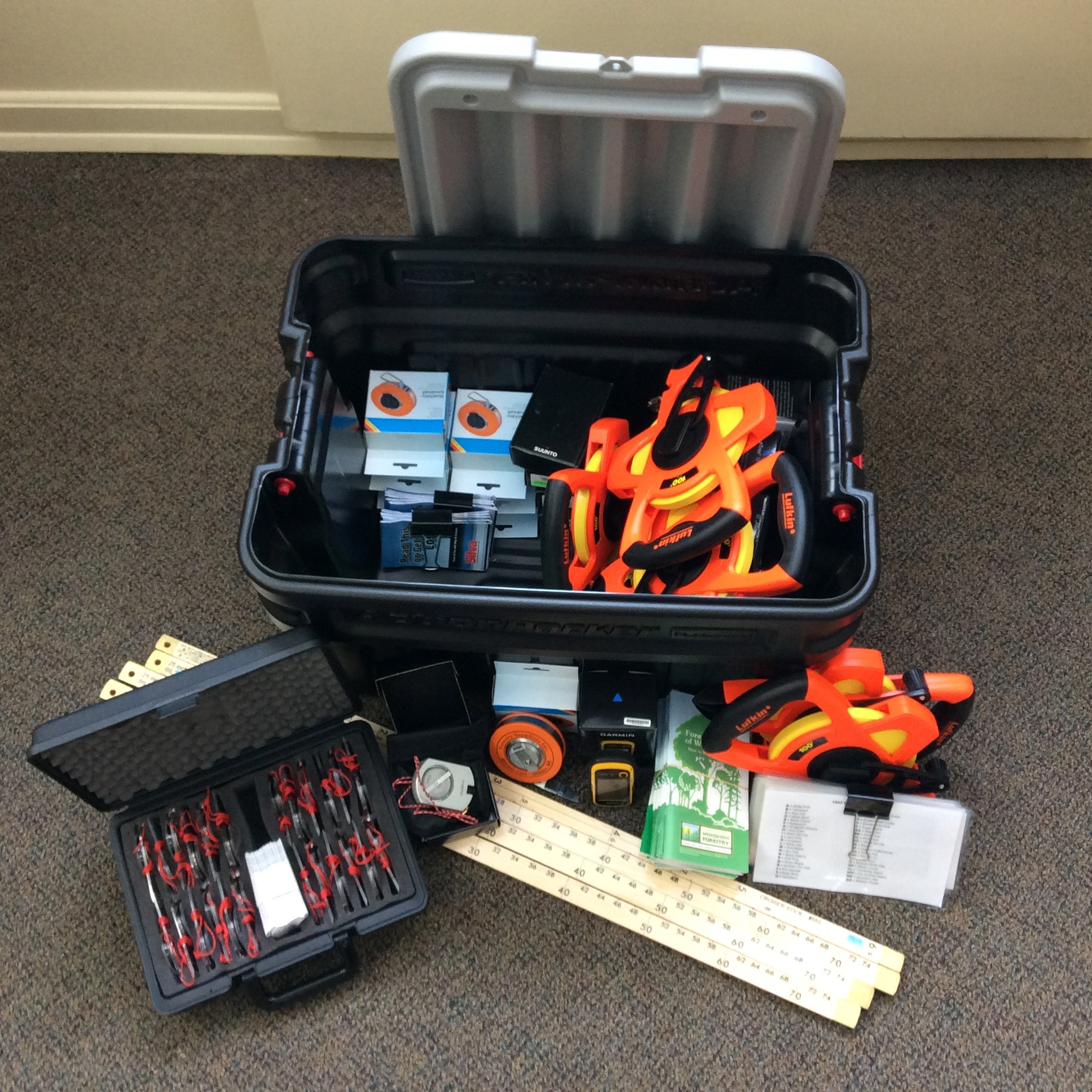
Hands-on forestry education!
Forestry Education Kits are available to check-out and are great for hands-on forestry education. There are eleven kits available – contact information for all eleven locations is below. The kits contain equipment and tools to facilitate teaching tree identification and management, plot investigations, and navigation using compasses. In addition, one kit contains 10 Garmin GPS units. Funding for this project was provided by the Wisconsin Environmental Education Board (WEEB), Wisconsin Environmental Education Foundation (WEEF), and LEAF – Wisconsin’s K-12 Forestry Education Program.
What’s in the box?
- Tree scale/cruising sticks (15)
- Clinometers (10)
- Diameter tapes (8)
- 100-foot tapes (5)
- GPS Units (10) and bag
- Kestrel Weather Meters (5)
- Prisms (15)
- LEAF Tree Identification Keys (15)
- Set of LEAF tree identification cards
- Forest Trees of Wisconsin booklets (15)
- PLT Focus on Forests Lesson Guide
- Binder containing lessons and instructions
- Guides:
- Snakes of Wisconsin by WI DNR
- Amphibians of Wisconsin by WI DNR
- Lizards and Turtles of Wisconsin by WI DNR
- Wildflowers of Wisconsin and Great Lakes Region
- Complete Guide to Trees and Shrubs of Minnesota
- Peterson Field Guide: Mammals
- Peterson Field Guide: Animal Tracks
- Peterson Field Guide: Reptiles and Amphibians
- Peterson Field Guide: Insects
- Birds of Wisconsin (CD and book)
- Compass Teaching Kit (23)
- A Sand County Almanac
- Battery Charger and Extra Rechargeable Batteries (8)
Enhance your kit experience
- Tree Measurement: Wood’s Worth, 5/6 field enhancement 1
- Forest Inventory: Timber Cruise, 9-12 field enhancement 4
- Tree Identification: Tree Identification, 7/8 field enhancement 1
- Ecological Diversity: Forest Diversity, 7/8 field enhancement 3
- Inventory Plots: School Forest Resource Plots, 9-12 field enhancement 2
- Wildlife Habitat: Habitat Assessment, 9-12 field enhancement 5
Reserve this kit from our partners
Ashland High School
Contact: Sandra Dee Naas | sdnaas@sdak12.net | 715-682-7089 x1107
Address: 1900 Beaser Ave, Ashland, WI 54806
CESA #2, Professional Resource Center
Contact: Rachel Holt | rachel.holt@cesa2.org
Address: 1221 Innovation Drive, Suite 116, Whitewater, WI 53190
Glenwood City High School
Contact: Sean Vanderwaal | Sean.vanderwaal@gcsd.k12.wi.us | 715-265-4266
Address: 850 Maple St,
Glenwood City, WI 54013
Lena Public Schools
Contact: Roberta Windus | windusr@lenak12.org | 920-604-1687
Address: 304 E Main St,
Lena, WI 54139
Mauston School District
Contact: Beth Babcock | bbabcock@maustonschools.org | 608-847-4410, ext 4467
Address: 800 Grayside Ave, Mauston, WI
53948
Monroe High School
Contact: Danielle Pernot | daniellepernot@monroe.k12.wi.us | 6083287353
Address: 1600 26th St,
Monroe, WI 54566
Plymouth High School
Contact: Tracy Heinbuch | theinbuch@plymouth.k12.wi.us | 920-893-6911 ext 1619
Address: 125 S Highland
Ave, Plymouth, WI 53073
Wehr Nature Center
Contact: Bev Bryant | beverly.bryant@milwaukeecountywi.gov | 414-425-8550
Address: 9701 W College Ave, Franklin, WI 53132
Winneconne Community School District
Contact: Jim Melby | melbyj@w-csd.org | 920-582-5810, ext 1816
Address: PO Box 5000, Winneconne, WI 54986
Forest Health Kit
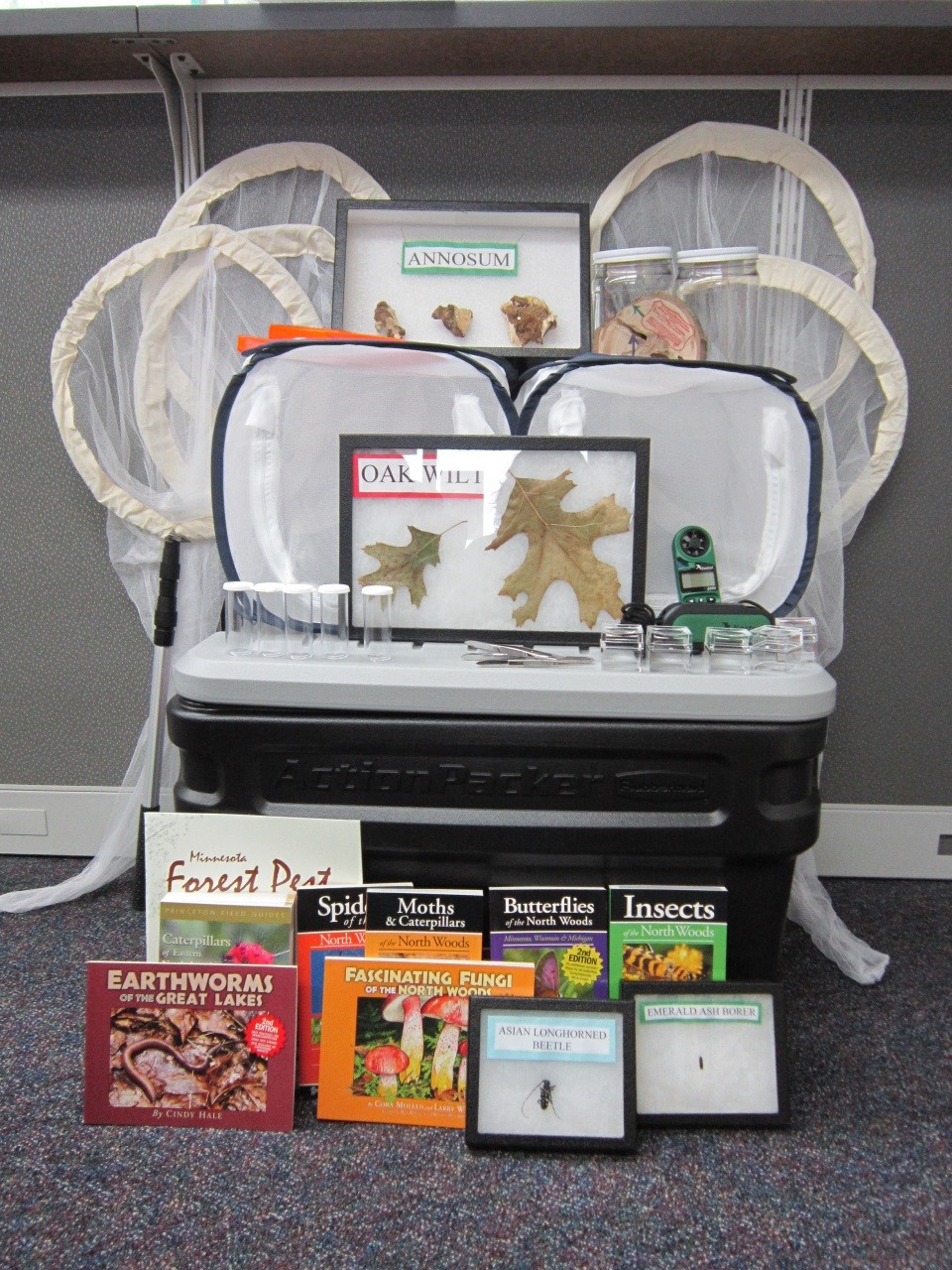
Facilitate the educational aspects of forest health!
Forest Health Kits are available to check-out and are great for learning about invasive species, disease, and other aspects that impact the health of a forest. There are eleven kits available – contact information for all eleven locations is below. The kit contains equipment and tools to facilitate the educational aspects of forest health including insect identification, invasive species, disease, and climate.
There is no fee for using the kits, but users are responsible for the loss or damage of kit contents. The forest health kit is a result of a partnership between the DNR’s Forest Health staff and LEAF. Funding was provided by a Wisconsin Environmental Education Board Grant.
What’s in the box?
- Asian Longhorn Beetle Wood Core Sample
- Asian Longhorn Beetle Sample
- Annosum Sample
- Oak Wilt Sample
- Emerald Ash Borer Sample
- Collecting Jar (32oz)
- Insect Rearing & Observation Cage
- Plastic Collection Tubes (small)
- Magnifying boxes
- Plastic Trowel
- Forceps
- Insect Nets
- Binder containing information and lessons
- Kestrel 2000 Weather Meter
- Books:
- Caterpillars of Eastern North America
- Butterflies of the North Woods
- Moths and Caterpillars of the North Woods
- Fascinating Fungi of the North Woods
- Earthworms of the Great Lakes
- Spiders of the North Woods
- Insects of the North Woods
- Minnesota Forest Pest First Detector Manual
Enhance your kit experience
- Forest Health Info Sheets:
- Online Lesson Sheets:
- Management Decisions and Biodiversity, Urban Forest 5-8 Unit Lesson 3
- Wisconsin Worm Watch
Reserve this kit from our partners
Edgar High School
Contact: Matt Reinders | mreinders@gapps.edgar.k12.wi.us | 715-352-2352
Address: 203 E Birch Street, Edgar, WI 54426
Reedsburg School District
Contact: Drew Lockwood | dlockwood@rsd.k12.wi.us | 608-768-8928, ext 1147
Address: 1100 S. Albert Ave, Reedsburg, WI 53959
Riveredge Nature Center
Contact: Rachel Race | rrace@riveredge.us
Address: 4458 County Rd Y, Saukville, WI 53080
Unity High School
Contact: Lisa Jagielo | ljagielo@unity.k12.wi.us | 715-825-3515 Ext. 1170
Address: 1908 50th Street, Hwy 46N, Balsam Lake, WI 54810
Waupaca Middle School
Contact: Kyle Mannel | kmannel@waupacaschools.org | 715-258-4140 ext. 7715 or ext. 7719
West Salem High School
Contact: Kelly Rueckheim | rueckheim.kelly@wsalem.k12.wi.us | 608-786-1220 ext. 2304
Address: 490 N Mark St, West Salem, WI 54669
Forest Products Kit
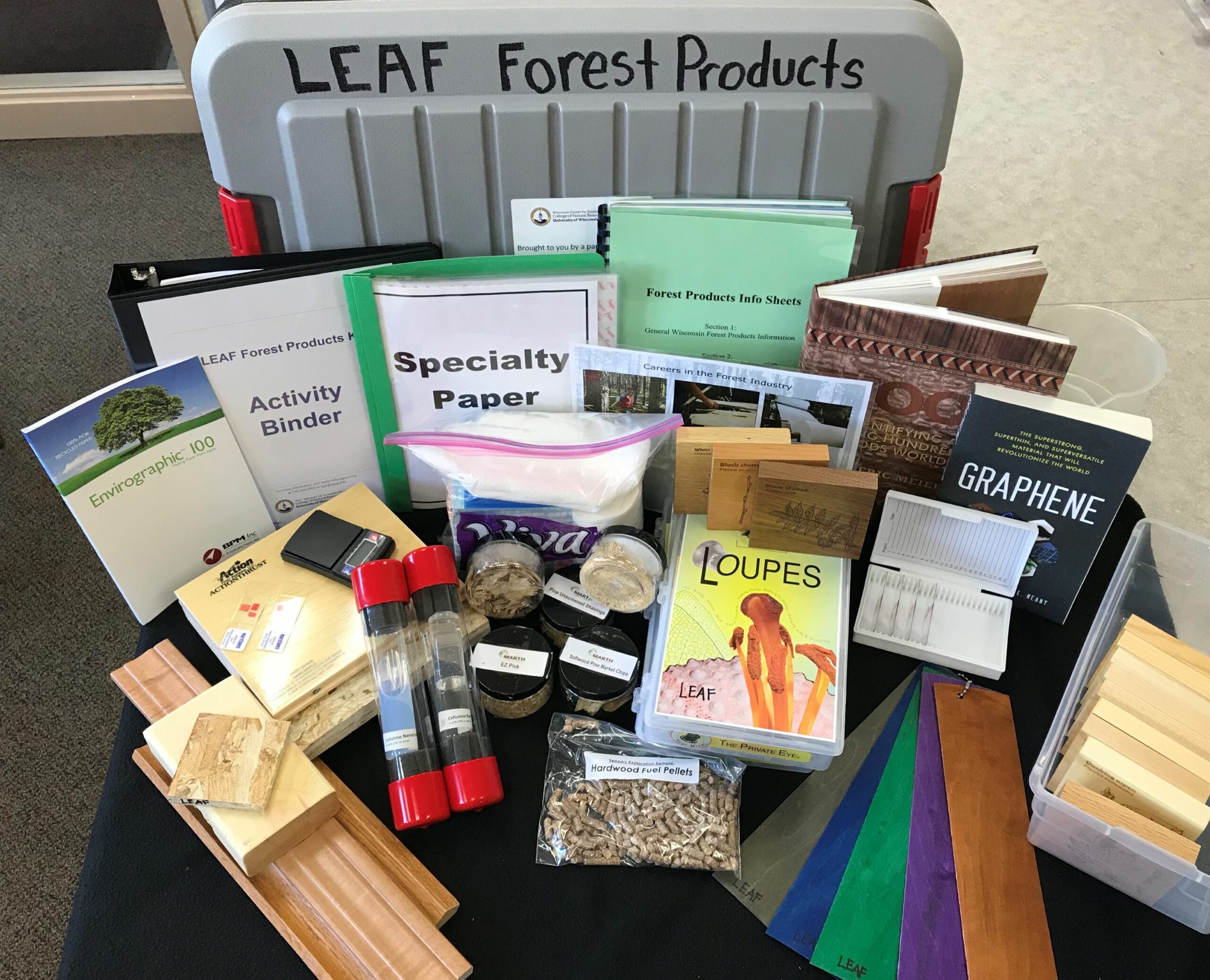
Learn about forest products!
The Forest Products kit allows students to learn about forest products, and associated careers, through hands-on exploration. Students will be able to Track that Product: From Forest to Finish, explore a forest product case study and trace a product’s journey through the forest, processing, and product. Each case study includes information about the tree, properties that make it important for specific products, and samples of the products themselves. In addition, students can compare between 12 specially engraved wood blocks of common Wisconsin tree species used in forest products and explore wood properties, density, and cell structure. In-line with both teacher and industry demands the kit contains a mix of career-focused resources and literacy components. There is no fee for using the kits, but users are responsible for the loss or damage of kit contents.
The forest products kit is a result of a partnership between the DNR’s Forest Products staff and LEAF. Learn about Wisconsin’s Forest Products Industry by downloading slides for your classroom provided by the Wisconsin Department of Natural Resources. AG-ED Industry Presentation DNR
What’s in the box?
- Beakers 5.7 Diameter, 1000ml (5)
- Periodic Table of Wood Poster
- Graphene Book
- WOOD! Identifying and Using Hundreds of Woods Worldwide Book
- X5 The Private Eye Loupe Set (18 Per set, 2 sets)
- Microscope Slide Storage Holder and Microscope Slides (oak, pine, basswood)
- Trees to Table book
- Activity Binder
- Forest Products Fact Sheets
- Graphene Guide – 28 pages
- Digital Pocket Scale
- Careers in Forestry Sheets (5)
- Urban Wood Wooden Token
- Wood Magic Curriculum Guide
- Samples (Specialty Paper, Trim, Moulding, Flooring, Lumber – 6″ – 2×4, OSB, 2 Nanotech, 12 Marth Wood Sensory Exploration Samples, 12 Marth Wood Product Jar Samples, 5 Veneer, 12 Engraved Wisconsin Wood Block Samples, 12 Non-Engraved Test Wood Blocks with ID Sheet and 5 Blocks for Volume Displacement Use, Toilet paper, paper towel, and tissue sample bag, and 3 Pulp)
Enhance your kit experience
Reserve this kit from our partners
CESA 10
Contact: Kristin Rosenberg | krosenberg@cesa10.org
Address: 725 West Park
Avenue, Chippewa Falls, WI 54729
Lomira High School
Contact: Dan Robinson | drobinson@lomira.k12.wi.us | 920-269-4396 ext. 170
Address: 1030 4th St, Lomira, WI 53048
Mishicot High School
Contact: Jamie Propson | jpropson@mishicot.k12.wi.us | 920-755-3300
Address: 660 Washington Street, Mishicot, WI 54247
Oconto Falls
Contact: Walter J Taylor | walter.taylor@of-ps.org | 920-848-4467
Address:: 210 North Farm Road, Oconto Falls, WI 54154
Osceola Agriculture Department
Contact: Paul Jakupciak | jakupciakp@osceolak12.org | 715-294-2129 ext 4117
Address: 1111 Oak Ridge Drive, Osceola, WI 54020
Owen-Withee High School
Contact: Travis Engel | tengel@owk12.org | 715-229-2151 ext 251
Address: 832 West Third Street, Owen, WI 54460
Waunakee High School
Contact: Rhonda Knapp | RhondaKnapp@waunakee.k12.wi.us | 608-849-2100 ext. 2317
Address: 301 Community Dr, Waunakee, WI 53597
Weston School District
Contact: Randi Osborne | osborne@weston.k12.wi.us | 608-986-2151, ext 217
Address: E2511 County Road S, Cazenovia, WI 53924
BioBlitz Garmin Handheld GPS
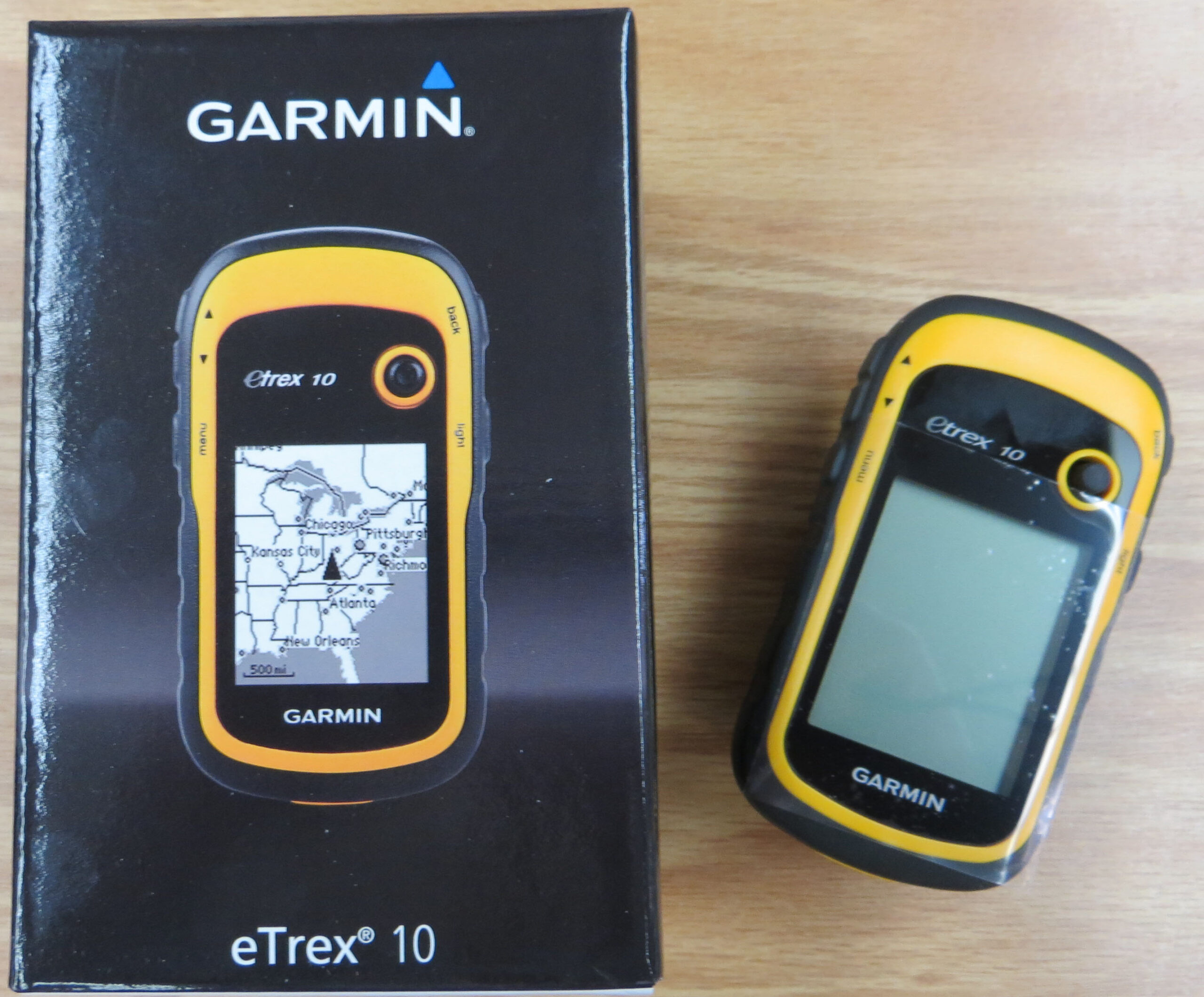
Develop mapping skills!
Get out, explore and develop your students’ mapping skills with the eTrex 10 handheld GPS from Garmin. The device includes a worldwide basemap, 2.2” display, and both GPS and GLONASS satellites for fast positioning. Kit contains 10 GPS units.
What’s in the box?
- 10 Garmin eTrex® 10 GPS Weather Meters
- 10 USB Cords and 1 User Manual
- 26 Batteries & Rubbermaid Tub
Enhance your kit experience
Need a lesson plan to go with it? Checkout LEAF’s GPS Basics on Your School Grounds
Journeys Guide Kit
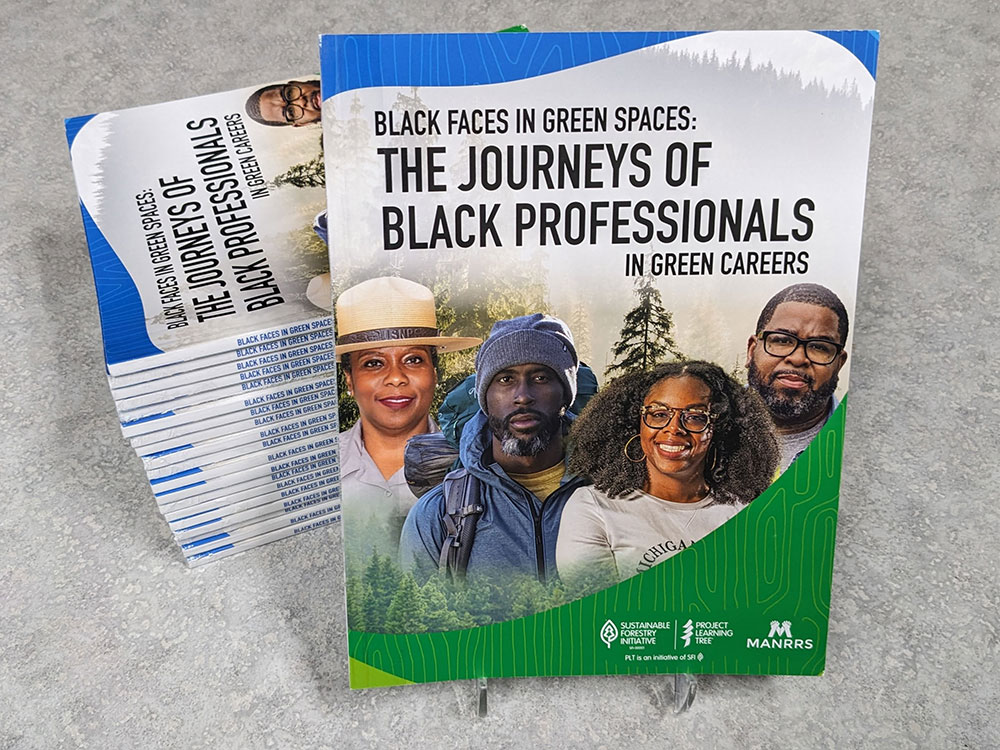
Explore diverse perspectives!
Project Learning Tree’s Black Faces in Green Spaces: The Journeys of Black Professionals in Green Careers introduces youth to the many jobs in the forest and conservation sector through the lens of Black professionals currently working in the sector. Filled with inspiring stories and profiles, this guide provides insight on the diverse career paths taken by individuals who found their way into a green career through their love of nature and the outdoors. Our kit contains a classroom set of 20 books, two careers-focused LEAF and PLT lessons and a link to the Educator Toolkit.
What’s in the box?
Enhance your kit experience
BioBlitz Kestrel 5500 Pocket Weather Meter Kit
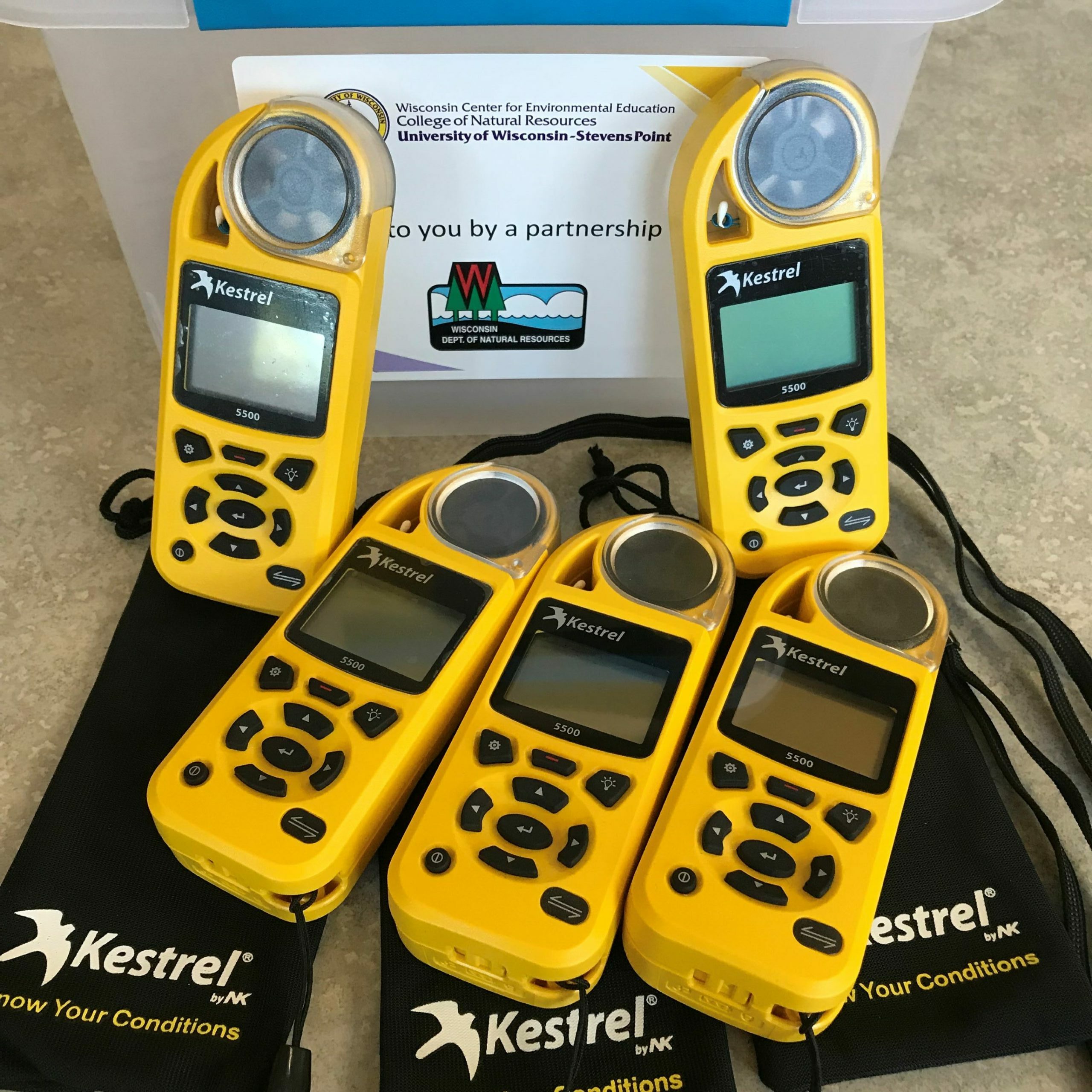
Discover the impact of weather conditions!
Help your students to discover the impact weather conditions have on forest environments. The Kestrel 5500 Pocket Weather Meter is a handheld weather-monitoring device that measures essential environmental factors like temperature and wind speeds. Additionally, an external temperature sensor and waterproof casing allow you to gauge the temperature of water (it even floats) and snow, as well as the open air.
The Kestrel Meter 3000 Wind Meter measures:
- Current Wind Speed
- Maximum Wind Gust
- Average Wind Speed
- Air, Water & Snow Temperature
- Wind Chill
- Relative Humidity
- Heat Stress Index
- Dewpoint
What’s in the box?
5 Kestrel 3000 Pocket Weather Meters (Includes: Neck Lanyard, Slide-On-Cover, Coin Cell Battery (average life 300 hours) and Kestrel Certificate of Conformity.
LEAF K-1 Lesson Guide Kit
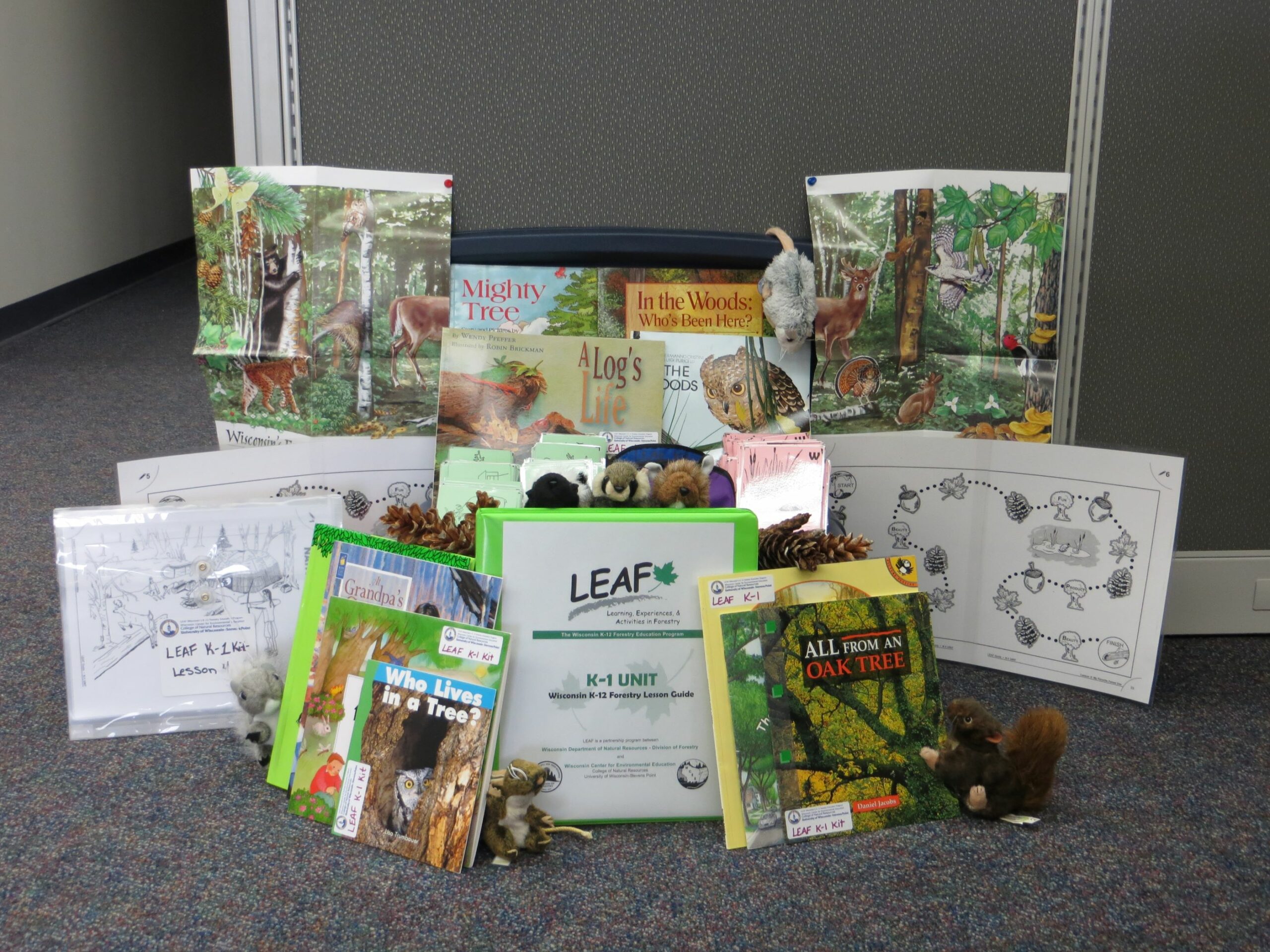
Supplemental lesson materials
LEAF K-8th Grade Kits correspond to the K-1st grade, 2nd-3rd grade, 4th grade, 5-6th grade, and 7-8th grade LEAF Lesson Guides. These kits contain supplemental lesson materials, fiction and non-fiction books focused on Wisconsin forests, and equipment for students to use when exploring the forest for grades K-1.
What’s in the box?
- 15 Books (see checklist for complete list)
- Puppets (Fox, Beaver, Opossum, Raccoon, Black Bear, Great Horned Owl, Red Squirrel, Bat, Skunk, Porcupine, Field Mouse, Grey Squirrel)
- Lesson Materials (Lessons 1-5 and Careers Exploration)
- Additional Materials
Enhance your kit experience
LEAF 2-3 Lesson Guide Kit
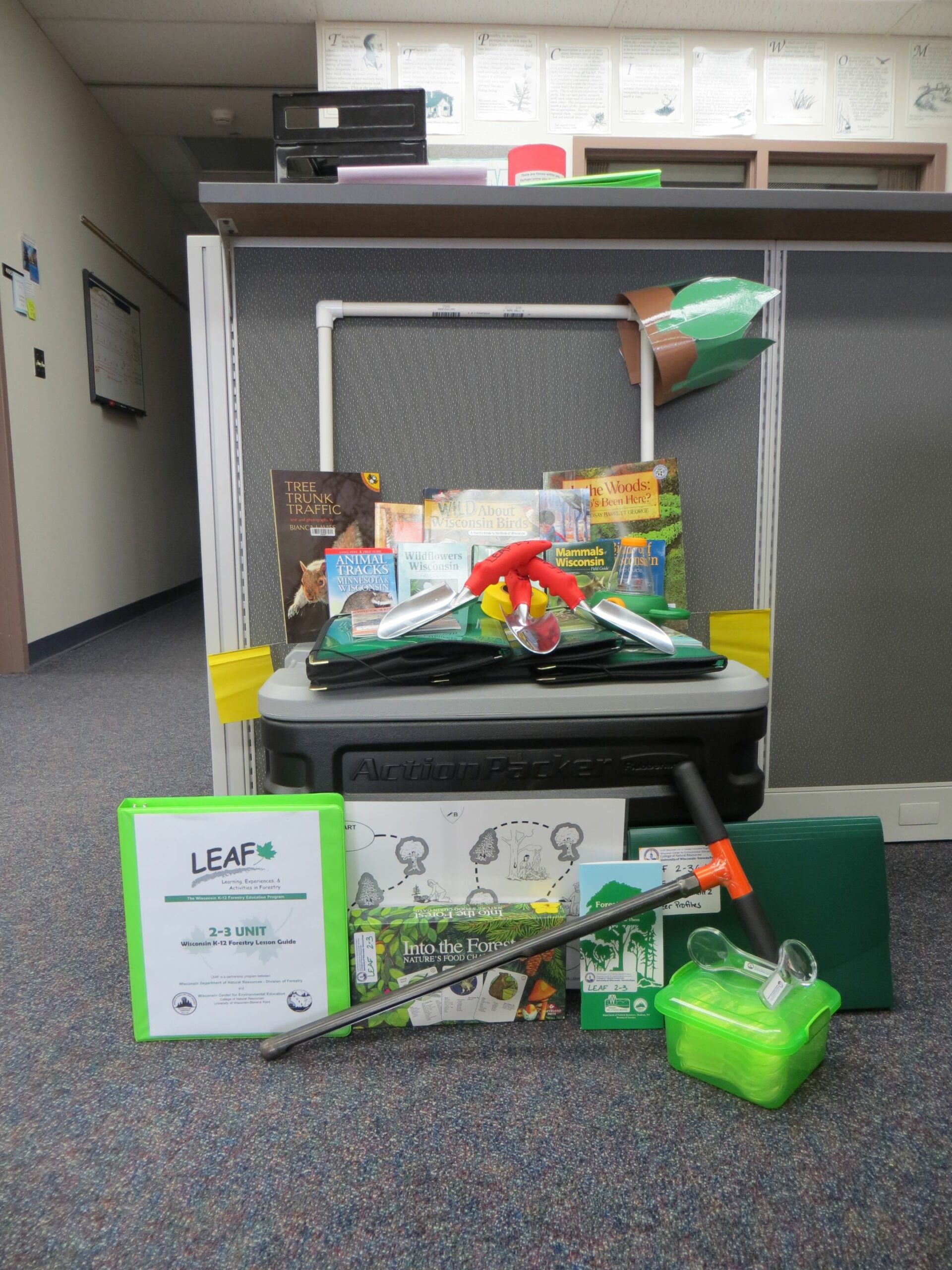
Supplemental lesson materials
LEAF K-8th Grade Kits correspond to the K-1st grade, 2nd-3rd grade, 4th grade, 5-6th grade, and 7-8th grade LEAF Lesson Guides. These kits contain supplemental lesson materials, fiction and non-fiction books focused on Wisconsin forests, and equipment for students to use when exploring the forest for grades 2-3.
What’s in the box?
- 10 Books (see checklist for complete list)
- 10 Field Identification Guides
- Lesson Materials (Lessons 1-6, Careers Exploration, Field Enhancements 1 & 2)
- Additional Materials
Enhance your kit experience
LEAF 4th Grade Lesson Guide Kit
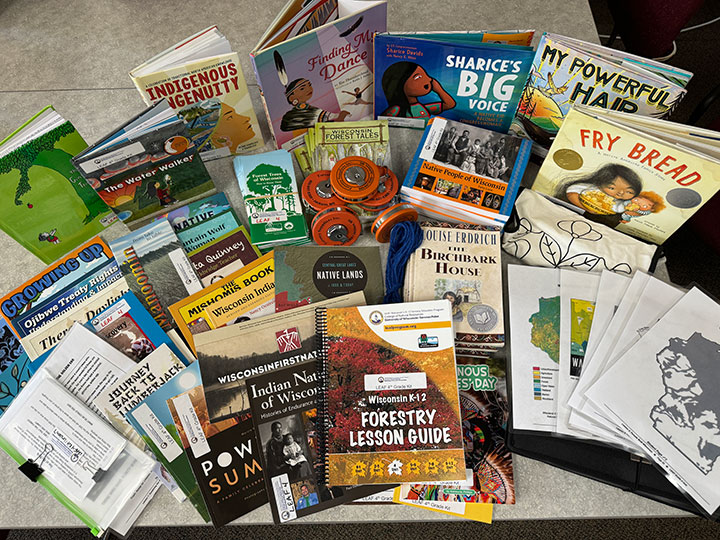
Supplemental lesson materials
LEAF K-8th Grade Kits correspond to the K-1st grade, 2nd-3rd grade, 4th grade, 5-6th grade, and 7-8th grade LEAF Lesson Guides. The 4th grade kit contains supplemental lesson materials, fiction and non-fiction books focused on Wisconsin forests and Wisconsin First Nations, and diameter tapes for students to use when exploring the forest.
LEAF received funding from the Wisconsin SFI Implementation Committee to assist with updates to this kit and the 4th Grade Forestry Lesson Guide.
What’s in the box?
This kit includes two totes.
Tote 1: Forestry Materials
- LEAF 4th Grade Unit Lesson Guide
- Materials for Lessons 1-7
- 15 Career Profiles
- Classroom set of Wisconsin Forest Tales books (25 copies)
- Classroom set of Forest Trees of Wisconsin books (25 copies)
- 10 Diameter Tapes
- 3 Books – fiction and non-fiction
Tote 2: First Nations Materials
- Classroom set of Native People of Wisconsin books (25 copies)
- Indian Nations of Wisconsin book
- 5 copies of The Birchbark House
- A Beginners Dictionary of Menominee book
- Bandolier Bag
- 20 Books – fiction and non-fiction
LEAF 5-6 Lesson Guide Kit
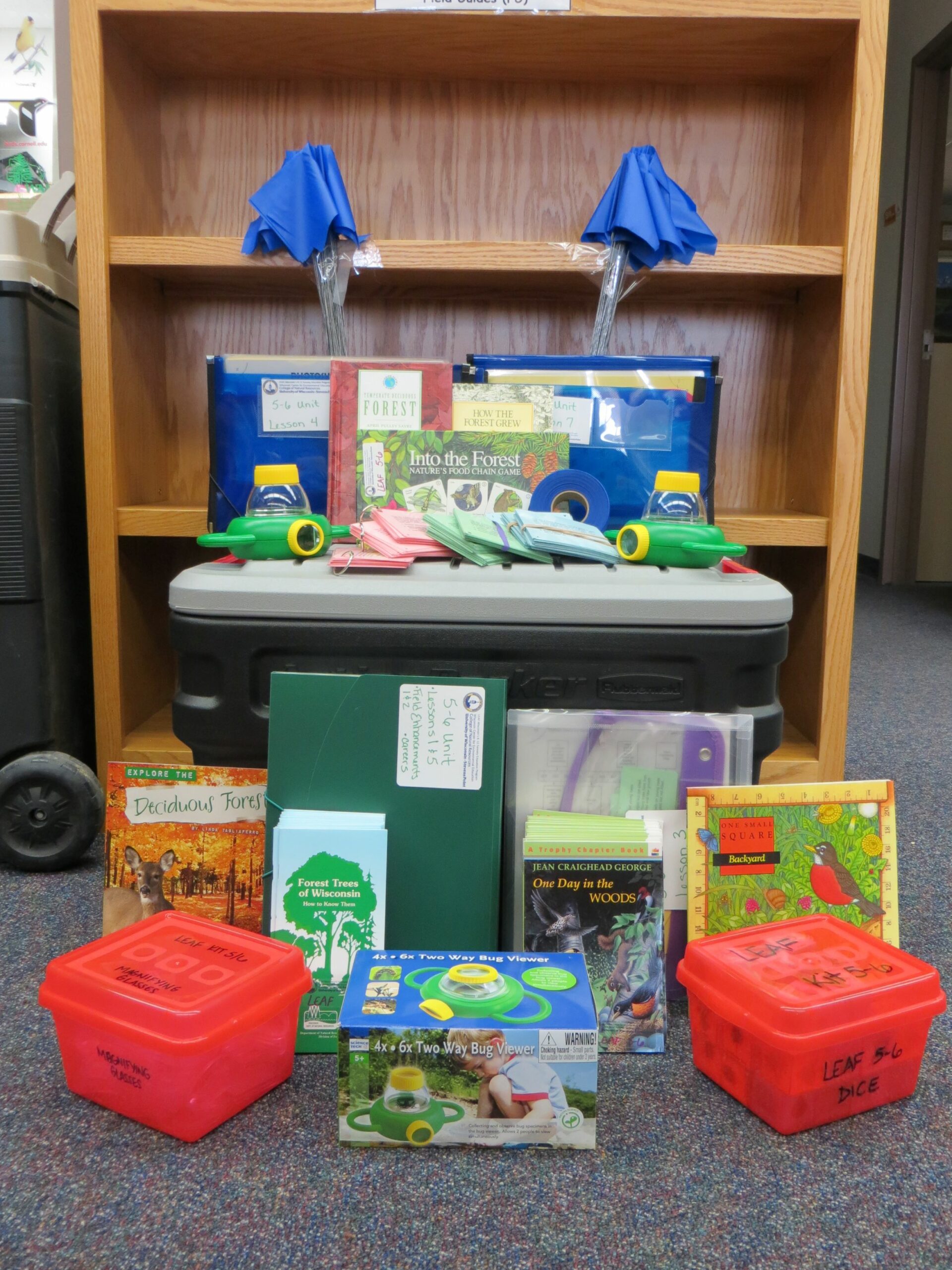
Supplemental lesson materials
LEAF K-8th Grade Kits correspond to the K-1st grade, 2nd-3rd grade, 4th grade, 5-6th grade, and 7-8th grade LEAF Lesson Guides. These kits contain supplemental lesson materials, fiction and non-fiction books focused on Wisconsin forests, and equipment for students to use when exploring the forest for grades 5-6.
What’s in the box?
- 6 Books (see checklist for complete list)
- Lesson Materials (Lessons 1-8, Careers Exploration, Field Enhancements 1, 2, & 3)
- Additional Materials
Enhance your kit experience
LEAF 7-8 Lesson Guide Kit
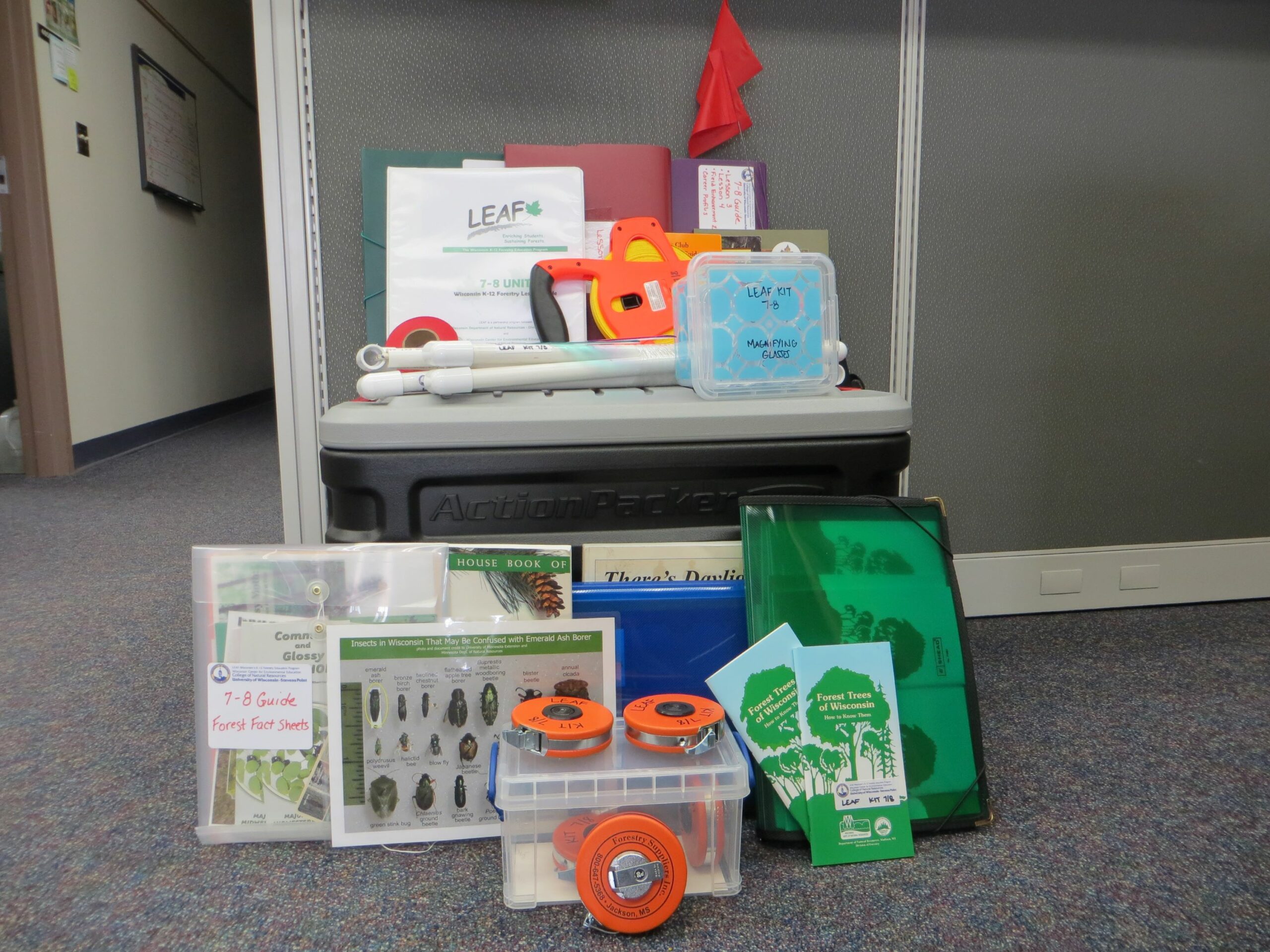
Supplemental lesson materials
LEAF K-8th Grade Kits correspond to the K-1st grade, 2nd-3rd grade, 4th grade, 5-6th grade, and 7-8th grade LEAF Lesson Guides. These kits contain supplemental lesson materials, fiction and non-fiction books focused on Wisconsin forests, and equipment for students to use when exploring the forest for grades 7-8.
What’s in the box?
- 6 Books (see checklist for complete list)
- Lesson Materials (Lessons 1-8, Careers Exploration, Field Enhancements 1, 2, & 3)
- Additional Materials
Enhance your kit experience
BioBlitz Private Eye Magnifier Kit
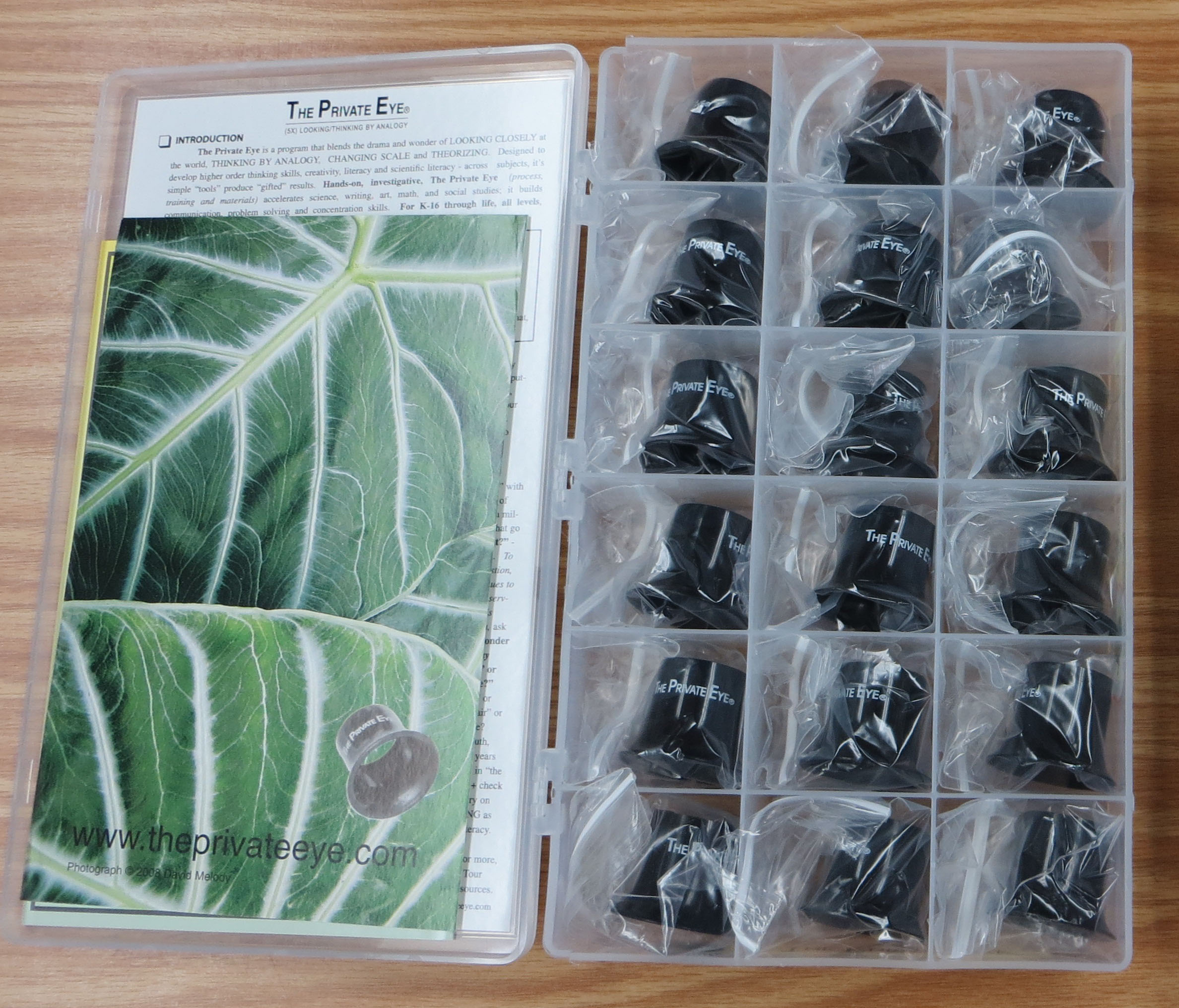
Bring out the private eye in your students!
Bring out the private investigator in your students with the Private Eye Magnifier kit. Great for enhancing outdoor discoveries and heightening student inquiry. Kit contains 36 loupes.
What’s in the box?
Set of 18 Private Eye loupes in a heavy-duty, poly-grid case (2)
Smokey Bear Kit
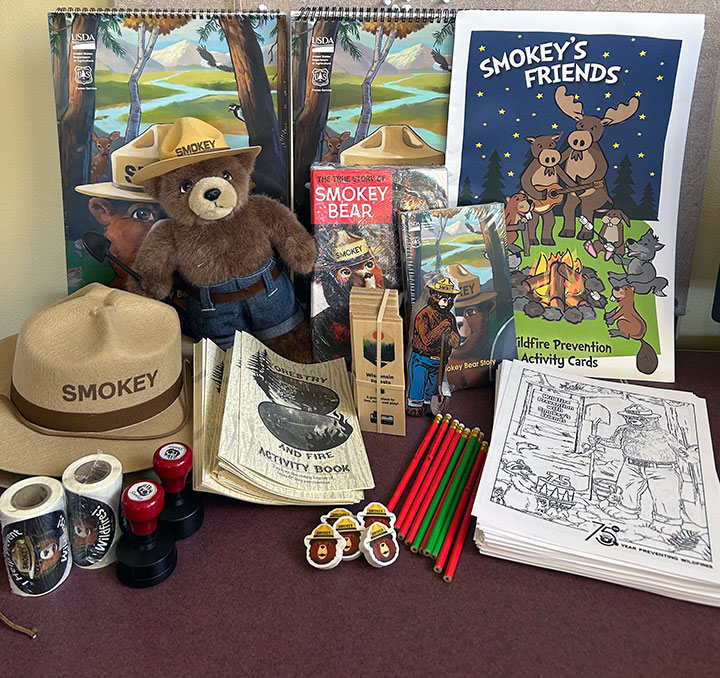
Spice up fire safety lessons!
Build literacy and fire safety skills with this Smokey Bear Kit! Learn about the history of Smokey Bear, read his story in English and Spanish, and spice up fire safety lessons with Smokey hats and a stuffed toy.
For a limited time only, celebrate Smokey’s 80th birthday with Smokey memorabilia students can keep! With Smokey comics, stories, coloring pages, pencils, erasers, bookmarks, and stickers, every student can take home their own set of Smokey gear. Available while supplies last.
What’s in the box?
- Permanent Items
- 2 Smokey Bear Story large flipbooks
- 3 Smokey Bear hats
- 1 stuffed toy Smokey Bear
- 2 Smokey stamps
- Smokey’s Friends activity cards
- LEAF Wildland Fire Lesson Guide
- Fire Career Cards (2 sets)
- The Smokey Bear Story
- “Smokey Bear Story” booklet (30 copies)
- “Meet Smokey Bear’s Team” booklet (30 copies)
- “Smokey Bear” comics (30 copies)
- Smokey’s First Steps
- Campfire plush pack (Plush logs, sticks, and flames to build a campfire indoors)
- Consumables (while supplies last!)
- Coloring pages
- Forestry and Fire Activity Book
- Smokey Bear erasers
- Pencils
- Wooden bookmarks
- Smokey Bear bookmarks
- Smokey Bear stickers
BioBlitz Tree and Log Scale Sticks Kit
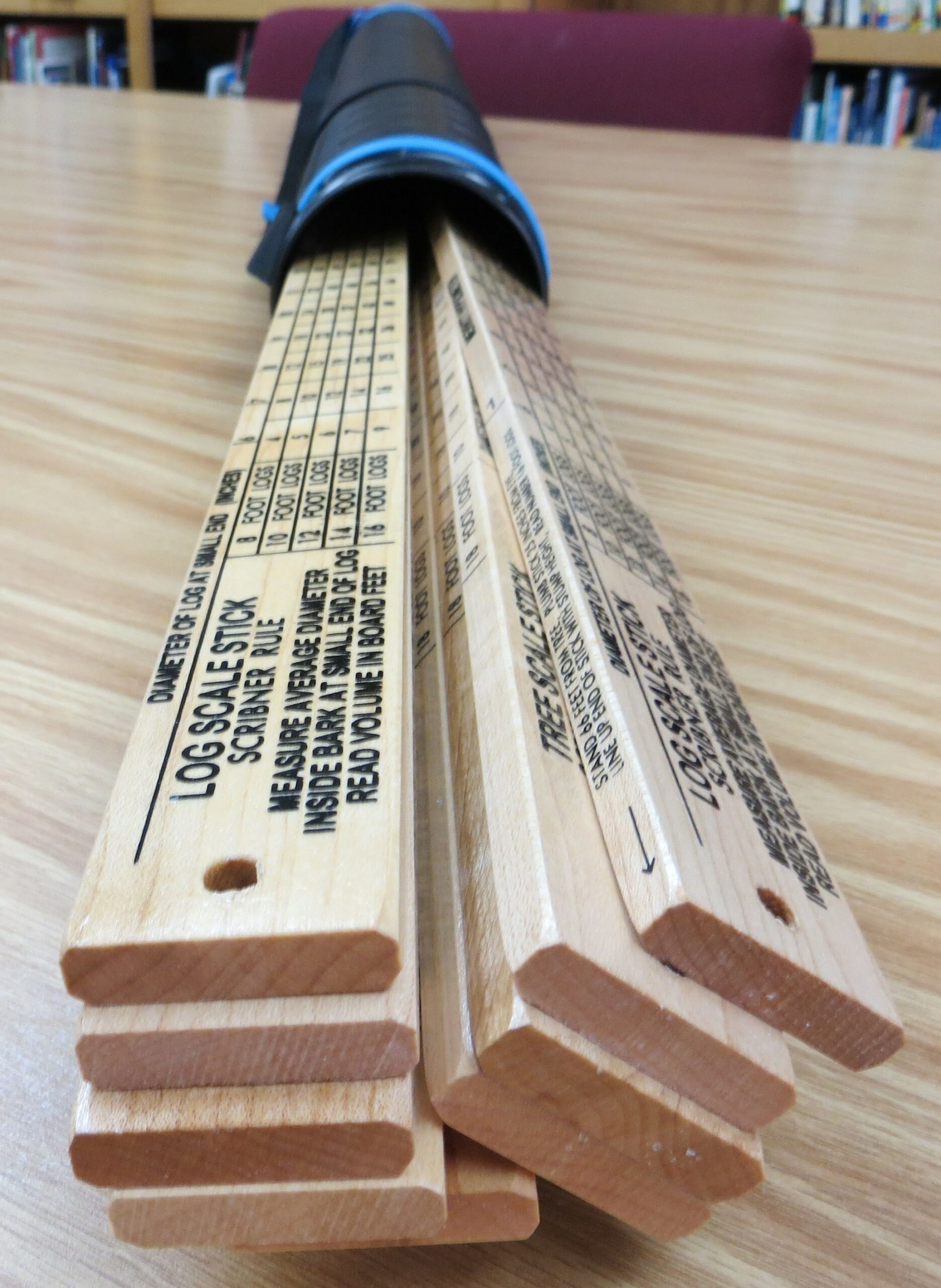
Grow measuring and math skills!
Develop your students’ measuring and math skills with the Tree and Log Scale Sticks. A Tree and Log Stick is a commonly used tool by foresters to measure tree diameters, heights and lumber potentials.
What’s in the box?
- 3 Carrying Cases
- 30 Tree and Log Scale Sticks
Enhance your kit experience
Need a lesson plan to go with it? Checkout LEAF’s Wood’s Worth Activity
Tree ID Kit
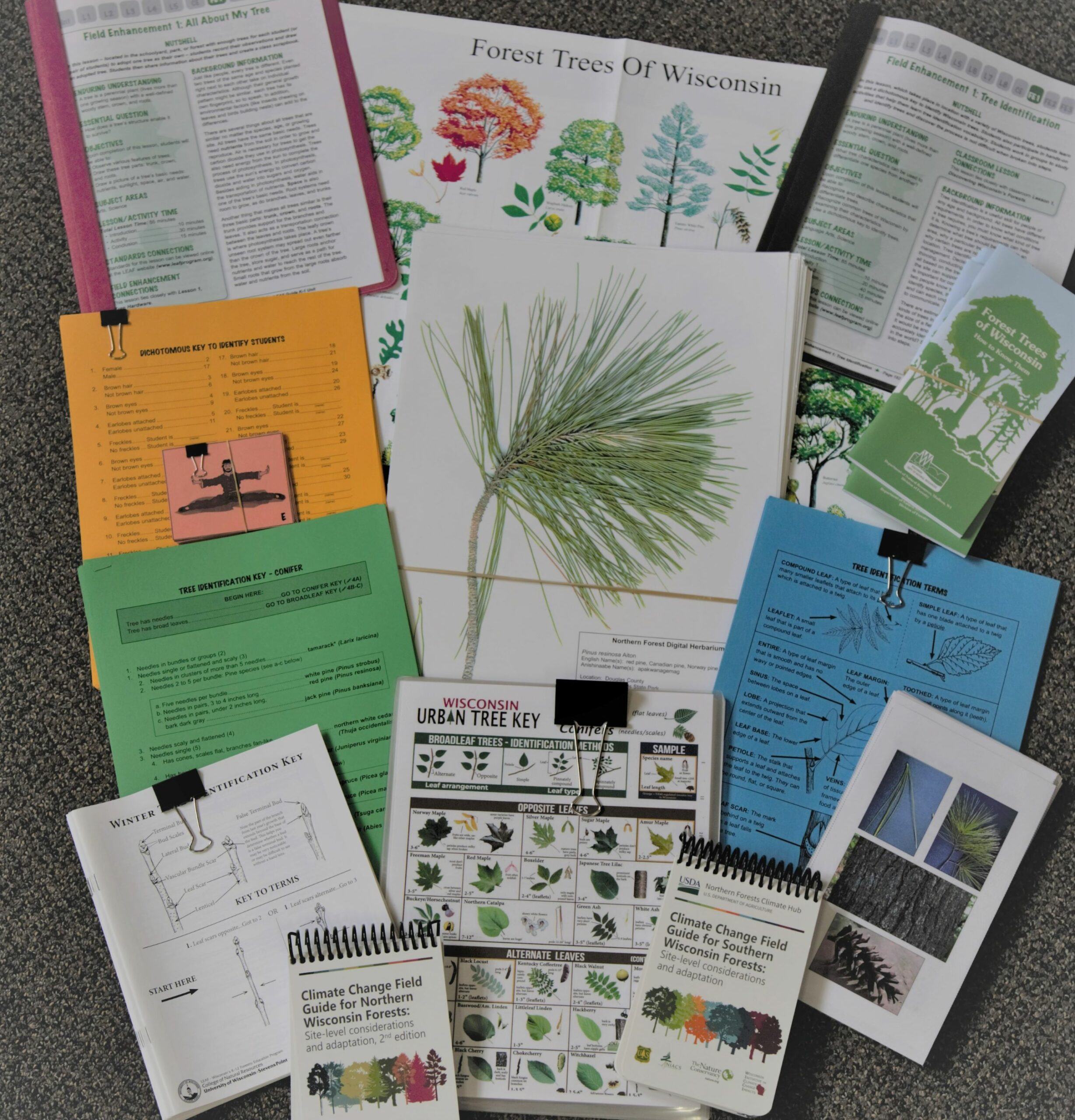
Become a master of identifying native Wisconsin trees!
LEAF’s Tree ID kit includes everything an educator needs to confidently work with students to master the skills of identifying trees that are native to Wisconsin. The kit pairs well with LEAF’s Field Enhancement 1, Tree Identification lesson or can be used independently as part of any Tree ID lesson. The kit also includes Climate Change Field Guides that will help students assess the impact a changing climate can have on trees in their communities.
What’s in the box?
- LEAF Tree ID Cards with Answer Key (41 species)
- Forest Trees of Wisconsin Booklets (30)
- LEAF Winter Tree ID Key (15)
- LEAF Tree ID Key (30)
- LEAF Tree Identification Terms Student Sheets (30)
- Tree Species from the Digital Herbarium (34 species)
- Wisconsin Urban Tree Key (15)
- Climate Change Field Guides (1 for Southern WI Forests, 1 for Northern WI Forests)
- Forest Trees of Wisconsin Poster (5)
- 7-8 LEAF Field Enhancement 1: Tree Identification
- Dichotomous Key to Identify Students (from 7-8 FE1: Tree ID) (15 keys, 2 sets of cards)
- K-1 Field Enhancement 1: All About My Tree
Enhance your kit experience
- Grades 3-12: LEAF Field Enhancement 1: Tree Identification
- Grades PK-2: LEAF K-1 Field Enhancement 1: All About My Tree
Wildland Fire Kit
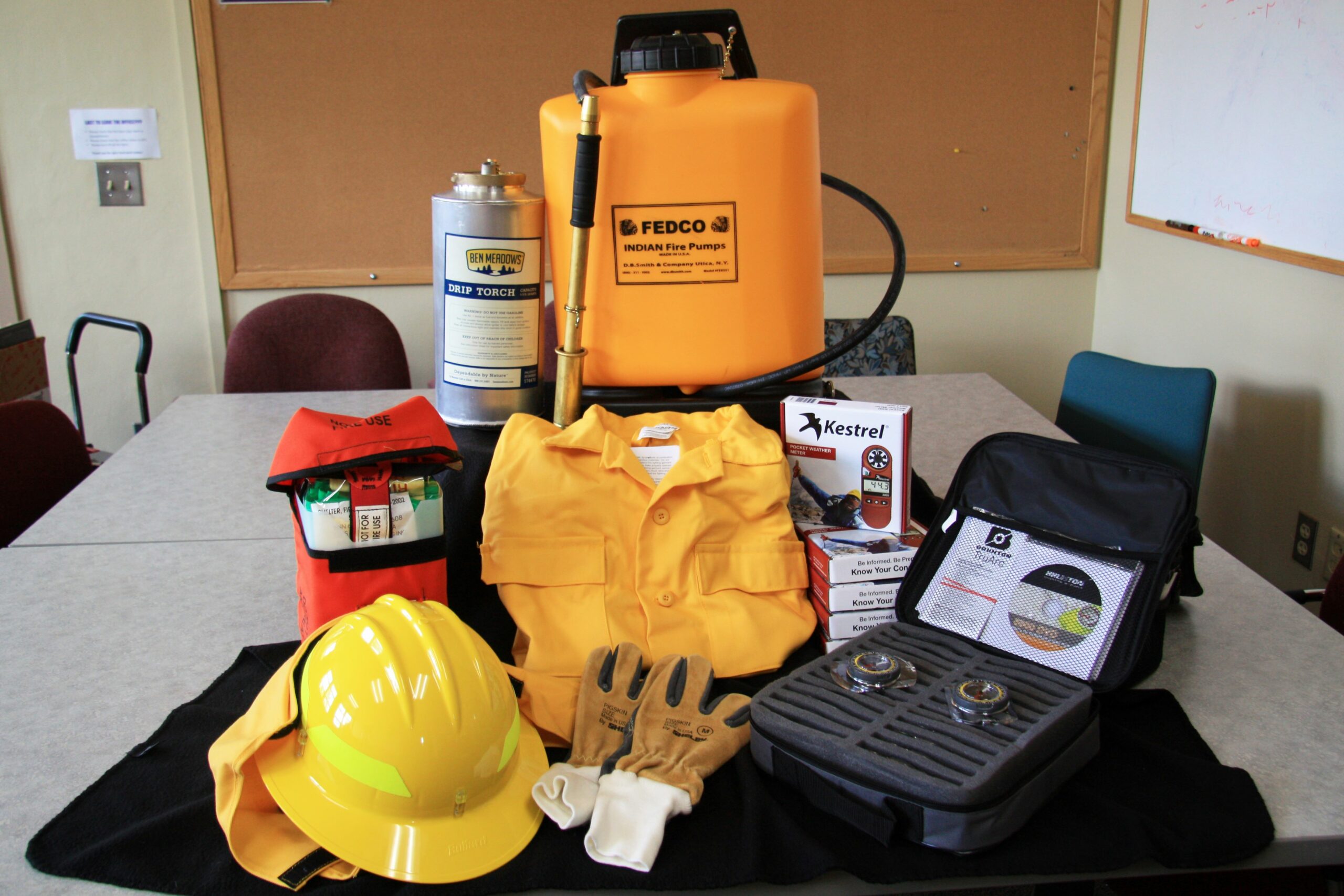
Model the cultural and historic practices of fire management!
The Wildland Fire Kit includes equipment to model what professional wildland firefighters use in the field. It includes protective gear, digging tools, mapping devices, and weather-monitoring equipment. Increase literacy skills with various fiction and non-fiction books focused on wildland firefighting and the cultural and historic practices of fire management. Pair this kit with LEAF’s K-12 Wildland Fire Lesson Guide (included in the kit) to teach students basic wildland fire principles.
Note: this kit is for educational purposes only. It is NOT to be used for firefighting.
What’s in the box?
- 24 compasses
- 1 drip torch
- 1 set of fire gloves
- 1 flame-resistant shirt
- 1 hard hat
- 1 fire hoe (*cannot be shipped)
- 1 fire pump
- 1 fire shelter
- 1 neck shroud
- 5 weather meters
- 1 K-12 Wildland Fire Lesson Guide
Enhance your kit experience
Wood Identification Blocks Kit
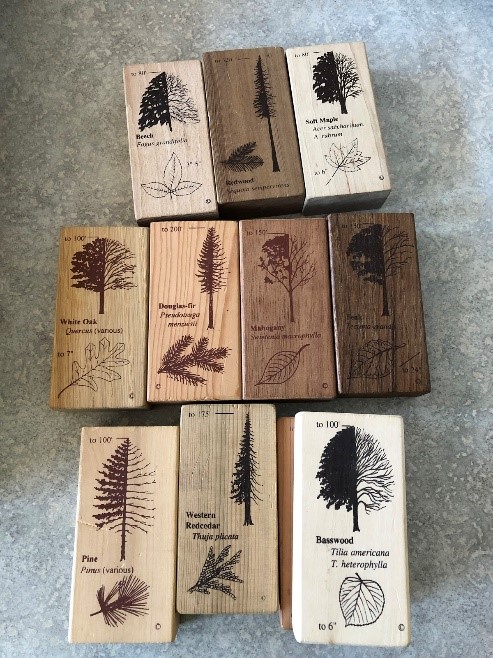
A tactile experience!
These wood identification blocks help bridge the gap between seeing pictures of trees in field guides and seeing the live tree itself! This kit contains 24 blocks of different species of wood. Each block is 4″ by 2″ by 1″ in size. This is a great tool to help students and adults see and feel the difference in colors, grains, and weights of wood.
What’s in the box?
- 24 Wood ID Blocks:
- Ash
- Basswood
- Bald Cypress
- Beech
- Black Cherry
- Birch
- Douglas-fir
- Eastern & Western Redcedar
- Elm
- Hickory
- Mahogany
- Pine
- Poplar
- Redwood
- Soft & Hard Maple
- Spruce
- Sweetgum
- Teak
- Walnut
- Western Hemlock
- White & Red Oak
- Lesson Guides
Enhance your kit experience
Into the Outdoors Managing the Forest for Multi-use episode – 6-8 lesson – People Need Wood Products