Physics

SMALL CLASSES, BIG ACHIEVEMENTS AWAIT YOU IN THE pHYSICS PROGRAM

Do you want a deeper understanding of how the physical universe works? If you’re curious about the world around you and you enjoy learning how physics explains everyday phenomena, the Department of Physics and Astronomy at UW-Stevens Point is the place for you!

Upper level students have co-authored published articles in scientific journals; others have presented talks describing their research at national conferences and regional meetings. Approximately half of our graduates accept fellowships or assistantships for advanced study at institutions across the country. Physics majors at UWSP can also enjoy study abroad opportunities, including academic coursework at sites worldwide, and short travel courses covering specialized topics.

Department of Physics and Astronomy

Why study Physics at UW-Stevens Point?

The Department of Physics and Astronomy can help you find rewarding employment upon completion of your degree. Graduates have found work as applications engineers, chemists, contractors, combat engineers, researchers, system administrators and teachers. Graduates have also pursued further schooling in aeronautical engineering, applied physics, astronomy, civil and environmental engineering, mathematics, nuclear engineering and security technologies. Current research activities involving students majoring in physics include astrophysics, optoelectronics, materials science, liquid crystals, and femtosecond lasers.

Physics and Astronomy Facilities

Grow your passion for astronomy and physics when you study at UWSP.  Hands-on learning opportunities include:

Through faculty research collaboration, the department has access to the world’s largest fully steerable radio telescope, the 100-meter Green Bank Telescope in West Virginia.


Dual Degree Physics and Engineering 3 + 2

Earn two degrees in five years, a bachelor of science degree in physics from UW-Stevens Point and a bachelor of science degree in engineering (biomedical, civil, electrical, industrial, materials or mechanical engineering) from UW-Milwaukee. The program includes three years and 90-95 credits at UW-Stevens Point and two years and 60 credits at UW-Milwaukee.

The dual-degree program helps students interested in an engineering career to get an enhanced background in physics. It will help you to distinguish yourself when you start your career, as well as when you must adapt to fast-paced industries in the long term.


Scholarships and Awards

The Department of Physics and Astronomy recognizes outstanding students at the annual School of Mathematics, Computing, Physics and Astronomy Awards. In 2026, a total of $55,000 was awarded thanks to our generous donors and endowed scholarships. Faculty will select the recipients based on academic achievement and scholastic merit.


WHAT TO EXPECT

Students work closely with professors in challenging coursework to earn a Bachelor of Science or Bachelor of Arts degree in physics. With either degree, a student may attain certification to teach at the secondary level.

Our department also offers two tracks within the physics major for students who plan to pursue a career in industry right after graduation: Physics Major with Applied Emphasis in Mechanics and Physics Major and the Physics Major with Applied Emphasis in Electronics.  Applied Emphasis majors are required to participate in an industrial internship either locally or in London through the Study Abroad Program.

Students may also lay the foundation for a career in biomedical, civil, industrial, materials or mechanical engineering as part of a physics/engineering dual-degree (3+2) program offered through a partnership with UW-Milwaukee. You can earn two degrees in five years through this dual-degree collaboration!

Academic minors may be obtained in physics, astronomy and natural science. Courses in astronomy are offered at the introductory and advanced levels. Pre-professional fields of study, such as engineering and medicine, also require certain courses in physics.

GET INVOLVED ON CAMPUS

Students interested in engaging with the professional community may get involved in the Society of Physics Students at UWSP. More opportunities can be found on the Stevens Point Involvement Network (SPIN).

Many students in the department are employed in relevant positions during their studies. Research assistants, tutors, graders, planetarium staff members and laboratory assistants are often hired by the department. In addition, a number of scholarships provide financial support to physics majors.

MORE STUDENT OPPORTUNITIES

Physics majors at UW-Stevens Point have been quite successful in national competition for summer research internships. In recent years, junior and senior level students have participated in programs at institutions such as Argonne and Brookhaven National Laboratories, Marshfield Clinic, Lucent Technologies, and at universities such as Cornell, MIT, Michigan State, and UW-Eau Claire. In addition, UWSP students enjoy access to a wide variety of study abroad opportunities. You could learn physics overseas!


MEET YOUR FACULTY

UW-Stevens Point physics classes are small, and students majoring in physics are able to work directly with faculty early in their academic careers. Faculty conduct research in areas such as astrophysics, optoelectronics, materials science, liquid crystals and femtosecond lasers.

Archives: Faculty / Staff Profiles – Faculty / Staff Directory

Profile Photo: Brad Hinaus

Brad Hinaus

  • Professor
Profile Photo: Chris Verzani

Chris Verzani

  • Associate Professor
Profile Photo: Mark Holdhusen

Mark Holdhusen

  • Professor
  • Chair, Department of Physics and Astronomy
381-D (UWSP at Wausau) and SCI B109 (Main campus)
Profile Photo: Maryam Farzaneh

Maryam Farzaneh

  • Professor of Physics
  • Physics/Engineering Dual Degree Coordinator

Physics for Educators

This certificate program is intended for, but not limited to, those students pursuing a degree in science education. The certificate can be completed concurrently with your undergraduate degree in Natural Sciences with teaching intent or a related field.

The certificate does not meet the requirements for a Physics license through the Wisconsin Department of Public Instruction.

Consists of 13 credits. View course catalog.
Required Courses, 13 credits:

  • PHYS 203 – College Physics I Credits: 5 and
  • PHYS 204 – College Physics II Credits: 5
    or
  • PHYS 240 – University Physics I Credits: 5 and
  • PHYS 250 – University Physics II Credits: 5

  • PHYS 300 – Modern Physics Credits: 3
    If you are completing the Physics 203/204 sequence, you need to take either Math 111 or Math 225 before taking Physics 300.

Earth and Space Science for Educators

This certificate program is intended for, but not limited to, those students pursuing a degree in science education. The certificate can be completed concurrently with your undergraduate degree in Natural Sciences with teaching intent or a related field. The certificate does not meet the requirements for an Earth/Space license through the Wisconsin Department of Public Instruction.

Consists of a minimum of 15 credits. The certificate is administered jointly by the Department of Physics and Astronomy and the Department of Geography and Geology.

Required Courses, 12 credits

  • ASTR 205 – The Solar System Credits: 4
  • ASTR 206 – Stars and Stellar Systems Credits: 4
  • GEOG 105 – The Dynamic Earth Credits: 3
  • GEOL 106 – Earth History Credits: 1

Elective Courses, 3 credits

Choose From:

  • ASTR 306 – Observational Astronomy Credits: 3
  • GEOG 208 – Weather and Climate Credits: 3
  • GEOG 308 – Climate: Past, Present, and Future Credits: 3 or
  • GEOL 308 – Climate: Past, Present, and Future Credits: 3
  • GEOG 312 – Geomorphology Credits: 3 or
  • GEOL 312 – Geomorphology Credits: 3
  • GEOL 104 – Physical Geology Credits: 4
  • GEOL 230 – Environmental Geology Credits: 3
  • GEOL 370 – Glacial Geology Credits: 3

For more information, please visit the UW-Stevens Point course catalog.

Pre-Engineering Curriculum

This is a two year program in which students take core math, physics and chemistry classes in preparation for acceptance into an engineering program other than in Paper Science and Engineering and Chemical Engineering.

For all pre-engineering areas except pre-chemical engineering, you should take the following physics and mathematics courses in your freshman and sophomore years: Math 225, 226, 227, 230 and Physics 240, 250, 300. Chemistry 105, 106 (or 117) is also recommended.

Pre-Engineering students also have the option of completing a Pre-Engineering Associate Degree or taking some introductory engineering courses as electives at our Wausau campus (online or hybrid option may be available). These courses include:

  • ENGR 105 – Engineering fundamentals
  • ENGR 107 – Engineering Graphics with Computer Aided Drafting (CAD)
  • ENGR 111 – Solid Modeling and Design
  • ENGR/PHYS 220 – Statics
  • ENGR 221 – Dynamics
  • ENGR 222 – Mechanics of Materials
  • ENGR 263 – Engineering Thermodynamics
  • ENGR 294 – Internship in Engineering
  • ENGR 299 – Independent Study in Engineering

Please contact your adviser or Dr. Mark Holdhusen (mholdhus@uwsp.edu) to discuss the electives that are right for you.

Specific engineering curricula and universities have individual requirements. See a physics advisor for additional information and suggested electives. For pre-chemical engineering and/or ABET accredited engineering, see Paper Science and Engineering in the catalog.

Physics with Applied Electronics Emphasis

This is one of the two applied tracks within the physics major aimed at the students who will pursue a career in industry right after graduation. You will take most of the core upper-level physics courses, especially those with a laboratory component. To major in physics with Applied Electronics Emphasis, you are required to participate in an industrial internship. This can take place either at a local business or in London through the Study Abroad Program.

Department of Physics and Astronomy

Why study Physics with Applied Electronics Emphasis at UW-Stevens Point?

The Department of Physics and Astronomy can help you find satisfying and appropriate employment upon completion of your degree. Graduates have found work as applications engineers, chemists, contractors, combat engineers, researchers, system administrators and teachers. Graduates have also pursued further schooling in aeronautical engineering, applied physics, astronomy, civil and environmental engineering, mathematics, nuclear engineering and security technologies.

Physics majors at UW-Stevens Point enjoy study abroad opportunities, including academic coursework at sites worldwide, London internships and short travel courses covering specialized topics.


Scholarships and Awards

The Department of Physics and Astronomy recognizes outstanding students at the annual School of Mathematics, Computing, Physics and Astronomy Awards. In 2026, a total of $55,000 was awarded thanks to our generous donors and endowed scholarships.


Study Abroad

Physics majors at UW-Stevens Point can also enjoy study abroad opportunities, including academic coursework at sites worldwide, London internships and short travel courses covering specialized topics.


Please consult with the Applied Emphasis Coordinator when planning your major. Some physics courses are offered only in alternate years.

REQUIREMENTS:

The physics major with an applied electronics emphasis consists of a minimum of 62 credits including:  

  1. Math 225, 226, 227, 230
  2. Chemistry 105 or 117
  3. Physics 111, 240, 250, 300, 315, 320, 370, 470
  4. Physics 383 or 385
  5. Physics 490, 6 credits
  6. Economics 110 or Business 320

More information available on UW-Stevens Point course catalog.


Applied Emphasis Coordinator:
Chris Verzani
Associate Professor
Office: SCI B103
Email: cverzani@uwsp.edu

GET INVOLVED ON CAMPUS

Students interested in engaging with the professional community may get involved in the Society of Physics Students at UWSP. More opportunities can be found on the Stevens Point Involvement Network (SPIN).

Many students in the department are employed in relevant positions during their studies. Research assistants, tutors, graders, planetarium staff members and laboratory assistants are often hired by the department. In addition, a number of scholarships provide financial support to physics majors.

The Department of Physics and Astronomy is a member of the Wisconsin Space Grant Consortium (WSGC). Our students have the opportunity to apply for various types of undergraduate programs and scholarships. Find out if any of these might be right for you!

MEET YOUR FACULTY

UW-Stevens Point physics classes are small, and students majoring in physics are able to work directly with faculty early in their academic careers. Faculty conduct research in areas such as astrophysics, optoelectronics, materials science, liquid crystals and femtosecond lasers.

Archives: Faculty / Staff Profiles – Faculty / Staff Directory

Profile Photo: Chris Verzani

Chris Verzani

  • Associate Professor
Profile Photo: Kenneth Menningen

Kenneth Menningen

  • Professor
Profile Photo: Mark Holdhusen

Mark Holdhusen

  • Professor
  • Chair, Department of Physics and Astronomy
381-D (UWSP at Wausau) and SCI B109 (Main campus)
Profile Photo: Palash Banerjee

Palash Banerjee

  • Professor
  • Principal Investigator, Applied Physics and Instrumentati…

Astronomy

The minor in astronomy will help prepare UW-Stevens Point students for entry into the competitive science, technology, engineering and mathematics workplace. The minor complements any science major, which can give students an advantage securing employment in education, industry, science museums and observatories, among other potential employers.

OBSERVATIONAL ASTRONOMY

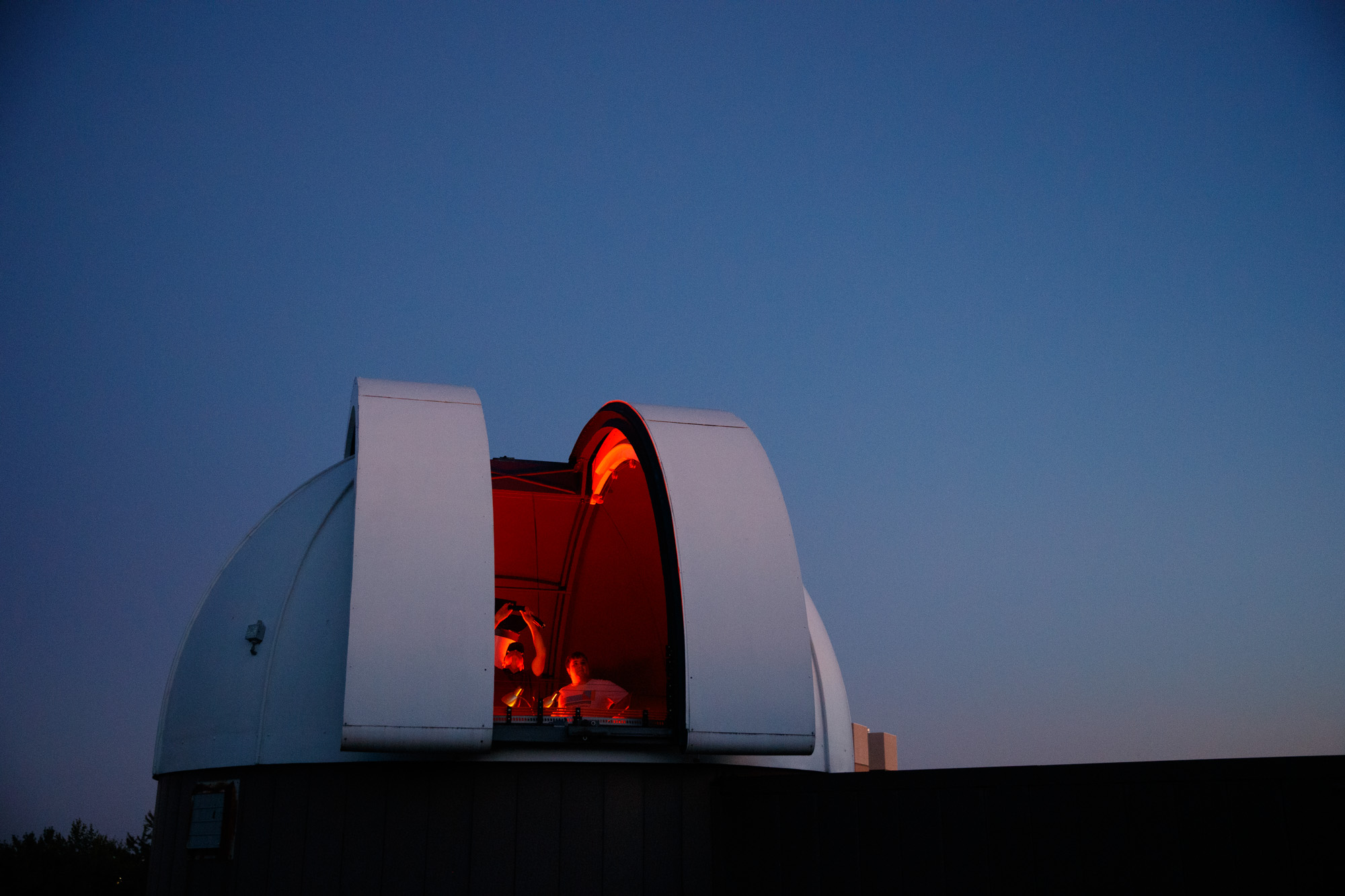
The program includes in its core courses a new Observational Astronomy class that takes advantage of the Arthur J. Pejsa Observatory, located in our Science Building. UWSP is the second comprehensive UW institution to offer such a program.

astronomy


According to Professor Brad Hinaus, “The astronomy minor provides students the opportunity to explore some of the most exciting topics in modern-age science, from the feasibility of colonizing Mars to the discovery of habitable planets orbiting other stars, from the exotic black holes lurking at the cores of large galaxies to the elusive neutrinos and gravitational waves that expand our view into the universe. Students minoring in astronomy gain exposure to the principles of astronomy, physics and mathematics. They learn to think critically and evaluate, interpret and solve problems related to the astronomical, as well as other technical and general scientific topics.”

In addition to the Pejsa Observatory, students will also use the Allen F. Blocher Planetarium, which is used as an immersive instructional tool for most astronomy courses required to complete the minor.

The astronomy minor consists of a minimum of 24 credits. For more information visit the UW-Stevens Point course catalog.

  • PHYS 203  – College Physics I (5 cr.)  or  PHYS 240 – University Physics I (5 cr.)
  • PHYS 204  – College Physics II (5 cr.)  or  PHYS 250 – University Physics II (5 cr.)
  • ASTR 205 – The Solar System (4 cr.)
  • ASTR 206 – Stars and Stellar Systems (4 cr.)
  • ASTR 306 – Observational Astronomy (3 cr.)
  • ASTR 305 – The History of Astronomy (3 cr.)  or  PHYS 384 – Astrophysics (3 cr.)

When you decide to minor in astronomy, register in the department office to be assured of proper advising. To be accepted as a minor you must have a minimum grade point average of 2.00, regardless of a declaration of academic bankruptcy. The department may grant exceptions. No more than one grade below C- in physics and astronomy courses numbered 300 or above may be applied to the minor.

For more information on the astronomy minor, contact Adriana Durbala at Adriana.Durbala@uwsp.edu or Sebastian Zamfir at Sebastian.Zamfir@uwsp.edu

Physics

A minor in physics gives you an outstanding foundation for understanding science and technology. By succeeding in a challenging field of study, you will be able to distinguish yourself when you start a job or a career!

The physics minor consists of the following:

  1. A minimum of 25 credits including Physics 111, 240, 250, 300 and other physics courses numbered above 300 not including 390 and 490. At least one elective must include a laboratory.
  2. Math 225, 226, 227.
  3. A minor in physics is certifiable for teaching only when accompanied by a certificate in another science (biology, chemistry, earth and space science, or environmental science) as part of the Natural Science for Science Teaching Certification degree.
  4. When you decide to minor in physics, register in the department office to be assured of proper advising. To be accepted as a minor you must have a minimum grade point average of 2.00 (2.75 to student teach), regardless of a declaration of academic bankruptcy. The department may grant exceptions. No more than one grade below C- in physics courses numbered 300 or above may be applied to the minor.

For more information visit the UW-Stevens Point course catalog.

Physics with Applied Mechanics Emphasis

This is one of the two applied tracks within the physics major aimed at the students who will pursue a career in industry right after graduation. You will take most of the core upper-level physics courses, especially those with a laboratory component. To major in physics with Applied Mechanics Emphasis you are required to participate in an industrial internship. This can take place either at a local business or in London through the Study Abroad Program.

Please consult with the Applied Emphasis Coordinator when planning your major. Some physics courses are offered only in alternate years.

Department of Physics and Astronomy

Why study Physics with Applied Mechanics Emphasis at UW-Stevens Point?

The Department of Physics and Astronomy can help you find satisfying and appropriate employment upon completion of your degree. Graduates have found work as applications engineers, chemists, contractors, combat engineers, researchers, system administrators and teachers. Graduates have also pursued further schooling in aeronautical engineering, applied physics, astronomy, civil and environmental engineering, mathematics, nuclear engineering and security technologies.

Physics majors at UW-Stevens Point can also enjoy study abroad opportunities, including academic coursework at sites worldwide, London internships and short travel courses covering specialized topics.


Scholarships and Awards

The Department of Physics and Astronomy recognizes outstanding students at the annual School of Mathematics, Computing, Physics and Astronomy Awards. In 2026, a total of $55,000 was awarded thanks to our generous donors and endowed scholarships.


Study Abroad

Physics majors at UW-Stevens Point can also enjoy study abroad opportunities, including academic coursework at sites worldwide, London internships and short travel courses covering specialized topics.


REQUIREMENTS:

The physics major with an applied mechanics emphasis consists of a minimum of 61 credits including:  

  1. Math 225, 226, 227, 230.
  2. Chemistry 105 or 117.
  3. Physics 111, 240, 250, 300, 315, 335, 370, 435, 470.
  4. Physics 490 (6 credits).
  5. Economics 110 or Business 320.

More information available on UW-Stevens Point course catalog.

Applied Emphasis Coordinator:
Chris Verzani
Associate Professor

Office: SCI B103
Email: cverzani@uwsp.edu

GET INVOLVED ON CAMPUS

Students interested in engaging with the professional community may get involved in the Society of Physics Students at UWSP. More opportunities can be found on the Stevens Point Involvement Network (SPIN).

Many students in the department are employed in relevant positions during their studies. Research assistants, tutors, graders, planetarium staff members and laboratory assistants are often hired by the department. In addition, a number of scholarships provide financial support to physics majors.

The Department of Physics and Astronomy is a member of the Wisconsin Space Grant Consortium (WSGC). Our students have the opportunity to apply for various types of undergraduate programs and scholarships. Find out if any of these might be right for you.

MEET YOUR FACULTY

UW-Stevens Point physics classes are small, and students majoring in physics are able to work directly with faculty early in their academic careers. Faculty conduct research in areas such as astrophysics, optoelectronics, materials science, liquid crystals and femtosecond lasers.

Archives: Faculty / Staff Profiles – Faculty / Staff Directory

Profile Photo: Brad Hinaus

Brad Hinaus

  • Professor
Profile Photo: Chris Verzani

Chris Verzani

  • Associate Professor
Profile Photo: Mark Holdhusen

Mark Holdhusen

  • Professor
  • Chair, Department of Physics and Astronomy
381-D (UWSP at Wausau) and SCI B109 (Main campus)
Profile Photo: Maryam Farzaneh

Maryam Farzaneh

  • Professor of Physics
  • Physics/Engineering Dual Degree Coordinator
Physics and Engineering Dual

YOUR ENGINEERING CAREER STARTS AT UW-STEVENS POINT WITH THE PHYSICS-ENGINEERING DUAL-DEGREE PROGRAM

The physics-engineering dual-degree program at the University of Wisconsin Stevens Point provides a broad base of skills designed to integrate with a variety of UW System engineering programs.

Students can earn a degree in physics and a second degree in engineering in just five years. This comprehensive program allows you to gain expertise for a career in biomedical, civil, electrical, industrial, materials or mechanical engineering.

Department of Physics and Astronomy

Why study Physics and Engineering at UW-Stevens Point?

You can earn both a Bachelor of Science degree in physics from UW-Stevens Point and a Bachelor of Science degree in engineering from UW-Milwaukee in a total time of five years! Approximately three years (roughly 90-95 credits) of the program are spent at UW-Stevens Point and approximately two years (roughly 60 credits) at UW-Milwaukee. Note: The start of the five-year timeline corresponds with enrollment in MATH 225 (Calculus I) at UW-Stevens Point. There are many variables that affect the time to degree for each individual student.


Scholarships and Awards

The Department of Physics and Astronomy recognizes outstanding students at the annual School of Mathematics, Computing, Physics and Astronomy Awards. In 2026, a total of $55,000 was awarded thanks to our generous donors and endowed scholarships.


UW-Stevens Point Dual-Degree Program Course Requirements

Complete all requirements of UW-Stevens Point’s General Education Program (GEP) for the physics B.S. major. UW-Milwaukee accepts UW-Stevens Point credits to satisfy its own general education requirements for students.

Complete a core set of required courses in physics, mathematics, and chemistry. These include:

  • Math 225, 226, 227, 230, 320.
  • Chemistry 105, 106 (Chemistry 117 may be replaced for the 105/106 sequence.)
  • Physics 240, 250, 300, 315, 470.

Please note that some required core engineering courses (Statics, Dynamics, Engineering Thermodynamics, Mechanics of Materials, etc.) can be completed at UW-Stevens Point at Wausau. You may take these courses either in person or online. Please consult with the dual-degree program coordinator for more details.

Complete two elective upper-level courses in physics, in addition to the core courses. The elective courses may be chosen from the following:

  • Physics 320, 335, 370, 385, 405, 435.

Note: Whether elective courses will satisfy your future engineering requirements is dependent upon the specific elective courses and the specific engineering program to which you are admitted at UW-Milwaukee.

UW-Stevens Point students who meet all course requirements with a GPA of 2.5 or higher will be admitted to an engineering program at UW-Milwaukee.

For more information visit the UW-Stevens Point course catalog. Choose “Academic Programs” and scroll down to “Physics and Engineering, BS Dual-Degree (3 + 2 Track)”

UW-Milwaukee Dual-Degree Program Course Requirements

Complete the remaining core engineering courses required for your engineering degree.

When a minimum of 30 credits of required core engineering courses is completed, students may submit a UW-Milwaukee transcript to UW-Stevens Point for credit transfer. UW-Stevens Point will accept 30 credits of core engineering courses completed at UW-Milwaukee to fulfill the remaining requirements for the physics bachelor’s degree.

 Dual-Degree Program Coordinator

Professor Maryam Farzaneh
Office: SCI-B105 
Email: mfarzane@uwsp.edu

MEET YOUR FACULTY

UW-Stevens Point physics classes are small, and students majoring in physics are able to work directly with faculty early in their academic careers. Faculty conduct research in areas such as astrophysics, optoelectronics, materials science, liquid crystals and femtosecond lasers.

Archives: Faculty / Staff Profiles – Faculty / Staff Directory

Profile Photo: Kenneth Menningen

Kenneth Menningen

  • Professor
Profile Photo: Mark Holdhusen

Mark Holdhusen

  • Professor
  • Chair, Department of Physics and Astronomy
381-D (UWSP at Wausau) and SCI B109 (Main campus)
Profile Photo: Maryam Farzaneh

Maryam Farzaneh

  • Professor of Physics
  • Physics/Engineering Dual Degree Coordinator
Pre-Engineering Associate of Science

After Fall 2026, we are no longer enrolling in the program.

ACHIEVE A BROAD BASE OF KNOWLEDGE IN ENGINEERING, MATH, AND SCIENCE

The program is designed to provide transfer pathways to a variety of University of Wisconsin System baccalaureate programs and consists of 61-67 credits. The total includes 45 that satisfy general requirements, 15-20 required to provide math and basic science courses relevant to engineering, and 3-4 engineering elective credits. Pre-engineering associate degree courses are delivered primarily face-to-face, with some courses now offered 100% distance delivery.

TRANSFER TO UW SYSTEM ENGINEERING SCHOOLS

The UW-Stevens Point AS in Pre-Engineering allows for smooth transfer into engineering programs across the University of Wisconsin System, including these ABET-accredited engineering programs:

UW-Madison, UW-Platteville, UW-Milwaukee

  • B.S. in Mechanical Engineering
  • B.S. in Civil Engineering
  • B.S. in Electrical Engineering

UW-Stout

  • B.S. in Manufacturing Engineering
  • B.S. in Mechanical Engineering

Other Transfer Possibilities

Milwaukee School of Engineering, Michigan Tech, University of Minnesota-Duluth, University of Minnesota-Twin Cities, and others. Your faculty adviser can assist you in evaluating other programs.

Completing the AS satisfies general education requirements at all UW System schools.

WHAT TO EXPECT

The pre-engineering curriculum gives you a solid foundation in math, chemistry, and physics to prepare you for acceptance into an engineering school. The Pre-Engineering Associate Degree also includes courses that will fully satisfy your general education requirements. You might take a few introductory engineering courses at UWSP, but the primary goal of the pre-engineering curriculum is to prepare you for the engineering courses you will take after transferring to an engineering school.

GET INVOLVED ON CAMPUS

Students interested in engaging with the professional community may get involved in the Society of Physics Students at UWSP. More opportunities can be found on the Stevens Point Involvement Network (SPIN).