
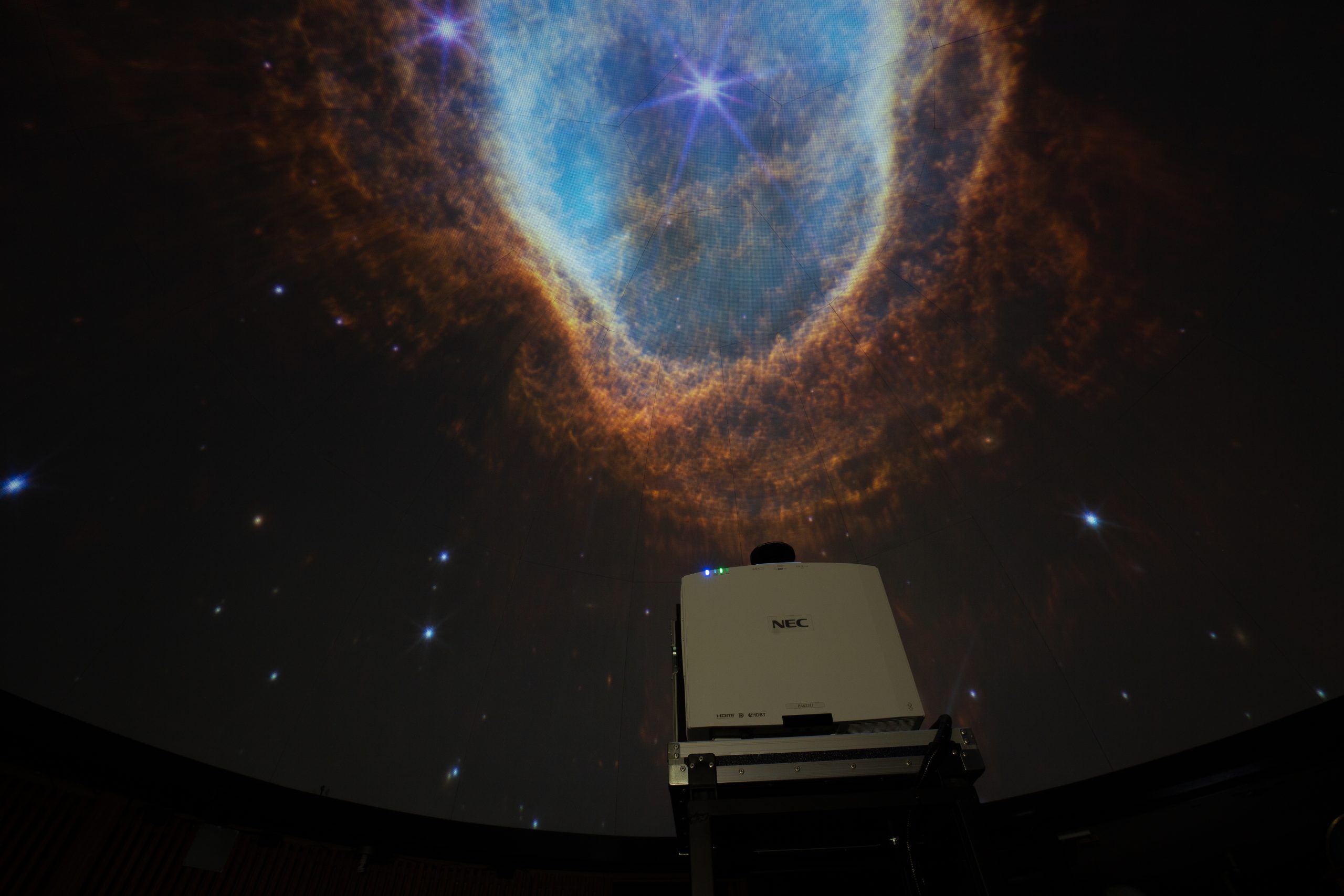
JOURNEY INTO THE UNIVERSE, INSIDE THE UW-STEVENS POINT PLANETARIUM
UW-Stevens Point opens our shows to the public in the Allen F. Blocher Planetarium. The space consists of a 7.3m diameter dome that houses a Digistar Lite projector. This immersive instructional tool is used for most astronomy courses at UWSP.
Planetarium shows provide impactful experiential learning experiences. Themes are selected to educate the public on topics ranging from cosmic cycles to planetary systems, exoplanets, telescopes, cosmology, the history of space exploration, and much more. Weekly public shows are presented throughout the academic year, typically on Sunday afternoons at 2:00 p.m. During the eight weeks of the summer (end of May through the end of July), the planetarium hosts regular public evening shows, twice per week, on Monday and Wednesday nights at 7:00 p.m.
2026-2027 Featured Shows
- Sunday, Sept. 13 – 2 p.m. “Supermassive Black Holes ” – We explore the environments of the black holes in an impressive and understandable way to the audience.
- Sunday, Sept. 13 – 3:30 p.m. “Traveling Around the World” – Junior Scientist – From the pyramids of Egypt to the beaches of Rio de Janeiro, viewers discover fascinating places, cultures, and stories through a dynamic and engaging narrative. A show perfect for family learning time! Offered as part of the Junior Scientist program, in collaboration with the Olson Museum of Natural History. Join a book reading in SCI A201, followed by the planetarium program at 3:30 p.m.
- Sunday, Sept. 20 – 2 p.m. “Mars, the Ultimate Voyage” – Explore the challenges of deep space exploration in a full-dome show to see the Red Planet.
- Sunday, Sept. 27 – 2 p.m. “One Sky Project” – Through a collection of short films, learn how different cultures see and interpret humanity’s shared sky.
- Sunday, Oct. 4 – 2 p.m. “Cosmic Origins Spectrograph” – We explore the science of spectroscopy and highlight how the Hubble Space Telescope’s COS instrument analyzes light to decipher the cosmic evolution, composition, and large-scale structures of our universe.
- Saturday, Oct. 10 – Family Day for UWSP Homecoming
10 a.m. – “From Earth to the Universe”
11 a.m. – “Supermassive Black Holes”
1 p.m. – “Two Small Piece of Glass – The Amazing Telescope”
2 p.m. – “Phantom of the Universe – The Hunt for Dark Matter”
3 p.m. – “Mars, The Ultimate Voyage”
4 p.m. – “Sunstruck”
7:30- 10 p.m. – Stargazing at Specht Memorial Forum (weather permitting) - Sunday, Oct. 11 – 2 p.m. “Two Small Pieces of Glass” – Learn the history of the telescope from Galileo’s modifications to a child’s spyglass — using two small pieces of glass — to the launch of the NASA/ESA Hubble Space Telescope and the future of astronomy.
- Sunday, Oct. 11 – 3:30 p.m. “The Solar System” – Junior Scientist – We explore the Sun and the eight planets of our own planetary system. A show perfect for family learning time! Offered as part of the Junior Scientist program, in collaboration with the Olson Museum of Natural History. Join a book reading in SCI A201 starting at 3:00 p.m., followed by the planetarium program at 3:30 p.m.
- Sunday, Oct. 18 – 2 p.m. “Mysteries of Your Brain” (included in the Wisconsin Science Festival) – Let’s go on an immersive, animated adventure into the human brain, exploring how the brain works and what makes human brains so special.
- Sunday, Oct. 25 – 2 p.m. “Spark: The Universe in Us” (included in the Wisconsin Science Festival) – We explore how hundreds of millions of celestial events have forged the elements that make up the Solar System, Earth, and us.
- Sunday, Nov. 1 – 2 p.m. “Messengers of Time and Space” – We show how astronomers combine light, cosmic rays, neutrinos, and gravitational waves to observe cosmic events and uncover the mysteries of our ever-changing Universe.
- Sunday, Nov. 8 – 2 p.m. “Big Astronomy: People, Places, Discoveries” – We invite the viewers behind the scenes of world-class observatories in Chile to meet the diverse people, explore the places, and discover the many careers that make groundbreaking astronomical research possible.
- Sunday, Nov. 8 – 3:30 p.m. “Constellations” – Junior Scientist – Let’s learn the constellations! A show perfect for family learning time! Offered as part of the Junior Scientist program, in collaboration with the Olson Museum of Natural History. Join a book reading in SCI A201 starting at 3:00 p.m., followed by the planetarium program at 3:30 p.m.
- Sunday, Nov. 15 – 2 p.m. “The Sun, Our Living Star” – We take viewers on an immersive journey into our nearest star, revealing its turbulent surface, powerful energy, and essential role in driving Earth’s weather, marking time, and sustaining life.
- Sunday, Nov. 22 – 2 p.m. “5000 Eyes: Mapping the Universe with DESI” – Join us on an immersive journey into modern astronomy, exploring how a powerful instrument with 5,000 robotic eyes maps thousands of galaxies to reveal the universe’s vast structure and help scientists understand its evolution.
- Sunday, Dec. 6 – 2 p.m. “Big Astrobiology Questions” – This show takes you on a journey to answer some of the biggest questions in the universe. How did Earth develop a habitable environment? Where did life come from? Could life exist elsewhere? Humans have been asking these questions for centuries, and their pursuit of knowledge led to the launch the OSIRIS-REx mission. On its quest to study and sample the asteroid Bennu, OSIRIS-REx has shaped our understanding of planetary formation and the existence of life on Earth.
- Sunday, Dec. 13 – 2 p.m. “Phantom of the Universe – Th Search for Dark Matter” – We explore the historical discovery of and ongoing hunt for dark matter. The journey will be tracking early cosmic clues discovered by scientists Fritz Zwicky and Vera Rubin, deep-diving into an underground detector in South Dakota, and witnessing particle collisions inside the Large Hadron Collider.
- Sunday, Dec. 13 – 3:30 p.m. “The Calendar and the Cosmic Cycles” – We will explore the meaning of the units of time that define our time-keeping system and calendar (day, month, year, etc.). Join a book reading in SCI A201 starting at 3:00 p.m., followed by the planetarium program at 3:30 p.m.
- Sunday, Dec. 20 – 2:00 p.m. “Season of Light” – Humans are so fascinated with lighting up their lives during the December holiday season. The show is an exploration of the astronomical meanings behind seasonal traditions, with an emphasis on astronomical and cultural themes related to the holiday season.
The planetarium and observatory facilities are operated and maintained by staff and student workers in the UW-Stevens Point Department of Physics and Astronomy. Our planetarium and observatory director is Dr. Sebastian Zamfir.
WHERE TO FIND US
The Allen F. Blocher planetarium is located on the second floor of the Science Building, by the Foucault pendulum, right above the east main entrance. Direct access is obtained through the east entrance. Planetarium programs for groups (schools, scouts, organizations, etc.) can be arranged during our academic year and our summer sessions.
The planetarium is typically open from early September through mid-December and from mid-January through late July. Public observing sessions with portable telescopes are scheduled weekly (Monday, Tuesday, and Wednesday nights) from mid-September through mid-December, and from late-January through mid-May, subject to weather constraints.
FREQUENTLY ASKED QUESTIONS
Don’t see an answer to your question? Call 715-346-2120 or email physastr@uwsp.edu
What are Blocher Planetarium’s hours?
The Blocher Planetarium is open for public scheduled shows at 2:00 pm on Sundays during the regular academic year, at 7:00 pm on Mondays and Wednesdays from late May until late July during the summer, and by group reservation. The planetarium and observatory are closed during the University interim and break periods.
What is the seating capacity?
Planetarium seating is first come, first served for up to 55 people.
When can I visit the Pejsa Observatory?
The Pejsa Observatory telescope (located in the dome atop the Science Building) has been upgraded for undergraduate research projects in observational astronomy and it is not accessible to the public at this time. However, if there are clear skies, public stargazing sessions with portable telescopes are available from mid-September through mid-May on Monday, Tuesday, and Wednesday nights (from 8:30-10:00pm), weather permitting. Meet between the SRC and Fine Arts Building to use the telescopes at the sundial. Free parking is available in Lot R, across from Portage Street. Viewings will be held only if the skies are clear and the temperature is above 20 degrees Fahrenheit.
How do you reserve the Planetarium?
Your group, of eight or more, can rent the Blocher Planetarium for special showings. Program rental charge is $35/show. The payment can be paid at the time of your visit.
We ask that you complete this request form completely, including your contact information and desired date. You may also call our office at 715-346-2120.
Where should I park?
Parking is free on campus for our guests only on Saturdays and Sundays. From Monday-Friday, the UWSP parking lots are enforced 2 am – 7 pm. Please visit this website for more details about parking options, rules, and regulations.
What are the Planetarium show fees?
There is no charge for our public programs, although donations are greatly appreciated. For private shows (school groups, scout organizations, etc.) we charge $35.00 per show per group.