
The earliest mention of a museum at UWSP goes back to the founding of the campus and the construction of the Normal School Old Main Building in 1894. By 1898, mounted bird and study skin collections, formerly housed in the Assembly Room, were relocated to the third floor “Biology Laboratory” and were combined with biologic and other natural history specimens. By 1903, a formal museum existed in Old Main. This museum was divided into three main disciplines, “Biological, Geological, and Historical.” The majority of the biological specimens were obtained from the Smithsonian Institution and Woods Hole, Mass.
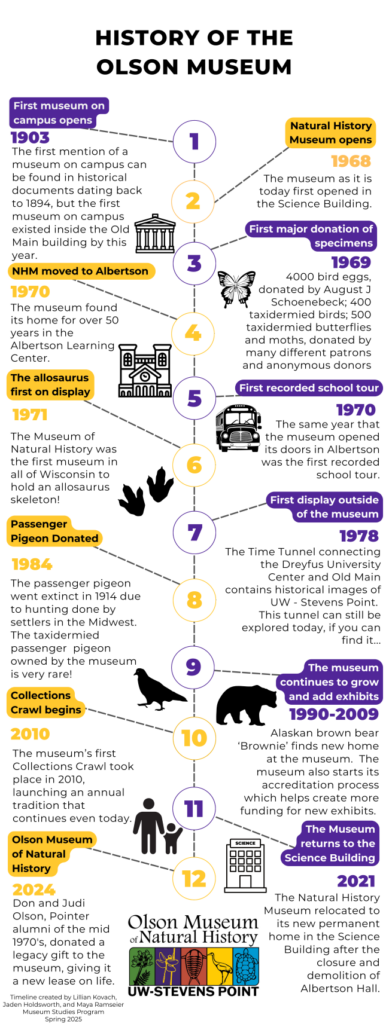
Some of the most notable museum milestones are shown in adjacent image.
The current version of UW-Stevens Point Museum of Natural History was founded in 1968 to exhibit portions of the research and teaching collections held by UW-Stevens Point, and to acquire specimens related to research in biology, geology, and anthropology.
The Museum moved into Albertson Hall in 1970, when the first school group toured the space.
In 1989, Mr. And Mrs. George Haertel of Stevens Point donated more than 1,000 rocks and minerals to the UWSP Museum. These specimens on display represent only a fraction of that donation. Most of the collection remains catalogued and stored for research and study purposes.
The collection continued to grow over the 1990s, when the Alaskan brown bear “Brownie” was donated. In this period, the museum began its accreditation process.
The first public Collection Crawl was held in 2010!
Extensive teaching collections are maintained by the Museum and individual disciplines with total curated specimens now exceeding 420,000.
Names
Key People in the Museum’s Early Days
The initial museum exhibit space and collections were located in the UWSP Science Building and was overseen by Bob Searles. Later that same year, members of the Biology Department formalized the Museum of Natural History under the auspices of a steering committee from various departments. The Steering Committee consisted of Charles Long (Mammalogy), Robert Freckmann (Botany), George Becker (Ichthyology), Phil Bjork (Paleontology), Vince Heig (Ornithology), Garry Knopf (Herpetology), John Moore (Anthropology), and Marshall Parry (Geology).
The principal foci of the UWSP Museum’s collecting efforts are the Upper Great Lakes and adjacent Great Plains. In order to study relationships properly, and offer greater research opportunities, some collections have global coverage.