Prescribed Fire for Forest Management Series
Prescribed Fire and Ticks
Recorded Nov. 5, 2025
Tick-borne illnesses are a major source of morbidity and mortality for people inhabiting the Midwestern United States. Such diseases thus pose a significant – and, unfortunately, growing – threat to public health in the region. Prescribed burning may be able to contribute to efforts to reduce the burden posed by such illnesses by moderating the size of tick population. During this webinar, we will discuss how prescribed fire can directly and indirectly lead to such tick mortality and consider how such reductions could reduce the chance of people encountering ticks that are infected with pathogenic microorganisms. We will also explore how fire management influences other important aspects of tick-borne disease ecology, such as fire effects on wildlife hosts. Finally, we will discuss how fire management practices could be operationalized through a One Health-informed perspective in pursuit of such benefits.
PRESENTER

Samuel C. Gilvarg, M.S., NREMT
Ph.D. Student, Applied Forest & Fire Ecology Lab, Department of Sustainable Resources Management, SUNY College of Environmental Science and Forestry
Sam Gilvarg is a PhD student in Dr. Andrew Vander Yacht’s Applied Forest and Fire Ecology Laboratory at SUNY College of Environmental Science & Forestry. Gilvarg’s research primarily explores how the “One Health” approach can be employed to address problems that exist at the interface of human wellbeing, animal health, and environmental conservation. Currently he is focused on studying how fire management interacts with tick populations in the Atlantic Coastal Pine Barrens. Gilvarg holds a B.A. (Environmental Studies & History) from Gettysburg College and a M.S. (Conservation Medicine) from the Cummings School of Veterinary Medicine at Tufts University. He has previously worked as a Fire Effects Monitor with the National Park Service at Sequoia-Kings Canyon NPs, Shenandoah National Park, and Cape Cod National Seashore. He is currently affiliated as an AD with the Green Mountain and Finger Lakes National Forests.
MODERATOR
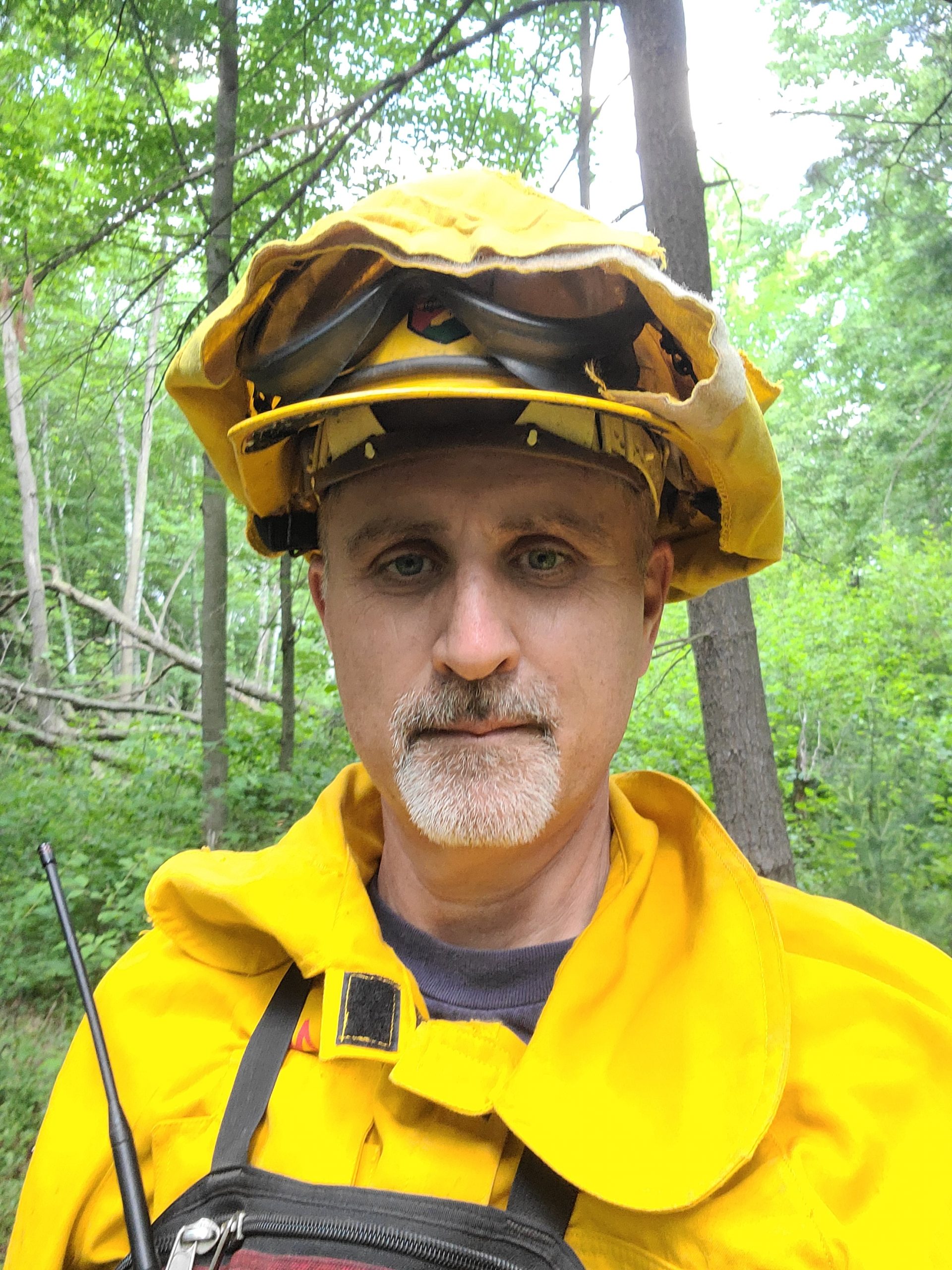
Michael Tiller, Ph.D.
Assistant Professor of Forest and Fire Management, College of Natural Resources, University of Wisconsin-Stevens Point
Michael grew up in Northern California where he enjoyed an active outdoor lifestyle hunting, fishing, camping, and skiing in the beautiful Sierra Nevada Mountains and coastal redwoods. He enjoyed a 10-year career with Cal Fire serving as a Firefighter and Fire Apparatus Engineer. In 2006, he moved to College Station, Texas where he attended Texas A&M University and earned a B.S. in Wildlife and Fisheries Science. After completing his B.S. degree, he attended Stephen F. Austin State University where he earned an M.S. degree in Environmental Science and Ph. D. in Forestry, both with a research focus on understory fuel flammability in forest and rangeland ecosystems. Michael also served as a Wildland Urban Interface Specialist for the Texas A&M Forest Service for 2-years where he was actively engaged with fuels management and prescribed burning. He recently accepted an Assistant Professor of Forest Ecology position at UW-Stevens Point where he leads the fire science program and serves as an adviser for the UWSP Fire Crew.
Additional Resources
Continuing Education
This webinar series has been pre-approved for the following:
- 18.0 Society of American Foresters (SAF) Cat. 1 CFEs (1.5 CFEs per webinar)
- 12.0 SER Certified Ecological Restoration Practitioner (CERP) CECs (1.0 CEU per webinar)
- 12.0 Wisconsin DNR Cooperating Forester CEUs (1.0 CEU per webinar)
If you would like a Certificate of Completion for a webinar, please send your request to wfc@uwsp.edu. Certificates are sent only by request.This webinar has been pre-approved for the following:

Resources
Prescribed Fire and Ticks – Gilvarg
Using Fire Management to See How Ticks…Tick – Brookhaven National Laboratory

Platinum Sponsors
Gold Sponsors