
UW-STEVENS POINT EMERGENCY PROCEDURES
For all emergencies call 9-1-1.
UW-Stevens Point Police and Services 715-346-3456
INITIAL EMERGENCY RESPONSE
EMERGENCY OPERATIONS PLAN (BASIC PLAN AND APPENDICES)
Learn more about the Emergency Operations Plan (Basic Plan and Appendices).
EMERGENCY GUIDEBOOKS
Learn more about the Emergency Guidebooks.
GENERAL RESPONSE GUIDELINES
For all life/property threatening emergencies:
- Call 911
- When calling emergency personnel, stay on the line until all requested information is provided.
- Hang up only after you have been told.
As quickly as possible, people at the scene of an emergency must determine the basic incident facts (who, what, when, where, and how) and get this information to University Police.
GENERAL EVACUATION PROCEDURES
Evacuation from buildings may be required due to emergencies such as fire, chemical spill, bomb or other threats, terrorism, or during other immediate safety and health crisis. Supervisors, Faculty, Department Heads, Managers, and other staff must advise their employees, visitors, and students on evacuation procedures.
Be familiar with all exit locations of buildings you frequent prior to an emergency.
Never ignore an evacuation alarm. To do so puts your and responding emergency personnel lives in extreme danger. It is your responsibility to evacuate and is also required by Wisconsin law. Violators will be fined.
Response
In the event of a fire or other event (e.g., chemical spill) requiring evacuation:
- Pull a fire alarm and leave the building. Alert others to the nature and location of emergency on your way out. Remain calm and do not panic, proceed calmly to the exterior, and never push others. If the exit is blocked or crowded, use a secondary exit.
- If time permits, shut down any hazardous equipment or processes.
- Evacuate the building using stairs and closest exit. Do not use elevator during fires.
- If you observe staff or students not taking an alarm seriously, please encourage them to do so. It may save their life and will reduce the risks to responding emergency personnel.
- From a safe location and distance, call 9-1-1.
- Once evacuated, move away from the building upwind a minimum of 100 yards (or to your designated upwind meeting location if applicable) unless otherwise instructed by emergency personnel. Ensure you are accounted for by your Supervisor, Hall Director, or Faculty. Follow directions of fire and police. If you are aware of an individual unable to self-evacuate or in need of medical care, immediately call 9-1-1 and tell the dispatcher the exact location of the person(s). Advise responding emergency personnel if anyone requires medical treatment. Expanded evacuation may be required depending on the hazards present.
- For individuals with disabilities, see the following section below on Evacuating People with Disabilities for applicable instructions.
- The individual that pulled the alarm and persons with information regarding stranded occupants or emergency details must notify responding emergency personnel.
- Do not reenter the building until authorized by emergency personnel.
Maintaining an accessible means of egress is very critical and legally required for safe evacuation in the event of an emergency. Per the law – A continuous and unobstructed way of egress travel from any point in a building or facility that provides an accessible route to an area of refuge, a horizontal exit, or a public way must be maintained.
EVACUATIONS OF PEOPLE WITH DISABILITIES
In the event of an evacuation, University Police and emergency personnel will check the stairwells and the building to determine if any person(s) require evacuation. The fire department will provide emergency and non-emergency evacuation services for personnel with disabilities.
If you are aware of an individual unable to self-evacuate, immediately notify 9-1-1 or the responding emergency personnel of that person’s location.For nonemergency evacuation of disabled individuals, such as elevator failure, contact University Police 715-346-3456. They will contact the fire department nonemergency number to request evacuation assistance.
It is the responsibility of the disabled person to follow evacuation procedures.
The Building Manager, Dean, Department Chair, or Director shall ensure that the evacuation procedures are made available to all students and employees. UW-Stevens Point employees and students are not required to evacuate disabled individuals. Any assistance rendered is voluntary.
Emergency Procedure for Persons Needing Assistance to Evacuate include the following:
- If you are on a building floor WITHOUT exit doorways directly to the outside, and need to evacuate, immediately go to an Area of Refuge/Rescue Assistance and close the door.
- Areas of refuge/rescue assistance may include:
- Stairwells (preferred location). Stairwell landings are preferred because generally exit stairwells have fire prevention construction and landings provide visibility, quicker response and access for emergency personnel.
- If unable to reach stairwell, rooms with windows to the outside and equipped with a telephone.
- Stairwells (preferred location). Stairwell landings are preferred because generally exit stairwells have fire prevention construction and landings provide visibility, quicker response and access for emergency personnel.
- Inform or ask someone, a building occupant or manager in particular, to alert 9-1-1 of your presence and location.
- Areas of refuge/rescue assistance may include:
- If possible, call 9-1-1 to ensure rescue personnel are notified of your location and:
- Request “IMMEDIATE ASSISTANCE TO EVACUATE”, especially if threatened by smoke or toxic fumes;
- Provide operator with your exact location, building name, floor and room number;
- Give phone number you are calling from;
- Remain by the phone. Police have radio contact with officers at the scene and will keep you informed of situation
- Request “IMMEDIATE ASSISTANCE TO EVACUATE”, especially if threatened by smoke or toxic fumes;
- If unable to communicate or call from a safe area, get in front of a window and signal emergency responders from the window to alert them of your presence. Use towel or other means to draw attention to your location. Try to seal any cracks, vents, etc. where smoke might enter. Follow other applicable Fire/Explosion procedures.
- If you are on a ground floor (main floor) with exit doors, leave the building by normal means.
MEDICAL-PSYCHOLOGICAL
MEDICAL EMERGENCIES
Sometimes it’s difficult to determine whether a medical condition warrants a 9-1-1 emergency response. Call 9-1-1 if you can answer any of these questions in the affirmative:
- Is the condition life-threatening?
- Could the condition rapidly worsen on the way to the hospital without emergency transport?
- If the victim is moved by non-medical professionals, is it likely to increase health risk or cause further injury?
- Do injured or ill people need the skills and equipment provided by paramedics or EMTs?
Response
- If you see someone in medical distress or for any medical emergency, DIAL 9-1-1 (or designate someone). State your name, the location, nature and severity of the medical/emotional emergency. If available, have someone remain with the victim while the call is made.
- STAY ON THE LINE: The 911 emergency dispatcher may give you some first aid instructions to perform on the patient prior to the arrival of emergency personnel.
- Assess the situation – quickly determine if victim is breathing and has a pulse.
- Keep area clear. In general, victims should not be moved unless other hazards pose an immediate threat to life. If possible, have someone stay with the victim.
- Have someone waiting at the entrance to direct emergency personnel to the victim(s).
- Offer first aid, including administering naloxone, cardiopulmonary resuscitation (CPR)/ automated external defibrillator (AED) if trained, willing to do so, and aid is needed and allowed.
- Follow any further instructions received from emergency personnel.
- Use protective equipment if possible and refer to the UW-Stevens Point Bloodborne Pathogens policy for any cleanup procedures if bodily fluids are present.
- If you may have been exposed to blood or other infectious materials through the provision of first aid or through a needle stick, contact Environmental Health and Safety for information regarding medical attention and injury reporting.
Do not drive a medical emergency victim to the hospital or allow them to drive.
__________________________________________________
Completion of Post Injury Reports
Work-related injuries – Supervisors, together with the employee, must complete the worker’s compensation reports. Contact Environmental Health and Safety for assistance.
Non-employee injuries – Complete the online non-employee accident report form. Contact Environmental Health and Safety for assistance.
Training Videos
Hands-Only CPR (American Heart Association)
AED Training (Zoll)
Stop the Bleed (National Center for Disaster Medicine and Public Health)
First Aid Kits
First Aid Kit Content Recommendations
AED and Naloxone Locations
Naloxone, a medicine commonly referred to by the brand name Narcan, blocks effects of opioids. More than one dose of naloxone may be required when stronger opioids like fentanyl are involved.
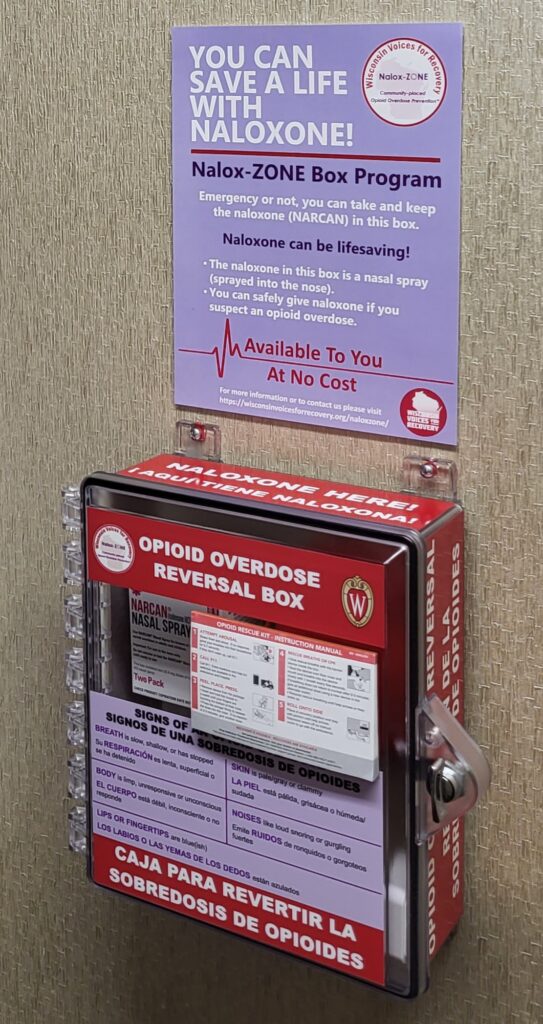
Box Contents: Each Nalox-Zone box includes two doses of Narcan (naloxone) nasal spray, a breathing barrier (if CPR is needed), and instructions on how to use the nasal spray (in Spanish and English).
30-second video: How to use Naloxone Nasal Spray (CDC)
12-minute video: DHS WI Naloxone Training
Box Location – Marshfield
- PE (Physical Education building), located on wall in hallway directly across from fitness center
Box Locations – Stevens Point
- Residence Halls, near AED cabinet
- Dreyfus University Center, next to AED cabinet near Encore
- DeBot Dining Center, next to AED cabinet
- Marshfield Clinic Health System Champions Hall, near AED cabinet outside Quandt
- Noel Fine Arts Center, near AED cabinet in courtyard
Box Location – Wausau
- Main building concourse (near room 180)
SUICIDE THREATS AND ATTEMPTS
Contact the UW-Stevens Point Counseling Center, 715-346-3553, for confidential assistance in all suicide threats or with general questions or concerns.
Response and Prevention
Prevention resources
24-Hour Suicide & Crisis Lifeline – Call or text 988
UW-Stevens Point Counseling Center 715-346-3553
American Foundation for Suicide Prevention
RESPONSE TO SUICIDE THREATS AND CONCERNS
When a threat is immediate, but no suicide attempt has actually occurred, stay with the person or have someone stay with the person and get immediate assistance.
Contact any of the following for assistance:
- Applicable Hall Director
- Director of Housing and Residence Life
- Dean of Students (for students) 715-346-2611
- 9-1-1
- University Police and Security Services 715-346-3456
- UW-Stevens Point Counseling Center 715-346-3553
Establish a caring, supportive, assuring, accepting and firm relationship. Elicit suicidal thoughts and do not remain vague. If the person says, “I wish I were dead,” respond, “Are you thinking of suicide?” You will not contribute to a suicide by discussing these feelings directly; you may well prevent a suicide.
When the suicide threat is not immediate, but suggested, identify with the person a contact for support. Make sure to regularly follow up with them. Refer the person to the UW-Stevens Point Counseling Center or a treatment center of their choice.
Ensure the individual has a list of professional agencies to contact for assistance:
| 24-Hour Crisis Assistance (Call or Text) | 9-8-8 |
| University Police | 715-346-3456 |
| Stevens Point Police Department | 715-346-1500 |
| In Case of Emergency | 9-1-1 |
DEATH ON CAMPUS
Medical emergency response procedures above are to be followed first in the event of a death or suspected death. 9-1-1 must be called for all situations.
Response
The below response steps are to be followed after the medical emergency response steps have been completed and Stevens Point Police have responded. In the event of a confirmed death on campus:
- Do not interfere with scene of event and follow directions from emergency response personnel.
- Secure area and keep crowds at a safe distance.
- In the event of a death of a student University Police and Dean of Students are to be contacted immediately.
- In the event of a death of an employee or visitor, University Police and the Vice Chancellor for Finance and Administration are to be contacted immediately.
- The Dean of Students, Vice Chancellors along with University Communications and Marketing will ensure appropriate notification and procedures are arranged and completed for all deaths on campus. This will include:
- Notification to family of victim following established policy.
- Notification to University officials, victim’s roommates, closely affected campus population, and the entire campus community.
- Determine the need to call an Emergency Operations Team meeting.
- Make arrangements for alternate temporary living quarters as required. Ensure any affected areas are remediated.
- Publish fact sheets to be released as needed.
- Notification to family of victim following established policy.
- For death of UWSP employee as result of work-related incident, Human Resources must be notified immediately.
- Refer affected students to UW-Stevens Point Counseling Center.
- Refer affected employees to the Employee Assistance Program.
Resources:
University Police and Security Services
715-346-3456
Dean of Students
715-346-2611
Vice Chancellor for Finance and Administration
715-346-2641
UW-Stevens Point Counseling Center
715-346-3553
UW-Stevens Point Human Resources
715-346-2618
PSYCHOLOGICAL CRISIS
Mental Health Emergency
A psychological crisis exists when an individual is threatening to harm themselves or others, or is substantially out of touch with reality. Uncontrollable behavior and/or hallucinations could be manifested.
Response
If a psychological crisis occurs:
- Remain calm. Do not attempt to handle a dangerous situation. Evacuate immediate area if needed.
- Notify University Police at 715-346-3456. Call 9-1-1 if immediate threat to safety. Provide the following information:
- Your name
- Precise location
- Observed symptoms of behavior.
- Individual’s name, if known
- Until help arrives, be pleasant, considerate, and understanding to avoid aggravating the situation.
- Do not argue with the individual. Try to determine and recognize the individual’s point of view. Do not confront / detain the individual.
- Have someone meet law enforcement at the entrance to the building and provide up to date information. University Police will provide direction from that point forward. UW-Stevens Point Counseling Center will be called at 715-346-3553 for assistance as needed.
Resources
UW-Stevens Point Counseling Center
715-346-3553
University Police and Security Services
715-346-3456
IAMALIVE
1-800-442-4673
24-hour Crisis & Suicide Lifeline – chat or text 988
CONTAGIOUS DISEASE
For UW-Stevens Point contagious disease response and resources, see below.
Response
- Contact Student Health Service at 715-346-4646 in the event of an actual or suspected contagious disease outbreak.
- Student Health Service staff or Residential Living staff notifies UW-Stevens Point Director of Health Services of a possible contagious disease outbreak. The two primary categories are food-borne gastroenteritis (see food poisoning and food borne illness) and meningitis, which is spread by exposure to respiratory secretions.
- UW-Stevens Point Student Health Service Director calls Portage County Health and Human Services Department (PCHHS) with case data. They jointly determine if an epidemic is threatened and if preventive action is necessary.
- University Police is informed of the situation and is instructed that the situation is being actively investigated. Emergency Management is notified for emergency planning purposes.
- Incident description and causative agent exposure concerns are communicated by Student Health Service to the Vice Chancellor for Student Affairs who communicates with Chancellor to determine if an Emergency Operations Team shall be assembled.
- The PCHHS Department works with University Student Health Service to:
- Notify local hospital and other health care providers of the incident and coordinate information exchange and medical and transportation needs.
- Identify causative agent.
- Review standing links and make available information links regarding causative agent/disease. See Communicable Disease Fact Sheets in the section below.
- Determine isolation measures.
- Communicate information preventive measures throughout the community.
- Establish phone banks to provide information.
- Triage possible victims.
- Obtain necessary medications, supplies, location(s), and staff.
- Set up treatment center(s).
- Update and further advise the Emergency Operations Team.
- Notify local hospital and other health care providers of the incident and coordinate information exchange and medical and transportation needs.
Food Safety Information
FSIS Foodborne Illness and Disease
Communicable Diseases Fact Sheets
Wisconsin Department of Health and Family Services Sheets
WI DHS Meningococcal Disease fact sheet
WI DHS Viral Meningitis Fact Sheet
Travel Information
INFLUENZA
Did you know influenza is NOT the “stomach flu”?
Influenza, or flu, is a contagious respiratory disease, not a stomach or intestinal disease.
What are the symptoms of influenza?
Main symptoms are fever, chills, headache, extreme tiredness, dry cough, sore throat and muscle aches.
How is flu spread?
Flu viruses are primarily spread mainly from personal to person in close contact (3 feet or less) through coughing or sneezing by people with the flu. Sometimes people may become infected by touching something — such as a surface or object — with the flu virus on it and then touching their mouth or nose.
Prevention and Response
The single best way to prevent influenza is to get vaccinated each year. In addition, good health habits like covering your cough and washing your hands often can help stop the spread of germs and prevent respiratory illnesses. Below are three basic steps that are excellent prevention measures everyone can follow. See Take Preventative Actions. Prevent Flu!
Stay Home When You are Sick! until at least 24 hours after the fever is gone, or after symptoms have improved (at least 4-5 days after symptoms started).
Cold Versus Flu – How can you tell the difference?
It can be difficult to tell the difference as both share the same symptoms. Colds are usually milder than flu. Special tests can tell if a person has the flu.
For additional information see the CDC’s page Cold Versus Flu
Take Preventative Actions. Prevent the Flu
1. Get Vaccinated. The single best way to prevent the flu is to get vaccinated each year.
- Influenza vaccinations for university students may be obtained at Student Health Service.
- Employees, contact your health care provider.
2. Stop germs. Good health habits like covering your cough and washing your hands often can help to stop the spread of germs and prevent respiratory illnesses like the flu.
- Avoid close contact with people who are sick.
- Stay home when you are sick.
- Practice excellent respiratory etiquette. Cover your mouth and nose with a tissue when coughing or sneezing. Don’t use hands. It may prevent those around you from getting sick. Wash hands afterward. Throw away tissue when done.
- Washing your hands often will help protect you from germs.
- Avoid touching your eyes, nose, or mouth.
- Practice other good health habits. Get plenty of sleep, be physically active, manage your stress, drink plenty of fluids, and eat nutritious food.
3. Antiviral drugs. If one becomes ill, seek necessary care from your health care provider and follow their directions. This may include prescription of antiviral drugs.
If personals with flu symptoms must leave their residents (i.e., to seek medical attention), they should cover their nose and mouth with coughing or sneezing. A surgical loose-fitting mask or a tissue may be helpful.
If possible, persons with flu symptoms who wish to seek medical attention should contact their health care provider or Student Health Services to report illness by telephone or other remote means for guidance before seeking care in an effort to reduce the spread of the virus.
When should I seek Emergency medical attention?
See medical attention immediately if you are experiencing any of the following:
- Difficulty breathing or shortness of breath
- Purple or blue discoloration of the lips
- Pain or pressure in the chest or abdomen
- Sudden dizziness
- Confusion
- Severe or persistent vomiting
- Seizures
- Flu-like symptoms that improve but then return with a fever and worse cough.
Other UW-Stevens Point Actions
- Departments/Units should have hand sanitizer (with at least 60% alcohol), disposable disinfectant wipes, and Kleenex available for general use. Wipes can be used by employees and students to routinely wipe down frequently used surfaces. Ensure items are dispose of properly in garbage containers. UWSP Departments/Units should order these items directly for their respective areas.
- CAMPUS GENERAL SUPPLES: Hand sanitizer, disposable sanitizing wipes, dispensers, and tissue all available to order through UWSP Central Stores, Facility Services.
- Departments and Maintenance areas are to establish regular schedules for frequent cleaning of high-touch surfaces (e.g., bathrooms, doorknobs, elevator buttons, rails, shared computers, food service areas, remote controls, and table tops). Custodial steps up their cleaning efforts throughout campus, however all individuals can help in this effort by keeping their individual work and study areas clean. Most household disinfectant cleaners and detergents are effective for influenza.
Any cleaner questions contact Environmental Health & Safety at 715-346-2320. - Areas with high frequency of hand to hand exchanges, such as monetary or paper exchanges should have procedures in place to help reduce the risk of spreading the virus such as hand sanitizer, education posters, surface cleaning products and procedures, Kleenex availability, etc.
- Housing and Residence Life sends specific guidance for UW-Stevens Point residents. We encourage students to frequently clean their living quarters, including high-touch surfaces.
- We encourage all campus community to help in education of all individuals at UW-Stevens Point. Pass on key information to students, employees, family, friends, others. This can be done at employee meetings, beginning of class, prior to meetings, discussions, etc.
- Students may contact Student Health Services with health-related questions or concerns at 715-346-4646.
PANDEMIC
A pandemic is a global disease outbreak. It is determined by how the disease spreads, not how many deaths it causes.
UWSP monitors pandemic conditions and has Pandemic response plans developed.
News
VIOLENCE
BOMB THREAT
n the event a bomb threat is received follow the procedures below.
Response (if you receive the call)
- If the bomb threat is by phone, keep talking to the caller and attempt to get as much information as possible. On display phones write down the number that the call is coming from, the time, and date of the call.
- Fill out the Bomb Threat Checklist as soon as practical. Take exact notes. Law enforcement will use this information.
- Ask the caller the exact location of the bomb (building, floor, room, etc.), the time the bomb is set to go off, the kind of bomb, the timing device. Note the caller’s speech pattern, accent, lisp, distinguishing characteristics, and any background noises. Record all statements made by caller.
- Do not hang up your phone, even if the caller hangs up. Wait for the authorities to arrive. Use a different phone to call authorities.
- Immediately call 911 and then notify University Police and Security Services at 715-346-3456 from a different phone than the one in which the threat was received. If possible, do not use the involved phone until authorized by authorities.
Response (if campus receives a bomb threat)
- Remain calm.
- Follow directions from campus authorities and await updates.
- The Stevens Point Police Department and Fire Department can give a lawful order to evacuate a building. University Police, Line Officers, and Directors may also order an evacuation. Follow evacuation procedures if one is so ordered.
- Pay attention to your surroundings.
- Be alert to suspicious activities, items and packages.
- Notify law enforcement if you see anything out of the ordinary.
Resources
University Police and Security Services
715-346-3456
SUSPICIOUS OBJECTS AND PEOPLE
If you observe a suspicious object, package, vehicle, mail,letter or potential hazardous device on campus, DO NOT HANDLE THE OBJECT!
Response
- Clear the area and from a safe location immediately call law enforcement. Refrain from using cellular phones or portable radios near suspicious packages.
- Do not attempt to locate, move or disarm any suspicious items. Inform authorities of the item. Alert others to stay clear of it.
- Follow any instructions received from law enforcement.
- Isolate package/letter and other potentially contaminated items and secure room to prevent others from entering the area. Do not shake, open, smell or taste any substance on or within the object. If you have already touched the object, place it in a sealed plastic container or bag. If exposed, immediately wash hands and exposed skin thoroughly with soap and water and seek emergency medical attention.
- If a hazard is imminent or ordered by emergency personnel, evacuate the building using the nearest available exit. Follow Evacuation Procedures if one is so ordered. If disabled personnel cannot safely evacuate the building, assist to the nearest stairwell away from bomb threat area and follow Evacuations of People with Disabilities.
- Once outside, move to a clear area that is at least 500 feet away from the affected building. Keep streets and walkways clear for emergency vehicles and crews. The person discovering the threat should provide information to emergency personnel.
- Do not return to an evacuated building unless authorized by emergency personnel.
- Emergency personnel will determine if, how, and where the suspicious package should be transported or disposed.
- See Terrorism section for response steps to actual Nuclear/Biological/Chemical (NBC) terrorist attacks.
How to identify Suspicious Packages, Letters, Vehicles, Activity, and Personnel
Some characteristics of suspicious packages and letters include the following: excessive postage, poorly addressed, incorrect titles, no name, misspelled words, oily stains, discolorations or odor, missing or suspicious return address, excessive weight, lopsided or uneven envelope, protruding wires or aluminum foil, excessive security material such as tape, packages wrapped in string, visual distractions, marked with restrictive endorsements, such as “Personal” or “Confidential”, shows a city or state in the postmark that does not match the return address, addressee is not expecting the package, hand delivered or “dropped off for a friend” packages or letters, letters or packages arriving before or after a phone call from an unknown person asking if the item was received, pressure or resistance may be noted when removing contents from an envelope or parcel, buzzing, ticking or sloshing sound is heard from the package.
In regards to suspicious vehicles, activity, and personnel be aware of and report any of the following:
- People in buildings or grounds that do not appear to be conducting legitimate business.
- Unauthorized personnel in restricted, sensitive, or private areas. Unauthorized photography.
- Unauthorized persons requesting sensitive information such as security information.
- Abandoned or suspicious vehicles.
- Unexpected or unfamiliar delivery trucks.
- Vehicles arriving and being left behind at odd hours.
- Unauthorized individuals near or tampering with ventilation equipment.
Call University Police 715-346-3456
Resources
University Police and Security Services
715-346-3456
CIVIL DISTURBANCES
For civil disturbances that could threaten safety or property, the below procedures should be followed.
Response
- Keep calm. Resistance may only increase the destruction of property and a threat to bodily harm.
- Do not confront demonstrators.
- Call University Police at 715-346-3456 or 9-1-1 if immediate threat to safety. Provide the following information:
- Location (building, floor, room, entrance, etc.).
- Approximate number of leaders.
- Description of person(s) causing the disturbance.
- Size of group.
- Obvious objective or demand of group.
- Describe if group is rational, organized, violent, etc.
- Location (building, floor, room, entrance, etc.).
- If possible, continue with your normal work schedule until University Police arrive. If your safety is threatened, evacuate affected area.
- When law enforcement arrives, provide them with an update. Follow their instructions.
HOSTAGE SITUATION
For any hostage situation call 9-1-1. Follow emergency procedures below.
Response
For Those Held Hostage
- The initial 45 minutes are the most dangerous. Be patient, calm, and follow instructions. Don’t make any sudden abrupt movements that may jeopardize your well-being. Avoid heroics. Don’t threaten or intimidate. Keep a safe, non-intimidating distance. Keep your hands clearly visible.
- Don’t speak unless spoken to and then only when necessary. Don’t talk down to the captor or make promise that cannot be kept. Avoid appearing hostile. Maintain eye contact but do not stare. Treat the captor as friendly as possible.
- Comply with instructions as well as you can. Do not argue and be alert.
- Look for a place to dive or jump. Negotiations may not always be effective, be thinking about a potential escape plan for yourself and others. Move laterally away from the threat, put as many barriers as possible (e.g. desk, walls, doors) between yourself and the threat.
- Be observant. Try to remember all distinguishable characteristics. The personal safety of others may depend on your memory.
- Be prepared to answer the police on the phone should a line be patched to your location. Attempt to establish rapport with the captor. If medications or first aid are needed by anyone, say so.
For Those Outside The Hostage Situation
- Ensure 9-1-1 have been called.
- Using either the intercom or messenger, notify affected departments, classes, and individuals to evacuate away from the hostage situation. Isolate hostage area to prevent others from entering and evacuate the area.
- Gather all facts regarding the situation for the police. Keep notes on times, any communications from the person holding the hostage, and other witness information.
- Provide law enforcement with floor plan of area and arrange for any assistance as necessary.
- Law enforcement will take command of situation. Follow their subsequent directions until situation is resolved.
TERRORISM
National Terrorism Advisory System (NTAS)
The United States Department of Homeland Security has an advisory system to warn the country of potential terrorist attacks. The system and any current threats can be found at the U.S. Homeland Security Department website. In addition, media, emails, and Wisconsin Emergency Management will broadcast advisories.
Upon notification of an advisory, University Police and Security Services, in conjunction with the Emergency Operations Team, will provide necessary information to the campus through communication methods listed and institute appropriate actions to respond accordingly.
Nuclear/Biological/Chemical (NBC) Attack
Likely targets of a Nuclear/Biological/Chemical (NBC) terrorist attack are enclosed, densely populated areas.
NBC attacks may be apparent or completely indistinguishable. Therefore, consistent observation of one’s surroundings is critical.
Attacks could involve the University directly or the entire community. Direction will be provided by emergency personnel (e.g., Police/Sheriff, Fire Department, FBI, FEMA, etc.).
Evacuation orders will be contingent upon the amount, type, and degree of hazard present. Be prepared to assess the situation. Depending on the circumstances and the nature of the attack, emergency response authorities will provide information as to the need to evacuate or shelter in place (stay indoors) during an NBC attack.
University Police, the media, Emergency Alert System, and other listed communication methods will communicate this information throughout campus. Monitor reports and follow directions.
If emergency personnel are not able to provide information on what is happening and what you should do, use your knowledge to determine whether to evacuate or shelter indoors.
Use available information to assess the situation. If you see large amounts of debris in the air, or the air is obviously badly contaminated, you may not be able to safety step outside thus requiring the need to shelter indoors. On the other hand, if the strike is miles away and the threat is not immediate you may need to evacuate upwind, away for the attack.
Resources
U.S. Department of Homeland Security
Wisconsin Emergency Management
CDC General Bioterrorism Information
CDC Infographic: Nuclear weapon
CDC Infographic: Where to go in a radiation emergency
What to Do During a Radiation Emergency
DHS Infographic: Recognize the Signs of Terrorism-related Suspicious Activity
Response to Suspected Nuclear/Biological/Chemical (NBC) Attack
- Report all suspicious packages or activity immediately to University Police at 715-346-3456.
- When reporting, provide the following information:
- Your name.
- Description of the emergency.
- Exact location.
- Actions you have taken.
- Where to meet emergency personnel.
- Stay on line until told to hang up.
- University Police will contact the necessary emergency personnel to respond.
- Do not touch, smell, move, taste, or otherwise handle any suspicious items.
- Vacate and seal the affected room(s) if possible. Go to a safe area, avoiding additional contamination of other personnel. As practical and if instructed, take precautions to limit the spread of contamination to other areas by closing/sealing doors and windows of affected room, and alerting others. Wash your hands as soon as possible.
- If ordered by emergency authorities to shelter indoors during a NBC attack:
- Go indoors immediately. You can provide a minimal amount of protection to your breathing by covering your mouth and nose with a damp cloth.
- Close all doors to the outside and close and lock all windows.
- Turn off fans, heating and air conditioning system. Close other ventilation system dampers and inlets. Minimize use of elevator to only essential needs.
- Go to an interior room as directed with the fewest windows and doors. Take or have available emergency nonperishable food, water, flashlights, battery radio, and other emergency supplies (see Ready.Gov). Keep away from windows and doors.
- If instructed, seal with tape and plastic around doors, windows, fans, outlets, registers, vents, grills, or other sources of outside air. Wet towels or other fabric items and jam them in the crack under the door. Use plastic (trash bags are good) to cover all windows and doors. Use tape to seal the edges of plastic.
- If you become bothered by the gaseous release hold a wet cloth or handkerchief over your nose and mouth. If you experience medical difficulties call 911.
- Stay in the room and listen to the radio until you are told all is safe or you are told to evacuate.
- If the threat is imminent and known (e.g., gas emitting from room) that requires complete withdrawal from the building/area in order to protect life or if ordered by emergency personnel to evacuate area, initiate building evacuation following Evacuation Procedures. Wait for further instructions from emergency personnel regarding evacuation procedures (e.g., expanded evacuation may be required). Emergency personnel will order all other evacuations in less apparent and hazardous situations (e.g., unknown powder on table).
- When evacuating, cover your nose and mouth with a damp cloth (e.g., handkerchief). Doing this may filter out some hazardous particles which may be in the air. Evacuate upwind of the affected area a minimum of 100 yards away or as directed and wait for further instructions from emergency personnel. Evacuate to an area apparent to emergency personnel and communicate to them your status upon arrival.
- Decontamination may be required, therefore wait for instructions before leaving the evacuation gathering location. If attacked, your clothes may have trapped vapors or particles. It may be required to remove your clothing so you or others don’t get contaminated from residual materials.
- If professional decontamination is not available, take off known contaminated clothing. Attempt to self-decontaminate by using soap and excessive amounts of water. Leave discarded clothes in a single designated area that will inhibit spread of any harmful substance. Do not taste, eat, smell or touch anything during an NBC attack.
- Facility Services will adjust building ventilation system as needed.
- Buildings downwind and those surrounding the affected area will be evacuated as directed by emergency personnel.
- Individuals with any information regarding the attack must report it to emergency personnel.
- Do not return to an evacuated building unless authorized by emergency command. Warn others outside not to enter the affected building(s).
VIOLENT OR CRIMINAL BEHAVIOR
Everyone on campus is asked to assist in providing a safe environment by being alert to suspicious behavior and promptly reporting the situation to University Police. Violent or criminal behavior may include but is not limited to, physical assault, sexual assault, thefts, vandalism, and workplace violence.
General Response
Report all violence, criminal acts, and suspicious behavior promptly to 9-1-1.
If you are the victim, observe a criminal act, or observe suspicious people on campus, immediately call 9-1-1 from a safe area to report the incident, including the following:
- Your name
- Nature of the incident
- Location, date, and time of the incident
- Description of person(s) involved
- Description of property involved
- If there are weapons involved
- Description and license of any vehicles involved. Note direction of travel
Do not approach or attempt to apprehend the person(s) involved.
Stay on the phone with the police dispatcher until the police arrive and provide additional information, as it becomes available or as the situation changes.
Try to remain out of sight, act cautiously, and be concerned with your personal safety.
Provide additional information assistance upon request from responding emergency personnel.
Property Crime/Theft/Vandalism Response
Go to a safe place and notify University Police at 715-346-3456.
- Do not touch anything.
- Meet with the officer at the location the officer requests.
- Explain to the officer everything you observed, including telling the officer if you touched or moved anything.
- Follow the officer’s instructions.
Contact Risk Management to fill a claim for recovery of loss, if applicable.
Violent/Personal Crime Response
- As soon as possible get to a safe place and call 9-1-1. Advise the police of the nature of the incident, location, if medical assistance is needed, and a description of the person(s) involved. Follow medical emergencies procedures if immediate medical assistance is required.
- Be observant, as the more information you can provide, the better the chance the criminal will be apprehended.
- While a crime is being committed, you have three options:
- Submit to suspect.
- Passive resistance (talking or reasoning with suspect).
- Active resistance (physical intervention). Remember, whatever you decide to do, you must be prepared both mentally and physically. Your safety is the most important thing to remember during any attack.
- Meet with the officer and follow his/her instructions.
Sexual Assault Response
Whether an acquaintance, partner, family member or stranger has sexually assaulted you, it is not your fault. There are things you can do right now to help yourself and to facilitate your recovery.
- Find a safe place away from your attacker
- Tell a person whom you trust, or call one of the following resources for support
- University Police: 715-346-3456
- Sexual Assault Victim Services (SAVS): 715-343-7125
- UW-Stevens Point Counseling Center: 715-346-3553
- UW-Stevens Point Student Health Service: 715-346-4646
Have you witnessed or received a report of a sexual assault? Any University employee who witnesses a sexual assault on campus or receives a report that a student has been sexually assaulted is required by 1989 WI Act 177 to report the assault to the Dean of Students.
- Report forms are located in the offices of the Chancellor, Counseling Center, Student Health Service, Dean of Students, Residence Hall Directors, University Police, Academic Deans, and Department Chairs.
- Submit completed reports to the Dean of Students, Old Main, Room 212. Such reporting is for statistical purposes only; no other action is required unless a victim should desire it. This is to ensure the victim remains in control of the decisions made and to respect their privacy.
Policies, procedures and resources
- UW-Stevens Point Dean of Students Sexual Assault Information page Includes information such as, what to do after an assault, how to report an assault, legal definitions, common feelings after being assaulted, recovering from an assault, etc.
- UW-Stevens Point Counseling Center page Includes services/support available for victims of sexual assault and prevention measures.
Workplace Violence Response
- Call 9-1-1 from a safe location. Inform of situation and if medical assistance is required. State location of incident, person(s) involved, weapons involved, and other requested information.
- Leave area if safe to do so following Evacuation Procedures. Attempt to secure the affected area while evacuating to prevent others from entering.
- If unable to safely evacuate, find a safe location inside away from the violence.
ACTIVE SHOOTER
Every active shooter situation is unpredictable and will require individual judgment and alterations given the unique circumstance of each situation. However, below are basic recommendations to follow in these situations.
Definition: Armed person(s) (i.e., handgun, rifle, etc.) who has used deadly physical force on other person(s) and continues to do so while having unrestricted access to additional victims.
An active shooter situation will be announced to the campus as “ACTIVE SHOOTER on campus.”
Online training course available! Click to self-enroll in the Active Shooter Response Training Canvas course.
The campus will make all attempts to notify campus utilizing
- Pointer Alerts
- text message
- computer pop-ups screens
- announcement over residence hall and DeBot public address system (Main campus only)
- verbal or other, and notification via available speaker systems (through the fire alarms) in those buildings equipped with such systems
Response (RUN-HIDE-FIGHT)
Voice commands from responding emergency personnel shall be followed at all times. However, if you are not under the direction of emergency response personnel and you hear the term ACTIVE SHOOTER announced or made otherwise aware of an active shooter take the follow steps depending upon your location and the given circumstances listed in the scenarios below:
RUN
- Exit the building immediately using the nearest exit or window (if safe), move to a safe location.
- Warn others on way out of emergency and need to exit immediately.
- Call 9-1-1 from a safe location. (Use phone in other building, cell phone, or Blue Light phones). Provide law enforcement with the following:
- Your name and location.
- Nature of the incident.
- Location of the incident and location of shooter.
- Number of shooters involved if known.
- Identification or description of the shooter(s).
- Weapon or weapons involved (e.g., rifle, handgun, etc.)
- If medical assistance is needed. If possible, follow medical emergencies procedures if immediate medical assistance is required.
- Other requested information.
- If requested meet emergency response personnel in safe location for further debriefing.
- If law enforcement have already responded, when evacuating follow their orders exactly and answer their questions. Keep your hands empty, raised, and in plain view at all times. Carry nothing that could be mistaken for a weapon. Remember law enforcement does not know who the shooter is. Stay away from affected building(s).
- Wait for directions from emergency personnel and campus. Follow directions below for “NOT in Affected Buildings”.
HIDE
- As soon as possible go to a safe location away from the violence and danger. Notify anyone you may encounter to do the same.
- Go to the nearest room or office that is safe and lock door if able. Turn off lights. Draw window shades if available. Barricade entrance if possible with desks, chairs, etc. Do not answer the door.
- For classrooms – stay in classroom and lock door if able. Faculty leading classrooms are to follow these instructions and direct their students in these steps
- Spread out if able. Do not huddle together. Keep calm and keep others calm. Turn off lights, silence cell phones, go to the back of the room and remain quiet. Act as if no one is in the room. Stay down at ground level (kneel or lay down). Take protective cover under desk or other location. Stay away from windows and doors. Think of plan of action if shooter enters your room (see below for direct conflict guidance).
- Wait until law enforcement respond and provide direction. When you encounter law enforcement, follow their orders exactly and answer their questions. Keep your hands empty, raised, and in plain view at all times. Carry nothing that could be mistaken for a weapon. Remember law enforcement does not know who the shooter is.
WHENEVER IT IS SAFE TO DO SO:
Call 9-1-1. Provide law enforcement with the following information:
- Your name and location.
- Nature of the incident.
- Location of the incident and location of shooter.
- Number of shooters involved, if known.
- Identification or description of the shooter(s).
- Weapon or weapons involved (i.e., rifle, handgun, etc.)
- If medical assistance is needed. If possible, follow medical emergencies procedures if immediate medical assistance is required.
- Other requested information.
- If requested, meet emergency response personnel in safe location for further debriefing.
FIGHT
- There is no one exact procedure in these excruciating situations. Call 9-1-1 if at all possible and leave phone line open if unable to talk.
- If able to escape – do so immediately and follow instructions above.
- If unable to escape, use your best judgment and what you are capable of.
- Commit to you actions and act as aggressively as possible against the shooter.
- Recruit others to ambush the shooter with makeshift weapons like chairs, fire extinguishers, scissors, books, etc.
- Be prepared to cause severe or lethal injury to the shooter.
- Throw items and improvise weapons to distract and disarm the shooter.
Remainder of Campus Community NOT in the Affected Buildings
Upon notification of ACTIVE SHOOTER:
- DO NOT go near affected building(s).
- Stay in safe location and lock doors.
- Remain in safe location until notified by authorities or campus (i.e., stay in secure classroom/office, residential hall, etc.).
- If you hear the notification off-campus, REMAIN off campus until notified by authorities it is safe to return to campus.
ADDITIONAL INFOrmation
For Faculty teaching course – direct your students in above steps.
Supervisors/Managers shall direct their employees in above steps.
Training in above procedures prior to event is critical for all of the campus community so that response is a reaction, not a question. Complete the online Canvas training course. Contact the campus Emergency Management Specialist (cneeb@uwsp.edu) to schedule training. Remain calm as possible in these situations and keep focused on survival. Be familiar with the building rooms, routes, and exits. See campus Evacuation Maps. Prepare in advance.
Law enforcement will respond to these situations and take incident command. They will evaluate the situation to determine the best course of action for the safety of the university community. As stated every situation is unique. Use the above procedures as best possible and follow closely the direction from the responding law enforcement.
University Counseling Center resources will be made available after any active shooter situation. Announcement will be made to campus with necessary details.
Report a Concern
Resources
University Police and Security Services
715-346-3456
UW-Stevens Point Counseling Center
715-346-3553
Online Training
Click to self-enroll in the Active Shooter Response Training Canvas course.
Videos
RESPONSE videos
5-minute Video: Run. Hide. Fight. (FBI)
7-minute Active Shooter Preparedness Video: Options for Consideration (U.S. Department of Homeland Security)
20-minute Video: Shots Fired On Campus – When Lightning Strikes
STOP THE BLEED video Learn how and when to use a tourniquet: Stop the Bleed (National Center for Disaster Medicine and Public Health)
PREVENTION video
Learn how to recognize warning signs and understand how to respond to them to prevent violence on campus: Flashpoint on Campus (20-minute video)
BUILDINGS-GROUNDS
ANIMALS ON CAMPUS
Do not approach animals unless you are trained to do so. Any direct physical contact with an unknown animal, especially if it results in a bite or scratch, is serious.
If an animal has bitten, scratched or had direct physical contact with a person, they should seek medical attention as soon as possible.
If you see a suspicious animal running loose on campus, call University Police at 715-346-3456.
Response
If an animal, such as a rat or bat is found inside a building, isolate it in a room by closing doors behind it. Keep people away. Do not try to remove the animal yourself. Call the following for assistance:
- For removal during business hours, call Facility Services at 715-346-4219.
- For removal after-hours, call University Police at 715-346-3456.
If you are unable to contain the animal, call University Police at 715-346-3456.
For Animal Removal Call:
During business hours:
Facility Services
715-346-4219
After-hours:
University Police
715-346-3456
Resources
Student inquires for service or therapy animals on campus can be directed to Student Disability and Assistive Technology Services.
Employee, staff and faculty inquiries for therapy or pets on campus for occupational purposes can be directed to Human Resources.
FIRE/EXPLOSION
Next Stevens Point Campus Fire Drills (Academic & Administrative Buildings): Fall 2026
The procedures below outline the general response to fires and explosions.
PREPARE
Prepare ahead by doing the following:
- Always familiarize yourself with the fire safety features in a building, especially the locations of exits. A link to evacuation maps are found in the Resources column of this webpage.
- Practice your exit route(s). Participate in fire drills held on campus.
- Make sure exits are not blocked.
- Do not chock or prop stairway or corridor doors open.
- In a fire, remember to close doors when you leave the room.
- Report nonfunctioning or damaged fire protection features, such as an automatic door closer to your building manager or Facility Services.
RESPONSE
- If you see smoke or fire, shout “fire” and activate the nearest fire alarm or pull station.
- Leave the building following General Evacuation Procedures. Alert other occupants to evacuate. Use stairs, not elevators.
- Before opening a door, touch the doorknob with the back of your hand to feel if it is warm or hot. If it is warm or hot, DO NOT OPEN THE DOOR, USE ALTERNATE EXIT ROUTE.
If you encounter smoke, stay low. Place a towel or cloth over your head and face. Breathe through the towel by taking short breaths through your nose.
Wear something that can be easily discarded if it catches on fire such as a blanket. Should your clothes catch fire, stop, drop and roll to put it out.
If the doorknob is not hot, ensure all room windows are closed, brace yourself against the door and open it slightly to check for presence of smoke or fire. If the hallway appears clear, exit building. If time permits, close windows and doors behind you. Follow the same procedure through all doors as you exit the building. If all exits are blocked, go to the closest safe room/area of rescue and follow the next instruction.
If all paths are blocked by fire or heavy smoke and height of building floor does not allow for window exit, check outside window for presence of rescue crews and signal them by hanging an object out the window (e.g., sheet, jacket) or by other means. Keep doors closed between you and the fire. If possible, call 9-1-1 and inform dispatcher of your situation and exact location. Open windows only when necessary. Seal cracks around the door and at other places where smoke appears to be entering with wet towels, blankets, or similar materials. - From a safe location, at least 100 feet away from building, call 9-1-1. Provide them with the following information:
- Your name
- Building name
- Address
- Floor
- Location
- Note – ALL fires must be reported.
- Upon exiting building, notify firefighters of source of fire or explosion or other pertinent information.
- Do not reenter the building until authorized by the fire department.
FIRE EXTINGUISHERS
Don’t use a fire extinguisher unless you have first called 9-1-1.
Portable fire extinguisher use allowed only if:
- User is properly trained.
- Fire is small, contained, and in early stage (e.g., small wastebasket, few rags, etc.).
REPORT ALL FIRE EXTINGUISHER USE to Facility Services.
REPORT KITCHEN FIRES
LICENSED KITCHENS MUST REPORT ALL KITCHEN FIRES TO THE COUNTY HEALTH DEPARTMENT.
Call Environmental Health and Safety to complete this process.
REPORT PROPERTY DAMAGE
If there is any property damage, contact Risk Management within 24 hours.
FIRE DRILL FAQS (STEVENS POINT CAMPUS)
What is a fire drill?
A fire drill is a supervised practice of a mandatory evacuation of a building for a fire.
Can all campus buildings be tested at once?
No.
Can you tell me what time my building will have the drill?
Only if you are in the first building on the list to be tested. Fire drills are conducted starting at a certain time and go building by building from there. Each building takes an unknown amount of time to conduct the drill as it is dependent upon how quickly people evacuate, the size of the building, any issues encountered when running the drill, etc.
Why do we hold fire drills?
Per UW System Campus Fire Exit Drill Policy, “all educational buildings on campus must hold one fire drill per year …” To ensure effective campus evacuations it is necessary to conduct fire drills while classes are in session.
What do I do when the fire alarm sounds?
- Immediately evacuate building using nearest uninvolved exit. DO NOT USE ELEVATORS. Close doors and windows as you leave. Take your personal property.
- Wheelchair users and people unable to exit via stairs should enter an enclosed stairwell and close the door. If possible, call 715-346-3456 to alert Police and Security of your location. If this were an actual fire, call 911 and request immediate assistance to evacuate.
- If you are teaching a class when the fire alarm sounds, instruct students to evacuate the building using the nearest fire exit. Remind students to take all personal property with them. Ensure all students in your class have evacuated before exiting.
- Do not return to building until a police or security officer gives the all clear. Cessation of the fire alarm does not indicate an “All Clear.”
What is the fire alarm activation UWS policy?
UWS 18.10(4)(g) No person may remain in any university facility or on university lands when an audible or visual fire alarm has been activated or upon being notified by fire fighting, law enforcement or security personnel to evacuate.
Resources
Campus Emergency Evacuation Maps
Environmental Health and Safety 715-346-2320
Facility Services 715-346-4219
Risk Management 715-346-2053
Campus Fire Exit Drills Policies and Procedures (University of Wisconsin System)
___________________________
Living on campus
VIDEO: Dorm Don’ts: Safety Tips for Your Stuff
Use Extension Cords Properly
___________________________
Living off-campus
Off-Campus Fire Safety Resource
Fire Safe College Housing – What You Need to Look For!
____________________________
FLOODING
Flooding may include storm water building infiltration, sewer backups, or plumbing sources.
Response
- In all flooding situations, be aware of electrical equipment, appliances, cords, power strips, outlets, light/appliance switches, and other electrically connected items.
- Do not go near water that is touching or near electrical items.
- Do not touch or go near electrical objects in contact with water. If electrical circuits or items appear to be getting wet, leave the area immediately.
- Do not enter an area where electrical equipment or service may be in contact with water.
- Do not contact water involving sewage backup without proper personal protective equipment.
- Secure areas to prevent access as needed.
- Notify Facility Services at 715-346-4219 and University Police at 715-346-3456 for all flooding situations.
- Try to identify the source of water and turn if off if this can be done safely.
- Evacuate personnel to higher ground, as needed, and attempt to protect property and records by removing items from floors or covering with water resistant coverings.
- If the flooding is caused by torrential rain attempt to close doors and windows to prevent water from entering. Also, attempt to protect property and records by removing items from floors.
- Evacuation and other decisions will be made by the campus Emergency Operations Team and directions communicated to the campus. Portage County Emergency Management will be contacted to coordinate community evacuation and response in the event of a serious flood caused by torrential rain or river overflow.
- Facility Services will contact a restoration company, if such services are needed. Contact Risk Management for property insurance claim guidance.
Resources
University Police and Security Services 715-346-3456
Facility Services 715-346-4219
Risk Management 715-346-2053
Flash Flooding Information
National Weather Service – Turn Around Don’t Drown
HAZARDOUS MATERIALS RELEASE
Hazardous materials releases may occur on campus from maintenance, laboratory, vehicle, and facility activities involving the use of hazardous substances.
Response and Prevention
General Response Guidelines
- Stand clear and warn others to remain clear of the hazard.
- Isolate the release area, evacuating the immediate location.
- Assess the seriousness of the release and if necessary, contact University Police 715-346-3456 or dial 9-1-1 from a safe location. Provide the following information:
-
- Name and telephone number of the reporter. Location of the spill including name and address of facility or grounds location (e.g., Lot D, TNR Building, UWSP Campus).
- Time and type of incident (e.g., spill occurred at exact time).
- Identification and quantity of materials involved (e.g., 50 gallons isopropyl alcohol waste at TNR parking lot D).
- Extent of injuries (e.g., no injuries).
- The possible hazards to the environment and human health outside the facility (e.g., possible contamination of ground water).
- Name and telephone number of the reporter. Location of the spill including name and address of facility or grounds location (e.g., Lot D, TNR Building, UWSP Campus).
- University Police will contact Environmental Health and Safety to assess situation and activate appropriate response as describe in this section.
Response to Low Hazard Incidental Releases
If the release does not represent a hazard beyond its immediate location:
- Instruct the occupants to leave and secure the immediate area.
- Have staff member post signs outside area stating “Danger – Hazardous Material Keep Away”
- Arrange for clean up. If trained and properly equipped, departmental personnel may clean up small incidental hazardous material releases. Waste materials will be picked up by EHS. Contact EHS for guidance and training resources.
RESPONSE TO HIGH HAZARD/MAJOR RELEASES
If the material is unknown or if it poses a hazard beyond its immediate location because of fire, toxicity, or explosion (e.g., very large quantity, highly volatile or toxic compound), follow Evacuation Procedures. If possible to do so safely, post signs or other warning outside the immediate spill area to direct traffic away from the spill so those exiting the building do not go through affected area.
If deemed necessary, facility personnel may also be evacuated by the responding university emergency personnel, the Stevens Point Fire Department, WRR Spill Response, Building/Department management, or other authority. If evacuation is necessary, the facility fire alarm system will be activated and Evacuation Procedures followed. Personnel will be expected to exit the building using the nearest safe exits. Personnel will not be re-admitted until an authorized by the fire department.
The EHS Office member will assess the situation. If necessary resources are available (equipment and trained staff) clean-up procedures will be initiated. This may include use of Portage County Hazardous Material Response team or State contracted Veolia ES 1-800-688-4005 or WRR Environmental Services Co., Inc., 1-800-669-4162. Do not clean up unless trained and authorized.
If a hazardous material/waste spill results in a release to the environment, the EHS Office will call
- Wisconsin Department of Natural Resources, 1-800-943-0003
- the National Response Center, 1-800-424-8802 (for a major release)
- and UWSA Office of Risk Management at 608-263-7330 to report the incident and provide pertinent information.
If the spill may represent a hazard to building occupants, Facility Services should be contacted to control ventilation in a manner that will minimize contaminant migration within the building. This may include controlling the supply and/or exhaust ventilation sources depending on the type of release. Facility Services can be reached at 715-346-4219.
If exposed to chemicals, individuals must remove any contaminated clothing and flush all areas of the bodily contact with copious amounts of water (with the exception of chemicals that react with water) and seek medical attention immediately (see Medical Emergencies above).
Prevention of Hazardous Materials Release
- Identify hazardous materials in the work environment.
- Ensure containers are properly labeled, have adequate headspace, properly capped and stored with secondary containment if possible, and are in good condition.
- Ensure incompatible materials are not stored next to each other.
- Inspect hazardous material storage locations weekly.
- Ensure employees receive hazard communication, chemical hygiene, hazardous waste, and other applicable safety training as appropriate.
- UW-Stevens Point Hazardous Materials Contingency Plan.
NATURAL GAS LEAK
If a natural gas leak is suspected or detected, follow the response instructions below:
Response
- Stop all operations, turn off gas valves, open doors and windows, if able as you exit the building.
- Immediately evacuate area.
- Be certain to PREVENT IGNITION SOURCES by not operating any electrical equipment, switches, lights, heaters, hot water, telephones, heat ventilation air conditioning systems (HVAC), outlets, lighters, matches, etc. during a hazardous gas leak.
- Do not use elevators unless authorized.
- From a safe location away from the leak, REPORT INCIDENT to Facility Services and University Police.
If they are unavailable, contact Wisconsin Public Service at 1-800-450-7280.- Provide your name
- Exact location of the leak (room, floor, etc.)
- Other applicable information
Resources
University Police and Security Services 715-346-3456
Facility Services
715-346-4219
Wisconsin Public Service
1-800-450-7280
SEVERE WEATHER
Severe weather can occur throughout each season. Tornados have been documented in Wisconsin in every month of the year. Other potential severe storms include thunderstorms, high wind, ice, hail, snow, blizzard, and rain.
Skywarn Training – Free and Virtual
Training schedule and registration details found at NWS Green Bay Skywarn Spotter Home (weather.gov).
Future Tornado Drill Schedule
- Spring 2026
For additional information, please see the tornado drill Frequently Asked Questions (FAQs).
Hazardous weather may arise suddenly. Faculty and students must be vigilant to personally monitor changing weather conditions whether on the main UW-Stevens Point campus or participating in activities off campus.
See the National Weather Service website for detailed weather information. For additional weather monitoring sites, apps and more see the Weather Forecast/Alert Sources section below.
Weather Forecast/Alert Sources
National Weather Service-Green Bay
Pointer Alerts – UW-Stevens Point’s emergency notification system. Receive notification of tornado warnings to your UWSP email and as a text message.
Portage County Community Alert – Portage County’s emergency notification system.
Marathon County Alert Program – Marathon County’s emergency notification system.
Everbridge Nixle – Wood County’s emergency notification system.
Wireless Emergency Alerts (WEA)
Track Severe Weather on your Smartphone or Tablet
WSAW 24/7 SkyWarn Weather Authority
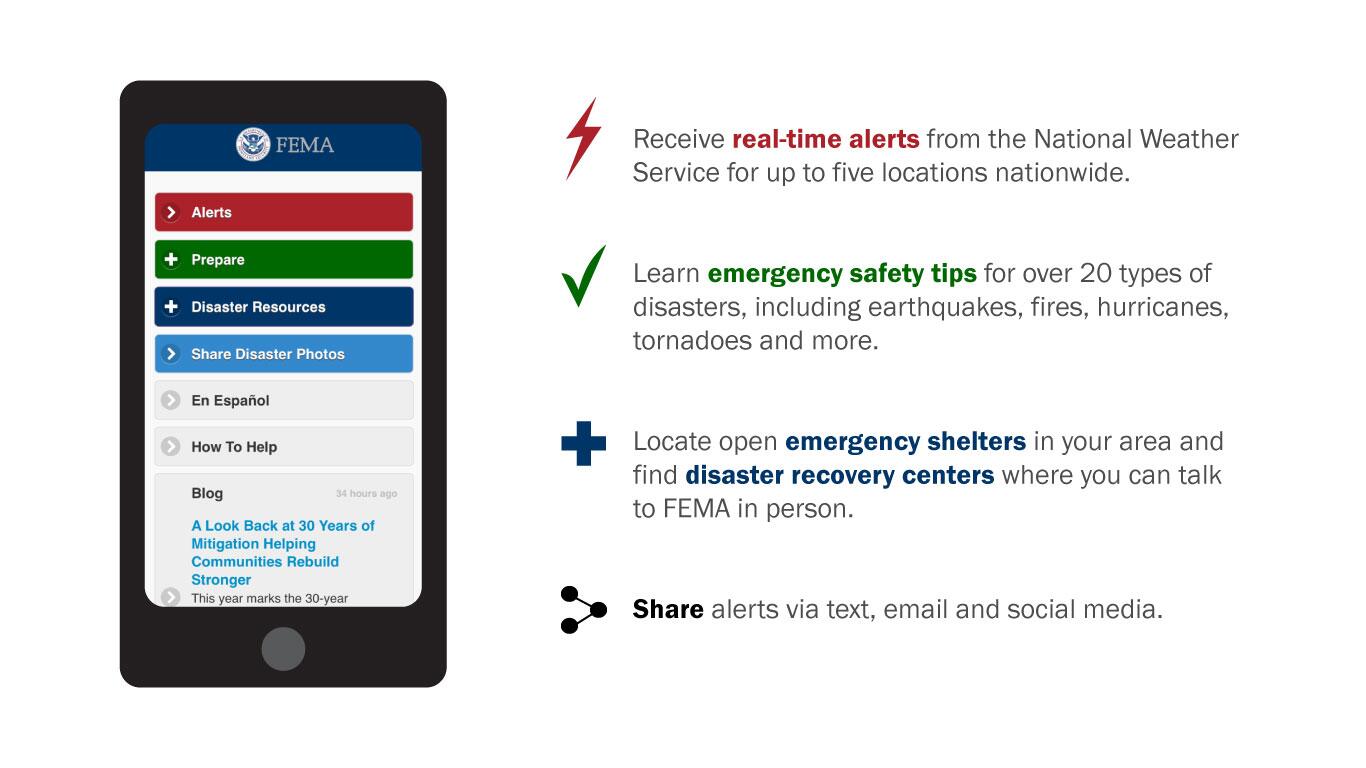
Federal Emergency Management Agency (FEMA) App
Watch Vs. Warning
Watch: Be Prepared! (Conditions are favorable or expected but not occurring or imminent)
Severe Thunderstorm Watch – Atmospheric conditions are favorable for the development of severe thunderstorms (i.e., producing hail at least 1 inch in diameter and/or 50 knot (58 mph) or greater wind speeds).
Tornado Watch – Atmospheric conditions ar favorable for the development of severe thunderstorms capable of producing tornadoes.
Warning: Take Action! (Conditions are occurring or imminent)
Severe Thunderstorm Warning – A severe thunderstorm has developed, capable of producing hail greater than 1 inch in diameter and/or 50 knots (58 mph) wind speeds.
Tornado Warning – A severe thunderstorm has developed and has either produced a tornado or radar has indicated intense low level rotation in the presence of atmospheric conditions conducive to tornado development. Source: National Weather Service
General Severe Weather Response
Stay away from windows and exterior doors during all severe weather. Notification of an approaching dangerous storm will be made by:
- County sirens will sound in the event of a tornado warning.
- The National Weather Service and Emergency Alert System via the broadcast media, weather radios, and email alerts (if equipped). If conditions are present for possible severe weather formation, you must monitor and keep aware of severe weather possibilities. Always be prepared to take action.
- University Police will announce a tornado warning via voice public address systems in buildings equipped with voice-capable warning systems.
Recipients of warnings must quickly disseminate weather information throughout their areas. This can be in the form of a phone tree or by walking through the area and verbally spreading the word.
Tornado Watch Response
Monitor the local media, weather radios, and weather Internet sites for weather updates and be alert to changing weather conditions. See Weather Forecast/Alert Sources above.
Be prepared to take action if the weather situation is upgraded to a tornado warning.
Tornado Warning Response
When a tornado warning is issued, building occupants should take shelter in the lowest level interior room without window exposure – preferably in a basement.
See building floor plans online for shelter locations at UWSP.
Take a flashlight, battery-operated weather or other radio, and cell phone to the shelter area.
Shield yourself as well as possible by seeking shelter under sturdy objects, duck and cover your head with your arms, or by other available means.
NOTE: If you are unable to get to the lowest area, go to an interior room or stairwell away from windows and exterior doors. Avoid wide-span structures such as gyms, pools, or large classrooms.
If for some reason you are unable to flee to a safer area, get under a desk, heavy table, or other object that could shield you from flying debris.
Remain in your shelter area until instructed to do otherwise by National Weather Service broadcasts, department management, or University Police.
If driving, park your car and seek shelter away from the car in a nearby ditch or ravine. Avoid areas with power lines, poles or signs. Never try to outrun a funnel cloud or tornado in a vehicle.
After a tornado, watch for secondary hazards such as electrical wires and other dangerous wreckage. If surrounded by debris, be aware that moving it may cause other debris or part of the building to collapse. If it is not safe or possible to leave the area, stay there until assisted out.
Severe Thunderstorm Response
Severe thunderstorm warning notifications will be made by NOAA weather radios and local broadcast media.
- Notify affected individuals and discontinue exterior work that may place persons in danger of the immediate storm.
- Seek interior shelter away from windows and exterior doors and close blinds and drapes.
If conditions worsen, individuals may be advised to relocate to the designated storm shelters as discussed above in the Tornado Warning section.
Ice/Sleet/Snow Response
Notification of a severe ice/sleet/snowstorm will be made by the same sources mentioned above.
Refer to the UW-Stevens Point Inclement Weather Policy.
WEATHER FOCUS: Facility Services’ Ice/Snow Removal Process
When snow/ice removal is significant or overly complicated, Facility Services will declare a “Weather Focus” and issue a campus Message of the Day (MOD) announcement. Staff will temporarily shift from less critical tasks (e.g., cleaning, trash and recycling pickup) to weather-related tasks (operating plow vehicles, sweepers, salters, snow blowing, shoveling and corridor clean-up) until after the “Weather Focus” concludes.
Exercise caution on outdoor walkways and while driving.
- Don’t rush or take shortcuts.
- Wear high traction footwear and fully wipe your boots on floor mats.
- Report unsafe conditions to Facility Services (during business hours) 715-346-4219 and University Police (after hours) 715-346-3456.
Check Wisconsin Road Conditions
By downloading the Department of Transportation’s free 511 Wisconsin Smartphone app or visiting www.511wi.gov you can access these current statewide travel resources:
- Road conditions
- Travel times
- Traffic delays
- Incident alerts
- Construction closures
- Traffic cameras
Campus Closure/Class Cancellation
When inclement weather exists, every effort will be made to keep UW-Stevens Point campuses open and operating as normal.
Students: UW-Stevens Point classes will meet as usual unless there is formal notification from the Chancellors Office. In the absence of such notice, classes are presumed to meet as scheduled.
Employees: For more details regarding reporting to work/leave expectations, see the UW-Stevens Point Inclement Weather Policy. Direct any questions to Human Resources.
In the unlikely event one or more UW-Stevens Point campus will close or classes will be canceled, the University will notify employees, students and the public through a variety of communication methods.
Primary methods for notification include
- UW-Stevens Point homepage (www.uwsp.edu), and Branch campus home pages (uwsp.edu/marshfield) or (uwsp.edu/wausau)
- campus emergency notification system (i.e., Pointer Alerts)
- local media
- campus information number (UWSP 715-346-0123) (UWSP Marshfield 715-389-6530) (UWSP Wausau 715-261-6100)
See the Winter Weather FAQs section below for additional information.
Winter Weather FAQs
During inclement weather, we often are asked why UW-Stevens Point doesn’t close. Here are FAQs you may find helpful.
Q: What does the university do to maintain the safety of students, faculty and staff?
A: The weather is carefully monitored by our emergency management specialist, University Police and Facility Services staff and others. In the event of inclement weather, communications are sent to students and employees encouraging them to use good judgment in deciding whether they feel they can safely travel to campus. Students and employees are also encouraged to contact their professors or supervisors if they have safety concerns regarding travel.
Q: The Stevens Point (Wausau, Marshfield, Amherst, etc.) schools are closed. Why isn’t UW-Stevens Point?
A: Local public (and private) K-12 school officials take into consideration bus transportation for young children, many of whom are only 6 or 7 years old waiting outdoors for buses. Often, buses must travel before all county and town roads are plowed. Also, because many school district buses are parked outside, they may have difficulty starting in sub-zero weather.
UW-Stevens Point generally remains open. Many of our students live on or near campus and can safely reach their classes. Those who travel are encouraged to use good judgment in determining whether they feel they can do so safely.
Q: Classes were canceled at UW-Stevens Point at Wausau and Marshfield. Why weren’t they canceled at the main campus?
A: Many students at our two-year campuses drive to the Wausau or Marshfield branch campuses, often from further distances over two-lane country roads. In Stevens Point, most students live on or near campus and can walk or drive shorter distances. Also, about 16 percent of students enrolled at our Wausau campus and 43 percent of students at our Marshfield campus are high school students and will not be in class if the K-12 schools in those communities are closed.
Q: If UW-Stevens Point doesn’t cancel classes, may faculty do so?
A: Faculty have discretion over their classes, and some offer alternatives that do not require in-person attendance. Some have canceled classes, depending on their own or their students’ travel circumstances. Students are encouraged to contact their instructors if they do not feel they make it to campus safely. Faculty members are encouraged to understand and accommodate weather-related absences.
Q: Why do employees still have to work when classes are canceled?
A: Campus offices generally remain open even when classes are canceled. Employees who do not feel they can safely make it to work, should check with their supervisors regarding attendance options. Working from home, taking paid or unpaid leave or making up lost time or other arrangements with the approval of your supervisor, are among the options. See the inclement weather policy.
Because of the nature of their work, it is not possible for some employees to work from home or to make up lost time. If the university closes, these employees would be required to take vacation time or leave without pay. By remaining open, employees have a choice about reporting to work. Some employees essential to the university’s operation – including but not limited to Police, Residential Living, Dining Services and various positions within Facility Services – are present, working to ensure the continuity of operations on campus necessary for the safety and welfare of our students.
Q: The mayor has declared a snow emergency. Why wouldn’t campus close?
A: This is less about a community emergency and more about snow removal. When a snow emergency is declared, parking is not permitted on city streets during the hours stated in the proclamation to allow the Street Department to clear streets of snow. Mayors and other municipal officials use this tool to facilitate snow removal.
Q: What are the best ways to find out if classes are canceled or the university is closed?
A: Watch your email and the UW-Stevens Point website for weather-related campus updates.
Resources
Storm Shelter Locations (Campus login required to access floor plans)
Human Resources 715-346-2606
Severe Weather 101 (NOAA National Severe Storms Laboratory)
National Weather Service Safety Tips
Wisconsin Travel Info www.511wi.gov
POWER OR OTHER UTILITY FAILURE
In the event of a power, water, or other utility failure, contact Facility Services at 715-346-4219 or University Police at 715-346-3456 and follow the procedures below:
Power Failure Response
- Report outages immediately to Facility Services at 715-346-4219 during regular business hours or University Police at 715-346-3456 during other times.
- Cautiously move away from any electrical equipment or machinery to avoid injury should it restart suddenly. Move slowly to avoid tripping. If able, shut down all electrical equipment as necessary and stay clear of all machinery during the power outage. Do not turn any equipment back on until authorized.
- During the failure, remain in a safe location. Back-up generators will supply emergency lighting to most areas. Supervising staff/faculty must decide whether to dismiss staff/students in the event of an extended power failure.
- Occupants should check and notify University Police of persons trapped in elevators or equipment that may present a hazard upon re-energization of the building. Department staff should conduct safety checks of all areas to determine if any person requires assistance.
- No one should be in a work area that has no light. If the condition exists, move people to an area with at least minimal light (enough to locate an exit path).
- Each Department should make flashlights available to employees for use during a power outage. In the event that emergency lighting fails, use flashlights to evacuate and conduct safety checks.
- Lab users should follow these precautions:
- Put vital equipment on emergency power circuits if available. Check with Facility Services.
- Make a list of equipment that must be reset or re-started.
- Keep fume hood sashes closed and all containers capped.
- Check cold storage items. Use dry ice if necessary.
- Facility Services and University Police will ensure that all affected equipment, security systems, and other alarms are reset.
Natural Gas Response
If a natural gas leak is suspected or detected, follow the response instructions below:
- Stop all operations, turn off gas valves, open doors and windows, if able, as you exit the building.
- Immediately evacuate the area.
- Be certain to PREVENT IGNITION SOURCES by not operating any electrical equipment, switches, lights, heaters, hot water, telephones, heat ventilation air conditioning systems (HVAC), outlets, lighters, matches, etc. during a hazardous gas leak.
- Do not use elevators unless authorized.
- From a safe location away from the leak, REPORT INCIDENT to the Facility Services ext.4219 and University Police ext.3456. Call 9-1-1 if an emergency.
If they are unavailable, contact Wisconsin Public Service at 1-800-450-7280.
- Provide your name
- Exact location of the leak (room, floor, etc.)
- Other applicable information
Do NOT reenter building until all clear is given by emergency command personnel.
Water Failure/Flood Response
- Report outages immediately to Facility Services at 715-346-4219 during regular business hours or University Police at 715-346-3456 during other times.
- Municipalities will provide additional directions regarding a water failure, including any water boil requirements.
- During a flood, do not come in contact with flood waters and do not go near electrical equipment.
Steam Leak Response
Employees should do the following during emergencies caused by steam leaks:
- If the steam leak is inside a building, employees should evacuate the area keeping away from steam.
- Call Facility Services at 715-346-4219 during regular business hours or University Police at 715-346-3456 during other times.
- Doors should be closed to isolate the affected area. Steam can cause severe burns, displace oxygen, and moisture from steam can conduct electricity.
- Be aware that a steam leak may cause the building’s fire alarm to sound. Employees should be advised to exit the building immediately even if it is ascertained that the problem is a steam leak.
Report Utility Failures
During Business Hours
Facility Services
715-346-4219
After Hours
University Police
715-346-3456
If an emergency
Call 9-1-1
ELEVATOR MALFUNCTION
Certain university buildings are equipped with elevator services. Emergency procedures involving elevators are covered below.
Response
- If you are trapped in an elevator, use the emergency phone to notify authorities. Elevators are linked to temporary emergency generator power for phones, alarms, and emergency lights.
- If the phone is inoperable, turn on the emergency alarm/bell that will signal for help. Do not attempt to exit a stalled elevator unless directed to do so by law enforcement, facility maintenance, or the fire department. If the alarm is inoperable, signal others outside the elevator by voice or other means.
- If a person is stranded in an elevator, do not attempt to force open elevator doors. Push the elevator call button and provide the following information:
- Your name.
- Building.
- Floor.
- Present situation.
- A person stranded in an elevator needs to be reassured that his/her situation has been noticed and help is coming. Keep in contact with stranded individuals until help arrives.
- If you find an inoperative elevator without occupants, notify your campus Maintenance Department.
Resources
University Police and Security Services
715-346-3456
UW-Stevens Point Facility Services (Stevens Point campus Maintenance)
715-346-4219
OTHER EMERGENCY RESPONSE/INFORMATION
EMERGENCY TRAVEL INFORMATION
Travel Safe, Travel Smart.
Latest Alerts and Health Information
U.S. State Department’s Current Travel Advisories (List) or (Color-coded map)
CDC Travelers’ Health Information
Don’t forget to enroll in STEP! It’s FREE!
The Smart Traveler Enrollment Program (STEP) allows U.S. citizens and nationals traveling abroad to enroll their trip with the nearest U. S. Embassy or Consulate.
Enrollment has the following benefits: you will receive important information about safety conditions in your destination country and it makes it easier for the U.S Embassy and family members to contact you in the event of an emergency.
Before you go
The Traveler’s Checklist outlines important steps to prepare for a safe trip outside the United States. For more information, visit the State Department’s U.S. Passports & International Travel page.
Consult the State Department’s Travel Advisories page for the advisory level issued for your destination.
Enroll your trip with the nearest U.S. Embassy or Consulate utilizing the Smart Traveler Enrollment Program (STEP).
Check the Centers for Disease Control (CDC) Travelers’ Health Information database for country-specific health concerns and vaccination recommendations. Student Health Service offers travel medicine services to UW-Stevens Point students.
Ensure you have insurance coverage if you should fall ill during your stay or need medical evacuation and prepatriation. See Insurance section below for details.
Know what to do in an emergency and review What the Department of State Can and Can’t Do in a Crisis.
Insurance
International Medical, Travel, & Security Insurance
All University of Wisconsin students studying/traveling abroad under a UW sponsored program must enroll in health insurance through an insurance plan offered by Cultural Insurance Services International (CISI). This program is also available to faculty and staff who are involved in educational programs abroad.
Attending UW-Stevens Point from another country?
Students attending UW-Stevens Point from another country may contact the Office of International Education for additional resources.
ENROLLED IN A STUDY ABROAD PROGRAM?
Contact the Office of International Education if you have questions or for additional information pertaining to your destination.
THREATS TO PUBLIC REPUTATION
Threats to the University’s public reputation, such as illegal activity by UW-Stevens Point personnel, ethical issues, environmental concerns, financial conflicts, or other public relation issues will be managed on a case-by-case basis. The below provides general guidelines to follow in the event of a threat to public reputation:
- Early warning to anticipate and manage threats before they develop into serious problems is critical. If one perceives a threat to UW-Stevens Point’s public reputation or potential threat to reputation, contact supervisor, director, department chair, or dean as applicable. The appropriate Vice Chancellor shall then be contacted who will then inform News Services and the Chancellor. The Chancellor will determine if formulation of the Emergency Operations Team is required. The Emergency Operations Team or other individual(s) assigned by the Chancellor will be responsible for addressing and resolving the threat.
- Establish the facts of the situation quickly and accurately.
- Utilize communication principles as a guide when communicating both internally and externally regarding University matters.
- Ensure any victims or potential victims are secure and afforded appropriate University resources as necessary.
- Ensure University is in compliance with all applicable laws and regulations. Contact UW System Administration Legal Department for assistance as needed.
- A strategic response is to be developed that details the remediation steps, assignment of responsibilities, and timeframe for completion.
- Ensure the highest ranking and/or most knowledgeable University official is available to address questions and provide frequent updates on the situation to both internal and external parties. This would include detailing the steps that have been taken and highlighting the overall strategic response.
- Monitor the situation continuously and provide updates to appropriate parities as necessary.
- Conduct post review to evaluate incident and implement preventative measures as identified.
WEATHER UPDATE
Learn more about weather updates at Weather Underground.
STORM SHELTERS/FLOOR PLANS
Learn more about storm shelters and floor plans.
REPORT A CONCERN
Report a concern to the Dean of Students Office.
TIMELY WARNINGS
The Jeanne Clery Disclosure of Campus Security Policy and Campus Crime Statistics Act (Clery Act) requires universities to alert the campus community to certain crimes in a manner that is timely and will aid in the prevention of similar crimes. Although the Clery Act doesn’t define “timely,” the intent of a warning regarding a criminal incident(s) is to enable people to protect themselves. This means that a warning should be issued as soon as pertinent information is available. Timely Warnings are issued for Clery Act crimes that occur on property owned or controlled by the university.
For more information about the Clery Act, Clery defined crimes, and Clery defined geography, please visit the university’s Clery Act website.