
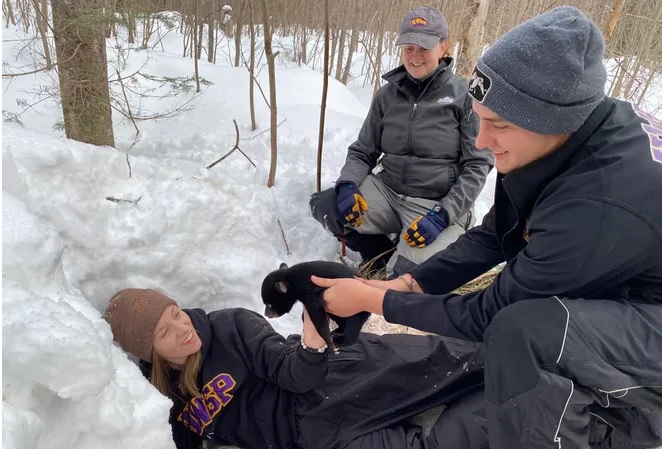
By Paul Smith, Milwaukee Journal Sentinel
Our group shuffles on snowshoes through a winter wonderland in the Wisconsin North Woods.
Bare, dark limbs of maple and oak trees reach to a cobalt sky; 30 inches of snow cover the forest floor.
After 20 minutes of moving over the undulating landscape, our Nordic conga line comes to a halt 100 yards from a knob.
In hushed tones, a message is relayed from the front: “We have arrived.”
The snow on this private parcel in the Chequamegon-Nicolet National Forest conceals more than the ground. It also helps hide the winter dwelling of a family of Wisconsin’s largest carnivore, the black bear.
The sow in the nearby den carries a distinction shared by only a handful of the other approximately 25,000 bears in Wisconsin. It is part of the Wisconsin Black Bear Project run by researchers at UW-Stevens Point.
The university’s project dates to the 1970s and is one of the longest-running studies of bear cub birth rates and survival in the nation.
It has also been extremely productive: About 60% of the scientific citations in the current Wisconsin bear management plan are from UWSP researchers.
The adult female in the nearby den, first fitted with a tracking collar in 2014 and followed each year since by UWSP, is part of a very valuable cohort. Findings from the project have helped shape bear management in Wisconsin and beyond.