School of Education Conceptual Framework
Conceptual Framework of the Professional Education Programs
The basic mission of the University of Wisconsin-Stevens Point Professional Education Programs (UWSP-PEP) is to provide quality pre-service training to undergraduates in early childhood, elementary and secondary education and to provide quality graduate, credit and non-credit, learning opportunities to educators in Central Wisconsin. It is the vision of the Professional Education Programs that students of our programs will encounter rich multicultural experiences, varied and meaningful opportunities for experimentation within classrooms, a sound understanding of educational pedagogy and knowledge of the most current views regarding educational practices. Part of our vision for our students is that they become reflective practitioners, capable of anticipating future needs and changes within the professional arena, and capable of assuming roles of leadership.
The PEP faculty and staff are dedicated to the creation of new partnerships between the University and the schools in this service area to enable teachers, students and schools to meet or exceed world-class standards. To further these goals, the PEP will strive to use the most advanced concepts of distance learning, computer technology and other innovations in technology to extend our campus into every district in Central Wisconsin.
These new partnerships, professional development alliances, will be embedded throughout the undergraduate program and will be a model of excellence for teacher certification programs. Implicit in this view of alliances is the vision of the educator (both public school and higher education faculty) as the professional who engages in life-long learning, professional development and personal growth.
Research Supports this Mission
Rich, Multicultural Experiences
For decades now, educators have been calling for increased culturally relevant pedagogy. That is, pedagogy that “empowers students intellectually, socially, emotionally, and politically by using cultural referents to impart knowledge, skills, and attitudes. These cultural referents are not merely vehicles for explaining the dominant culture; they are aspects of the curriculum in their own right” (Ladson-Billings, 2009, p. 20). Culturally relevant pedagogy (beliefs, attitudes, curriculum materials, instructional practices, etc.) should be implemented in all classrooms, regardless of age level, ethnic make-up, gender representation, and so on. Ladson-Billings (2021) writes, “The three primary components of culturally relevant pedagogy are academic achievement or student learning, cultural competence, and sociopolitical or critical consciousness” (p.4). Teacher education has the responsibility to use culturally relevant pedagogy within its practices, as well as to teach future educators how to make it a part of their teaching practices. In order to increase school achievement at all levels, educators will need to recognize, honor, and incorporate the uniqueness of students and who they are into instruction, assessment, and the classroom as a whole (Gay, 2018).
Opportunities for Experimentation within Classrooms
Experimentation and classroom collaboration implies movement away from students merely functioning as passive recipients of information. According to Kizilaslan, et al. (2021), hands-on, practical work in the classroom promotes the engagement and interest and curiosity of students, and develops a range of skills, knowledge, and conceptual understanding. Experimentation and active learning may be created through the application of collaborative and cooperative learning strategies. Herrera-Pavo (2021) found that the need for careful planning, an adequate dynamic to form collaborative groups, the relevance of student practices related to everyday use of technologies, teacher facilitation, and student autonomy are all integral components for successful collaborative strategies. Knowledge and skills are of little use if a student cannot apply them in cooperative interactions with others. Liebech-Lien & Sjolie (2021) state that the ability to collaborate is a central competence that students need to be taught, in order to prepare them for the social and work realities that they will face in the 21st century.
Understanding of Educational Pedagogy and Knowledge of Current Views of Educational Practices
We have long been aware of the importance of interaction between students and students and teacher in learning experiences. Dewey (1902) placed the learner at the center of the learning process and indicated the greater the depth of interaction with others the better the learning, and thus the experience. A synthesis of the literature on pedagogy and educational practices supports the following classroom strategies: 1) Allow students to write and discuss what they are learning; 2) Encourage teacher/student contact inside and outside the classroom; 3) Have students working with others on substantive tasks inside and outside of class; 4) Give prompt and frequent feedback to students; 5) Communicate high expectations; 6) Make standards and grading criteria explicit; 7) Help students achieve to their highest ability; 8) Respect diverse talents and ways of learning; 9) Motivate through posed problems, questions, means of inquiry, rather than merely content coverage; 10) Focus on assignments and help students successfully complete assignments (Astin 1985; Bonwell & Eison, 1991; Chickering & Gamson, 1987; Drummond, 1997; Erickson, 1984; Frost, 1991; Kurfiss, 1987; Light, 1992; McKeachie, 1986; Pascarella & Terenzini, 1991; Penrose, 1992.)
Understanding of Educational Pedagogy and Knowledge of Current Views of Educational Practices.
We have long been aware of the importance of interaction between students and students and teacher in learning experiences. Dewey (1902) placed the learner at the center of the learning process and indicated the greater the depth of interaction with others the better the learning, and thus the experience. Literature on pedagogy and educational practices supports the following classroom strategies: 1) Incorporating social learning; 2) Using a gradual release of responsibility model; 3) Planning utilizing a backwards design, or Understanding by Design, framework; 4) Implementing Universal Design for Learning, including Multiple Means of Engagement, Multiple Means of Action and Expression, and Multiple Means of Representation; 5) Teaching in students’ Zone of Proximal Development; 6) Including a mixture of summative and formative assessments; 7) Teaching Twenty-First Century Skills; 8) Providing Standards-Based Education; 9) Building strong teacher-student relationships; and 10) Communicating high expectations. (Bandura & Walters, 1977; McCombs, 1986; Meyer, Rose, & Gordon, 2014; NASNRC, 2012; National Commission on Excellence in Education, 1983; Pearson & Gallagher, 1983; Rosenthal & Jacobsen; 1968; Scriven, 1967; Vygotsky, 1978; Wiggins & McTighe, 1998)
The American Association of Colleges and Universities (AACU) endorsed eleven High-Impact Educational Practices for institutions of higher education to utilize in order to elicit high levels of learner success, as developed by Kuh (2008). These practices include: 1) First-Year Experiences; 2) Common Intellectual Experiences; 3) Learning Communities; 4) Writing-Intensive Courses; 5) Collaborative Assignments and Projects; 6) Undergraduate Research; 7) Diversity/Global Learning; 8) Service Learning, Community-Based Learning; 9) Internships; 10) Capstone Courses and Projects; 11) ePortfolios. “These practices take many different forms, depending on learner characteristics and on institutional priorities and contexts” (AACU, 2022). UW-SP promotes the use of these high-impact practices.
Becoming Reflective Practitioners Capable of Assuming Roles of Leadership.
It has been said that all teachers, formally or informally, engage in the process of reflection. Professional Education Programs typically encourage teachers to improve their reflective practices (Marcos, Sanchez, & Tillema, 2010). Any type of reflection on practice, pedagogy, and process allows for teachers to continue to learn and grow as professionals and as people. This reflection may be purposeful or incidental but is typically ongoing and powerful. Ideally, reflection on teaching is a shared process that presents an opportunity for discussion of practice with peers. If reflection is a normal process for teachers, we need to teach pre-service teachers to reflect critically on their teaching to continue to grow and learn about self, their students and the teaching profession. According to Shandomo (2010), the inclusion of critical reflection components for pre-service teachers results in greater understanding of their teaching styles, enhancement of their ability to challenge the traditional mode of practice, growth toward greater effectiveness as teachers, as well as a significant improvement in their ability to relate to their students.
PEP Enabling Students to Meet World Class Standards.
Wisconsin Model Academic Standards, which align with discipline-specific national standards, form a framework for content and pedagogical study within each certification area in UWSP Professional Education Programs. These standards are used in the creation of classroom lesson plans, consideration of appropriate learning strategies, examination of current discipline-specific research and practicum and student teaching experiences. See http://dpi.wi.gov/tepdl/standards.htm
PEP Using Advanced Concepts of Technology.
Understanding the most effective use of distance education continues to evolve with its ongoing usage. Due to the rapid advancements in technology, students could expose to virtual environments that are not common in regular classrooms (Schunk, 2012). Many schools currently are using technology as an aide to accomplishing traditional prescriptive approaches. Schools and districts incorporate educational technology in student learning. Since the pandemic, there has been a rapid and huge transformation in distance learning. As we progress toward maturity with these new tools, a more constructivist approach involving collaboration, authentic methodologies, and the development of higher-level thinking skills development and problem-solving is emerging through careful attention to broad-ranging assessment techniques. Researchers such as Chyung (2015), Spaulding, (2014), Tatum (2019) emphasize the evaluation of program components by the faculty and students in order to determine further refinement and development. Therefore, the Professional Education Program makes alterations to their courses using varying distance education technologies.
Vision of the Professional Engaging in Life-long Learning, Professional Development and Personal Growth
Every person is a product of his/her life experiences. These life experiences play heavily in shaping and determining an individual style of teaching. Professional competence is a critical factor in teaching (Campbell et al., 2004). Professional development courses or self-initiated learning activities could increase teachers’ professional knowledge (Desimone, 2009; Dunn & Shriner, 1999). Not surprisingly, there is an association between professional knowledge and student achievement (Baumert et al., 2010). In many cases, much of what we learn is incidental through either observation and/or trial and error, making it difficult to describe, understand and/or appreciate (Marsick & Watkins, 1990).
A great deal of research has been done to better understand the conditions essential for the successful implementation of any professional development plan or strategy for the improvement of teaching practices. (Buczynski & Hansen, 2010; Darling-Hammond et al.,2017; Desimone & Garet, 2015; Taylor at al,2017).
American Association of Colleges and Universities (2022). High-impact practices. Retrieved May 28, 2022, from https://www.aacu.org/trending-topics/high-impact.
Bandura, A., & Walters, R. H. (1977). Social learning theory (Vol. 1). Prentice Hall
Baumert, J., Kunter, M., Blum, W., Brunner, M., Voss, T., Jordan, A., . . . Tsai, Y.-M. (2010). Teachers’ mathematical knowledge, cognitive activation in the classroom, and student progress. American Educational Research Journal, 47, 133–180. doi:10.3102/0002831209345157
Buczynski, S. & Hansen, C. B. (2010). Impact of professional development on teacher practice: Uncovering connections. Teaching and Teacher Education, 26(3), 606
Campbell, A., McNamara, O., & Gilroy, P. (2004). Practitioner research and professional development in education. SAGE Publications Ltd https://dx.doi.org/10.4135/9780857024510
Chyung, A. Y. (2015). Foundational concepts for conducting program evaluations. Performance Improvement Quarterly, 27(4), 77-96.
Darling-Hammond, L., Hyler, M. E., Gardner, M. (2017). Effective Teacher Professional Development. Learning Policy Institute. https://doi.org/10.54300/122.311.
Desimone, L. M. (2009). Improving impact studies of teachers’ professional development: Toward better conceptualizations and measures. Educational Researcher, 38, 181–199. doi:10.3102/0013189X08331140
Desimone, L. M., & Garet, M. S. (2015). Best practices in teachers’ professional development in the United States. Psychology, Society and Education, 7(3), 252-263.
Dunn, T. G., & Shriner, C. (1999). Deliberate practice in teaching: What teachers do for self-improvement. Teaching and Teacher Education, 15, 631– 651. doi:10.1016/S0742-051X(98)00068-7
Gay, G. (2018). Culturally responsive teaching: Theory, research, and practice. Teachers’ college press.
Herrera-Pavo, M.A. (2021). Collaborative learning for virtual higher education. Learning, Culture, and Social Interaction. Article 100437.
Kikzilaslan, A., Zorlouglu, S.L., & Sozbilir, M. (2021). Improve learning with hands-on classroom activities: science instruction for students with visual impairments. European Journal of Special Needs Education. 36, 371-392.
Ladson-Billings, G. (2009). The dreamkeepers: Successful teachers of African American children. John Wiley & Sons.
Ladson-Billings, G. (2021). Critical race theory in education: A scholar’s journey. Teachers College Press.
Framework
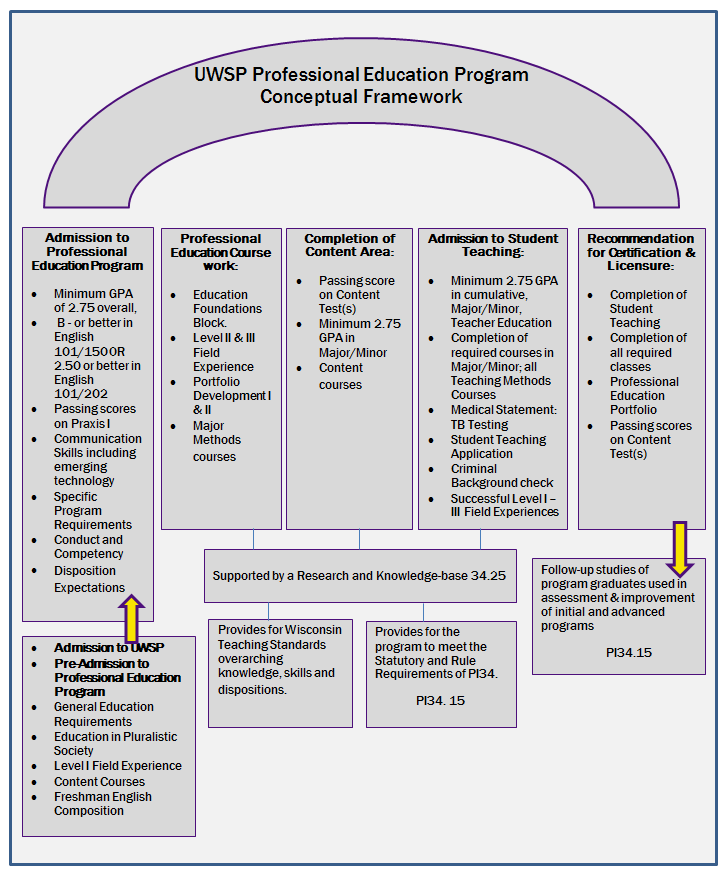
OVERALL ASSESSMENT PLAN
| Stage in Program of Study | Requirement | Task |
|---|
| Entrance to UWSP | See UWSP Admissions website | |
| Pre-Admission Coursework | • General degree requirements
• Content courses
• Freshman English Comp | • Level I Field Exp. |
| Admission to Professional Education Program | • Minimum 2.60 GPA overall
• Minimum grade of B- or better in English 101 or 150, OR 2.50 in English 101/202 OR five, ½ hour tutoring sessions with a Writing Lab Tutor through the Tutoring Learning Center OR bachelor’s degree, be currently enrolled in ENGL 101 or 150 and earn a B- or better by the end of that semester for full admission
• Complete Conduct and Competency Disclosure
• Agree to Dispositions Policy
• Criminal Background Check
• Meet specific additional program area requirements | |
| Completion of Professional Education Coursework | • All required courses completed | • Approved assessments to meet Wisconsin standards 1-8
• Level II Field Experience
• Level III Field Experiences |
| Completion of Content Area Course of Study | • Passing score on required Praxis Subject Assessment OR 3.00 or higher in teaching majors and teaching minors
• Passing Score for World Language teaching majors – ACTFL WPI and OPI tests
• Minimum GPA of 2.75 in major/minor; some majors require 3.00 | |
| Admission to Student Teaching | • Minimum GPA of 2.75 in major/minor, teacher education, and overall GPA, some majors require 3.00
• Completion of all required courses in major/minor
• Completion of all teaching methods courses
• Present medical statement re: TB testing
• Submit application for student teaching
• Obtain Criminal Background Check
• Successful Level I-III Field Experiences | • Evidence of minimum of 2, pre-student teaching evals based on 10 Wisc. Teaching Standards |
| Prior to UWSP Recommendation for Certification and Licensure | • Successful completion of student teaching as documented by UWSP Supervisor
• Completion of all required courses and assessments
• Content Knowledge Requirement met | • Positive student teaching evaluation based upon 10 Wisconsin Teaching Standards (Level IV Field Experience)
• Minimum GPA of 2.75 in major/minor, teacher education, and overall GPA
• Completion signature assessments to include specified performance tasks as evidence of proficiency in standards 1-10 Wisconsin Teaching Standards and evidence related to subject knowledge |